
Today I’m going to talk about a type of ESP experiment that we have done at the ASPR using targets that are totally unknown to the person who is tested, using a partial sensory-deprivation technique called the Ganzfeld procedure. First I want to touch on the idea of using unknown targets for ESP tests. It seems like a harder thing to try to do than if you know that the target will be one of a group of things you know about, like cards or numbers.
Forced choice versus free response
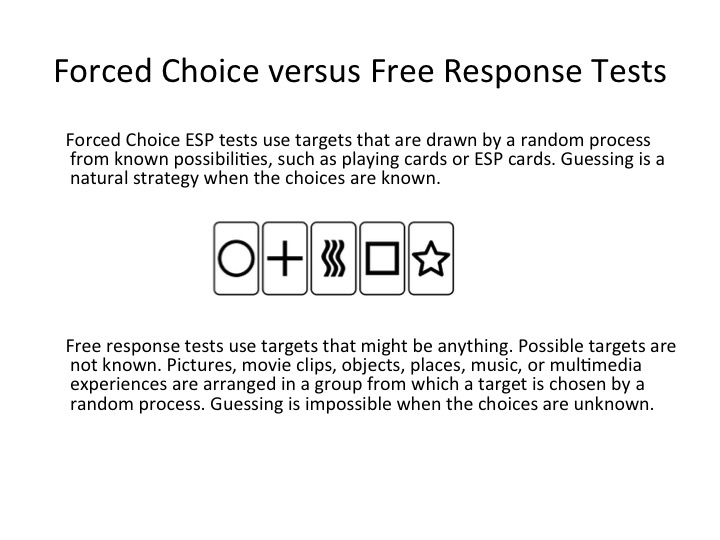
When a target can be anything in the world, rather than coming from a set of known things, it is called a free-response test. While it may seem harder to get information about a hidden target when you have no idea what the target may be, it is actually easier to get into a receptive state that allows ESP information to appear, and it’s harder to get into that receptive state when the choices are known. When you know that the target comes from something you know — like lottery numbers, or cards in a deck, or ESP-card symbols — it is called a forced-choice test. Forced-choice tests are useful because you can do a lot of them in a short time. The problem is that the person being tested naturally tries to guess what the target is. It turns out that guessing is not such a good strategy for succeeding in an ESP test. Relaxing, and waiting for surprising or unusual thoughts or images to pass through your mind, turns out to be a better strategy.
Suppose you know the target is one of the five ESP symbols. Your mind will want to guess. You may see one symbol, then another, one superimposed on another; one might morph into another. You might even see all five superimposed in your mind as you try to guess which one it is. That is why, if there is such a thing as ESP, more people don’t win the lottery. When you have no idea what the target may be, it is easier to clear your mind and wait for something surprising or unexpected.
The Ganzfeld technique
ESP often seems to happen in dreams, and there were some successful dream-telepathy studies at Maimonides Medical Center supervised by Dr. Montague Ullman, our past president. The Ganzfeld is a shortcut to produce a slightly altered state of consciousness that resembles dreaming, but it is faster than dream research because you don’t have to spend a whole night on each trial.
Ganzfeld means “whole field.” The Ganzfeld procedure is a partial sensory-deprivation technique for your eyes and ears. Your eyes and ears are stimulated by a field of uniform light and sound, and are deprived of patterns. It is an experimental way to produce a state of consciousness that resembles what’s called a hypnagogic state — the state between waking and sleeping. Everyone naturally enters this state just before falling asleep. Your internal images get more vivid and disconnected, more dreamlike. The idea is to quiet the attention we normally use our eyes and ears for, to allow internal images to enter awareness more easily.
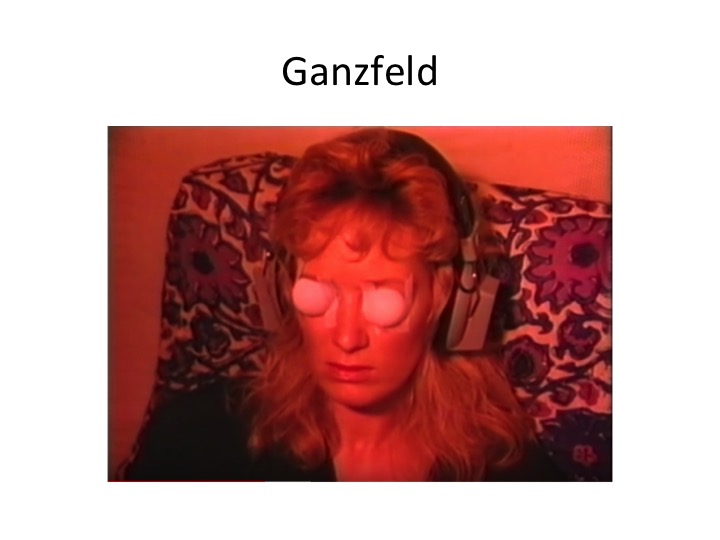
A subject in a Ganzfeld ESP experiment relaxes in a comfortable chair, isolated in a soundproof room, with ping-pong-ball halves taped over their eyes, in front of a red light, so that they see nothing but red, and white noise in their ears so they hear a constant buzz like an air conditioner. There is nothing for the mind to focus on coming in from the eyes and ears. The mind gets bored by the lack of pattern, and eventually starts to allow internal imagery to take over. People are asked to “think out loud” and report the thoughts, images, and feelings that pass through their minds. They know that in a distant room, someone will be concentrating on a randomly selected picture — the ESP target — and their task is to allow images and thoughts that may contain information about the target to enter their awareness. The idea is that there is a goal, to get information at a distance, but there should be no striving toward the goal, no trying, no guessing — just waiting, and reporting what appears. It is a difficult balance: to retain the desire for the information, but to wait for it without trying to get it.
At the end of the Ganzfeld stimulation, they are shown four pictures that had been arranged to be as different as possible from one another. Only one is a copy of the target that had been chosen by a random process; the other three are controls. The experimenter doesn’t know which picture the target will be, and has had no contact with the sender — the experimenter is “blind” to the correct choice. The volunteer hears everything they said when talking out loud, sees the four pictures, and chooses the one that seems most likely to be the target, then arranges the others in decreasing order of likelihood.
My first experience
When I was in graduate school, I read about a very successful Ganzfeld study in the ASPR journal. I wanted to do my own study, but first I wanted to have the experience myself — to see what I would be doing to people before I did it to anyone.
There was an ESP lab in the basement of Maimonides Medical Center at the time, and I volunteered to be in one of their Ganzfeld trials. I went out to Brooklyn with my husband and a friend from graduate school, and met Charles Honorton, who was running the study. I was sick, and had a slight temperature. Later I wondered if having a temperature had something to do with what happened.
I was put in their soundproof room, in a reclining chair, and Chuck covered my eyes with ping-pong-ball halves and positioned a red light in front of me so that I just saw red, and explained that a target would be selected at random and shown to my husband in another room at some point during my session. He took me through relaxation exercises and said that while I was alone I should just talk out loud and report my thoughts, images, and feelings as they passed through my mind. He put earphones on me, turned on a uniform noise of all frequencies, shut the door, and left me alone.
I knew from reading about the experiment that I should be seeing vivid images after my eyes got tired of the uniform red. But nothing happened. I just kept seeing the red for a long, long time. I was bored and frustrated at seeing nothing. Finally I said I was seeing nothing but red — where were the hypnagogic images already?
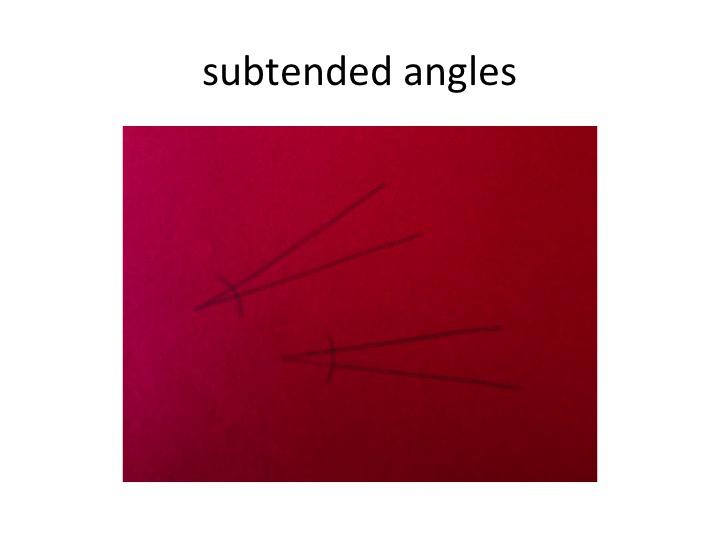
Finally, I thought that maybe I was seeing some slight vague grey lines in the red. I tried to describe the shapes as sharp angles with little curves cutting through them. They reminded me of subtended angles in a geometry textbook. I probably thought that because I had been a math major in college.
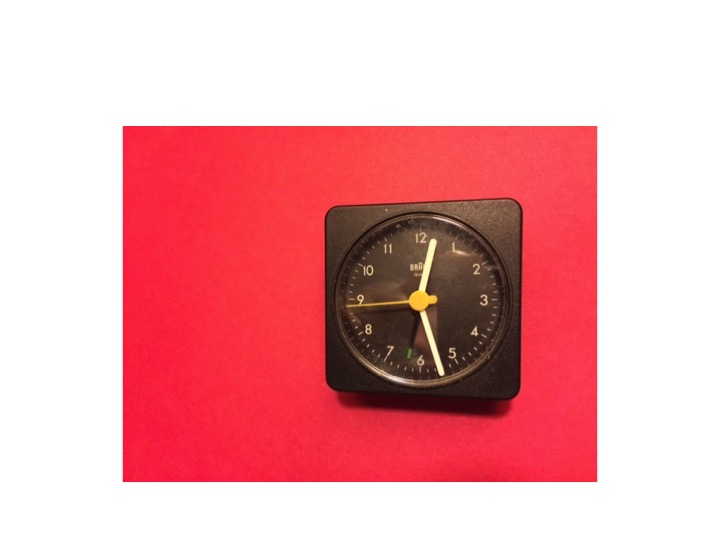
There was another long period of no images, no thoughts, just waiting in the red, and then I had a sudden image of a clock floating in the red background. So I laughed and said I think my subconscious is wondering when this experiment is going to be over, because I just saw a clock. Then images started coming.
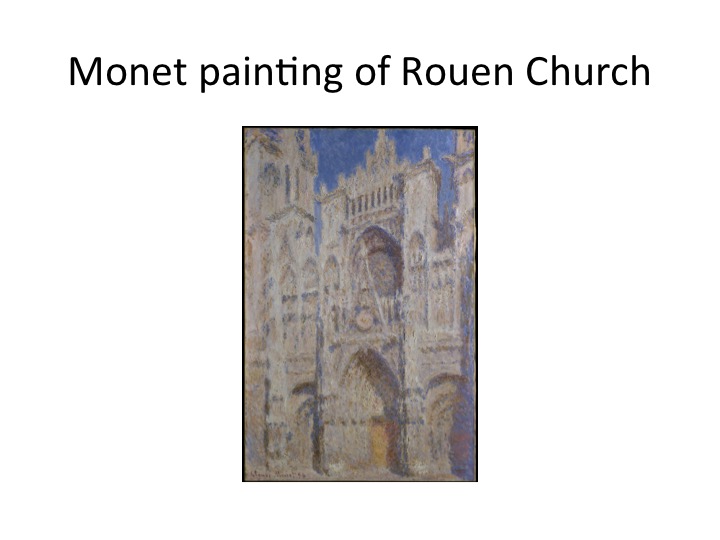
For a moment I thought I saw a pastel arch, like a small piece of a Monet painting. Monet painted the same church at Rouen over and over at many times of day as the light changed from morning to evening.
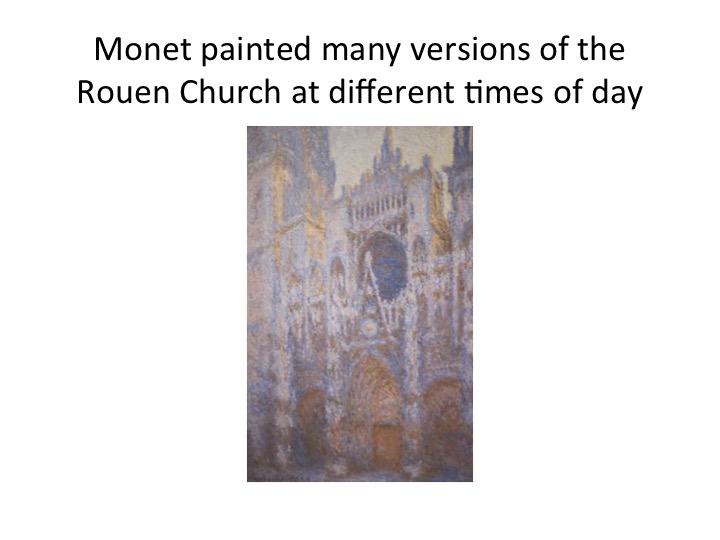
But what I saw was just an image of the curved archway above the door of the church at the bottom of the painting, dappled with pastel colors, and I thought it was a piece of one of Monet’s Rouen church paintings.
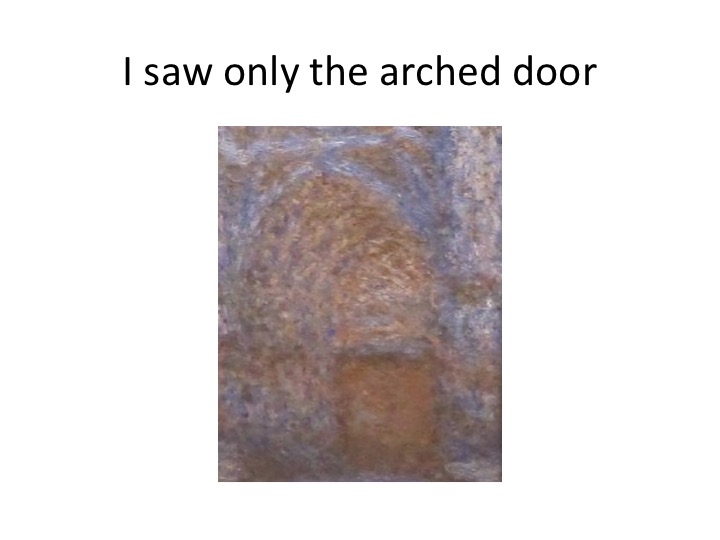
I didn’t see the whole church. I said, I see a door — it’s part of a Monet painting.
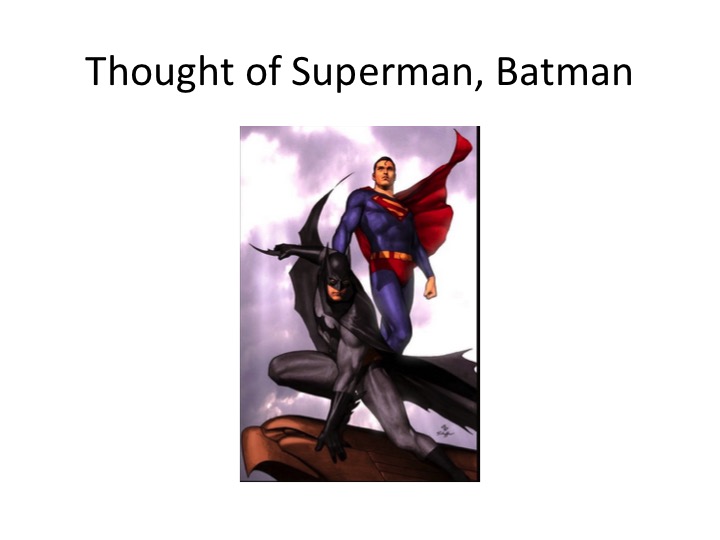
I mentioned that the idea of superheroes passed through my mind, maybe Superman or Batman. I actually thought first about Wonder Woman, but I didn’t want to tell them that, so I only said, Superman, Batman.
Then, after what felt like another long time waiting, there was an unexpected and startling image, very clear — a quick flash that came and went — a vivid Technicolor image of my parrot’s claw sticking out sideways in my field of view, looking like he was holding a black square in his claw, as if he were holding a black piece of paper. I didn’t see the whole bird, just the outstretched claw holding the dark square.
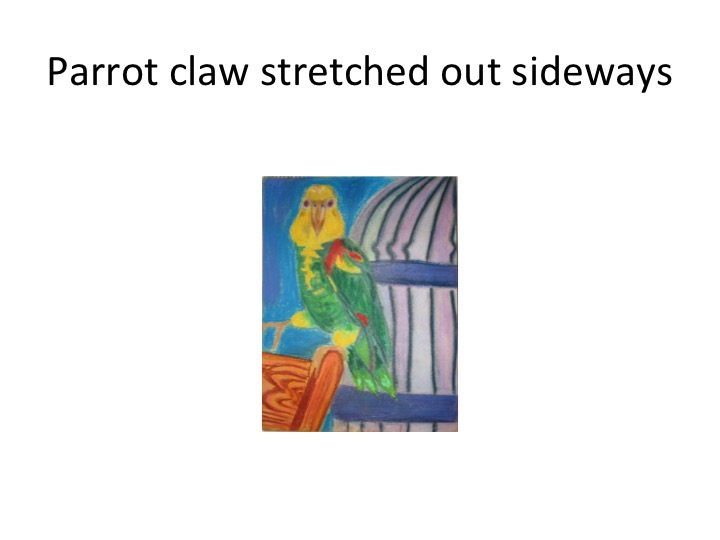
But I just saw the outstretched claw. Like this:
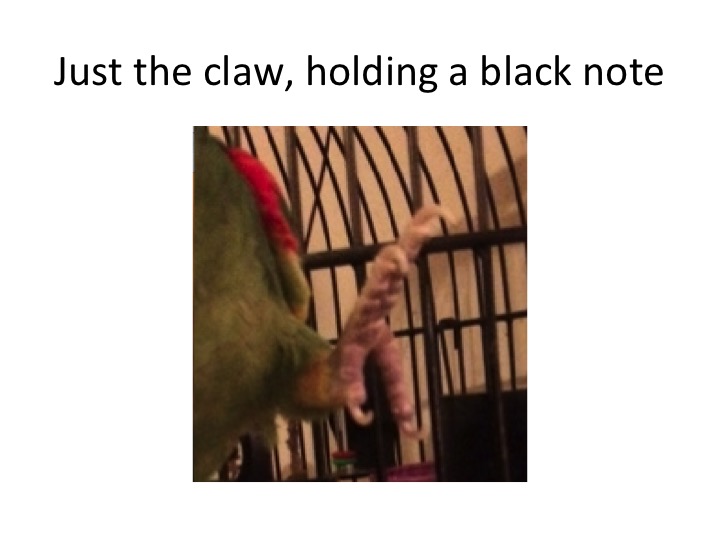
I was startled and surprised by the clarity and vividness of the image — the pale flesh color of the parrot leg and the black square. So I said, I see my parrot’s claw. He’s holding a black note. I can’t read what it says. Then back to the red again.
Later the red that was all I could see changed for a moment to pale yellow, then back to red.
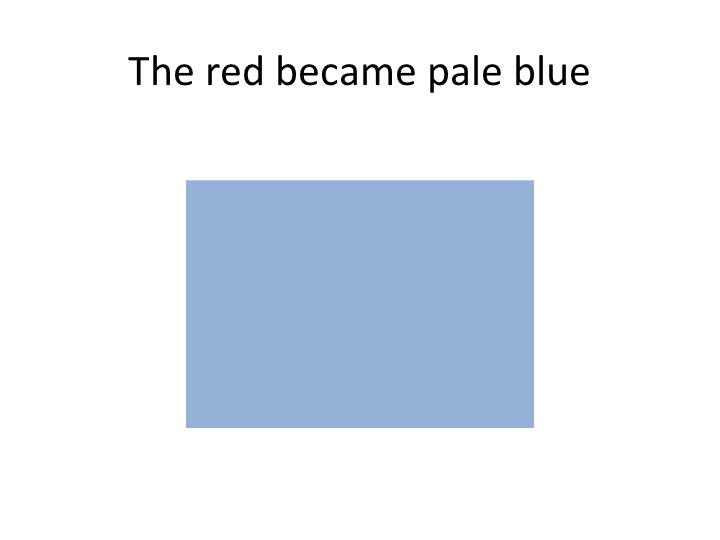
Later the red changed for a few seconds to a pale blue, then back to red. I reported the color changes when they happened.
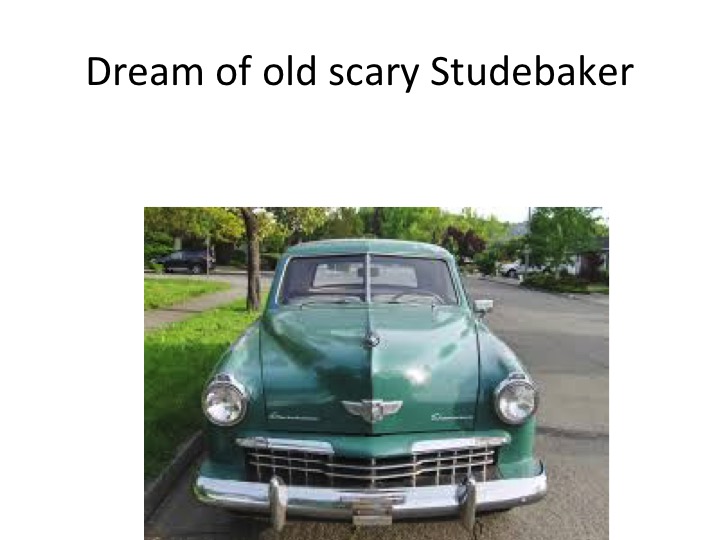
Then I remembered a nightmare I had had as a child, when I was maybe 5 years old. In the dream, I was standing in the driveway in front of my house, and there was a large car in front of me, a dark green Studebaker. It was looking at me menacingly with its big headlights. Its large scary grill was a big mouth with teeth, and it opened its grill and was threatening to eat me. It had already eaten my brother and my parents — they were sitting on the seats inside.
The target in this particular experiment was not really shown to the sender; it was flashed in front of him with a tachistoscope so fast that he didn’t consciously even see it. The idea was that he was just a beacon for me to find the distant target.
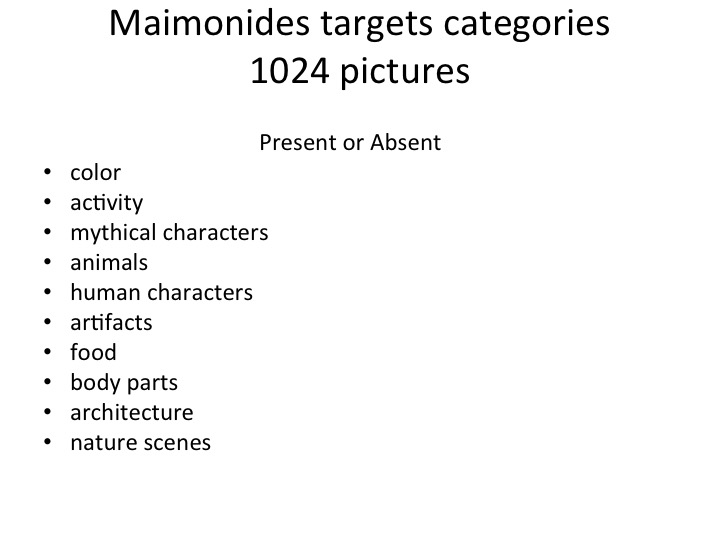
This lab used a different judging procedure. They had devised ten categories and created 1,024 targets (which is 2¹⁰), which differed in the presence or absence of each of the ten categories. One category was presence or absence of color; another, mythological characters (they counted comic-book and fantasy characters as mythological — so I might have had my superhero thoughts because I knew there was a 50% chance there might be one in my target). I was given the list and asked to say present or absent for each, based on my experience, and that was the judging. I think I was wrong for 4 and right for 6. Then they showed me the picture that had been my target.
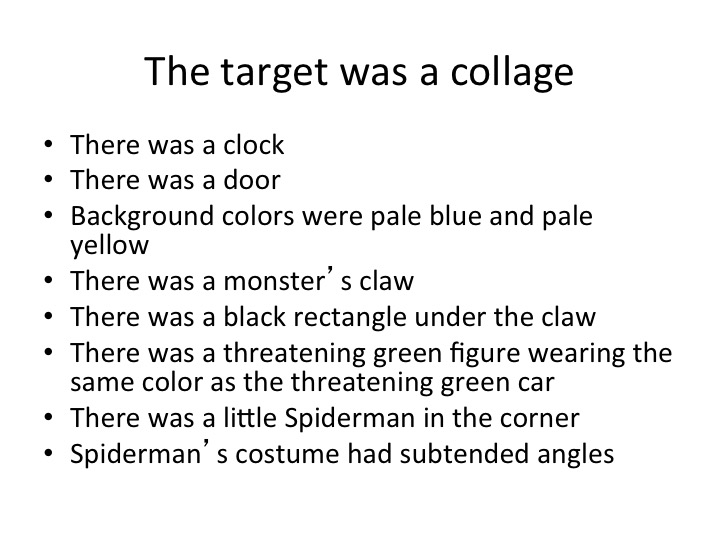
It was a collage with different things pasted together. There was a clock — not the little alarm clock I had imagined, but a clock. There was a door — a plain white rectangular door, not the beautiful curved Monet arch I had seen, but a door. The background colors were the exact pale yellow and pale blue that I had seen. There was a large grotesque human-like claw coming down from the top, and a black square behind it, like the black note I had seen in the parrot claw. There was a large scary, threatening man in the center, dressed in the same green as the threatening Studebaker car that was going to eat me in the dream I had remembered.
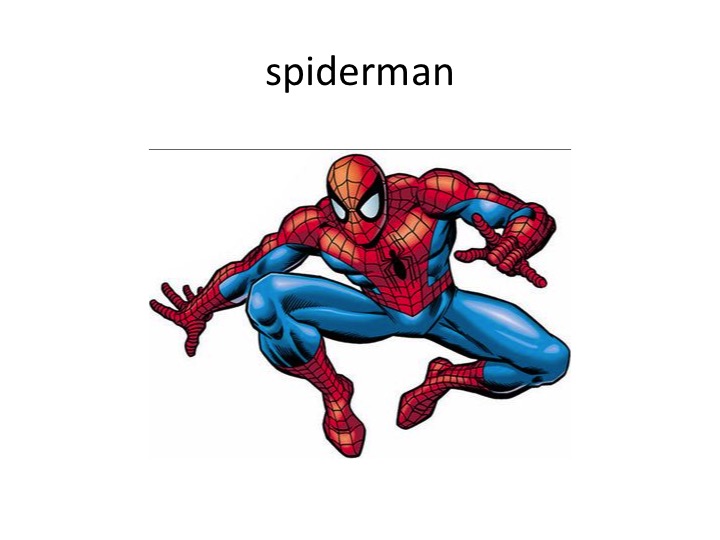
And up in the corner, there was a tiny Spider-Man. I thought — Superman or Batman, there’s Spider-Man.

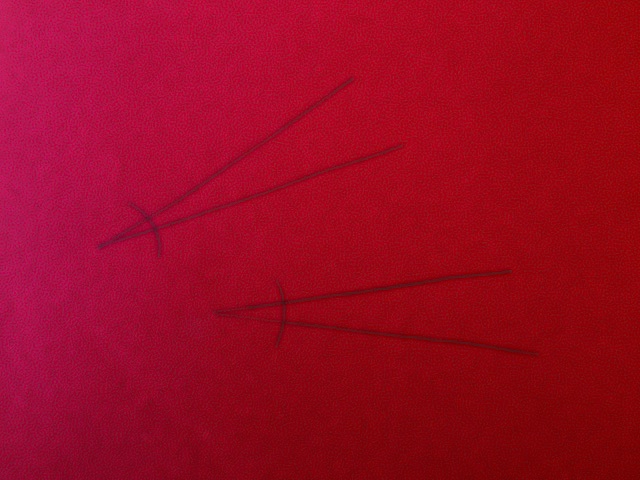
But then I realized the subtended angles I had seen in the beginning were part of the Spider-Man costume.
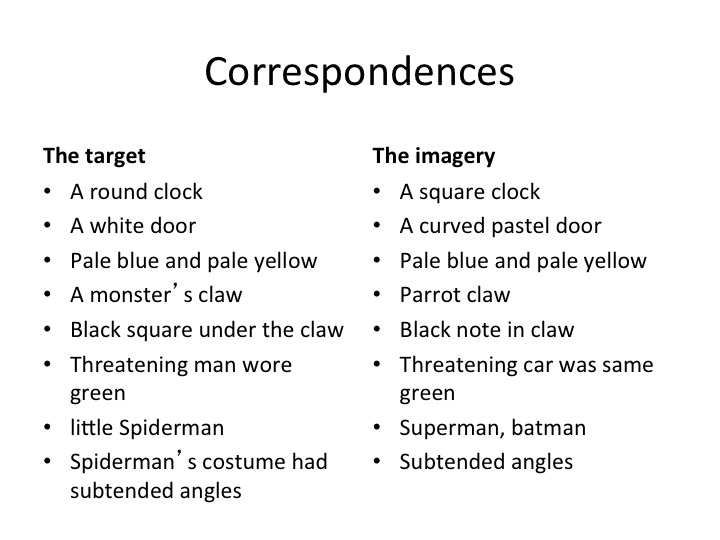
I was astonished. There were too many specific, unusual correspondences to dismiss. I had been interested in ESP research, but I thought that if it happened at all, it was rare and only happened to certain special people, not to the rest of us. I had never had a psychic experience in my life as far as I knew. I was a rationalist, trained in math. I thought: if I can do this, anyone can. My worldview was changed at that moment. Rather than ignoring or laughing off odd coincidences, I shifted into a questioning recognition of what might have been hidden in plain sight.
I found 20 people who each agreed to come for 5 different Ganzfeld sessions, and I ran 100 trials, beginning by telling them about my first experience, and that if I could do it, they probably could too. I made target packs with four pictures each, as different as possible. For each trial there was a one-in-four (25%) chance of choosing the target correctly by chance alone. In 100 sessions, a target should be chosen correctly by chance 25 times. But 41 were chosen correctly. Four of the 20 people each chose 4 targets correctly out of 5 sessions.
What ESP can look like in the lab
Target information can appear in a stream of consciousness in various ways. Information that seems to relate to the target often enters attention in fragments — a mixture of images, colors, shapes, movement, emotions, associations and memories, often mixed with other irrelevant thoughts.
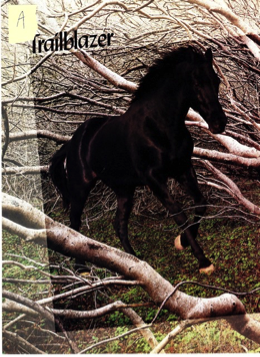
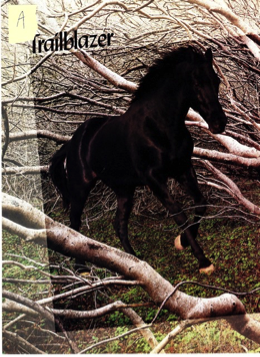
In a pilot session, a man chose the correct target of a horse running through branches. His imagery included animals, several mentions of horses, and long thin shapes like wooden branches:
“a Knight from a chess set (just the horse piece)… elephant’s trunk, letter Y, part of trellis, tree spreading its limbs high… horse’s tail, an X, big square… long thin things like poles… cylindrical wooden tube sticking across like the branches from the park at home… crescent moon like hoof, dark train coming almost toward me….”
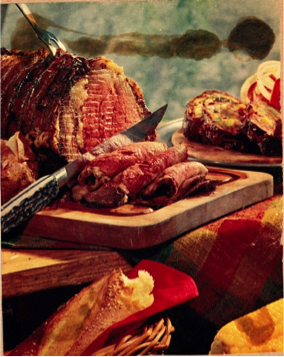
A woman’s imagery during the Ganzfeld included:
“…cherries, banana, an orange, lots of fruit… popcorn, crackerjacks, a Chinese menu, beer bottle… a picnic basket with hard-boiled eggs in it… a fig tree, a spoon, fork, bowl of soup, a wedding cake… jar of molasses on a red checkered tablecloth, a duck, an ice cream sandwich… a picnic table… a tuning fork, celery…”
When she judged the four pictures and chose the correct target, she had been thinking of roast beef sandwiches, and she saw a wooden picnic table. Associations to the target included the picnic basket, checked tablecloth, the fork, and all the food imagery.
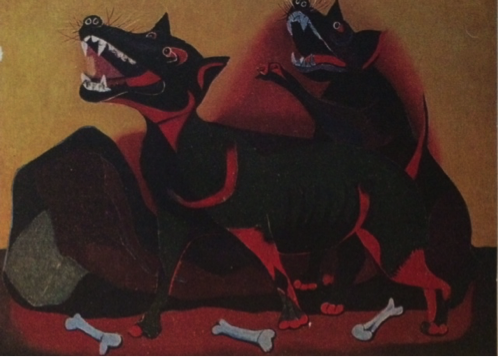
A woman chose the target based on a series of long-forgotten memories of fearful or angry moments from her past that came into her mind, ending with a last image of a dog. She marveled that she had not thought in years about those disturbing memories, but they matched the target’s emotional tone. The target was a painting by Tamayo of ferocious-looking dogs with teeth bared. She specifically mentioned teeth, animal faces, and “a brown dog, no kind of breed dog, fluffy tail, head’s down toward the ground, it’s outdoors.”
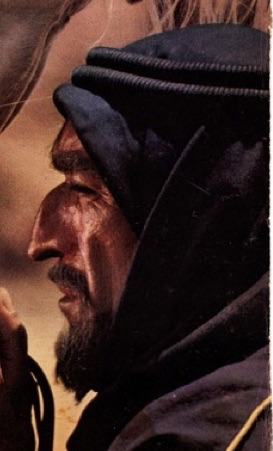
A man did five Ganzfeld trials with five different packs, and chose the correct target four times out of five. He had very little imagery, and long silences. In one session he said: “Ever see the advertisement for the play ‘Equus’? …the shape of a horse, sort of a caricature… that horse that looked like Equus a moment ago just looked like a Dick Tracy cartoon.” He elaborated that it was the profile of a horse with a blunt nose, and a profile of Dick Tracy.
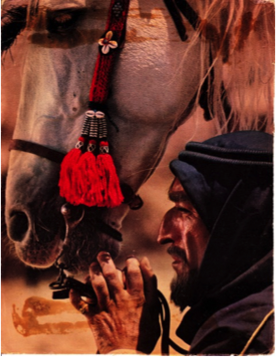
The target was a horse and an Arab with a hooked nose, reminiscent of Dick Tracy, both in profile.
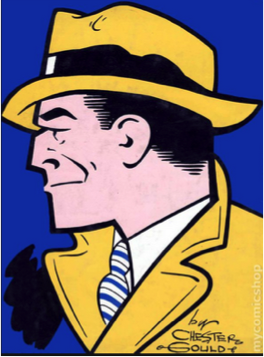
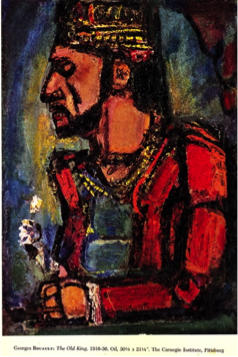
In another session he said: “Could that have been a man wearing plaid trousers? …black, red, green, very bold plaid… saw a disembodied head lying on its side.” Because the bold plaid reminded him of the black-bordered red and blue areas in the painting, and he had seen the head, arm and part of a torso, he chose the correct target — a Rouault painting, “The Old King.”
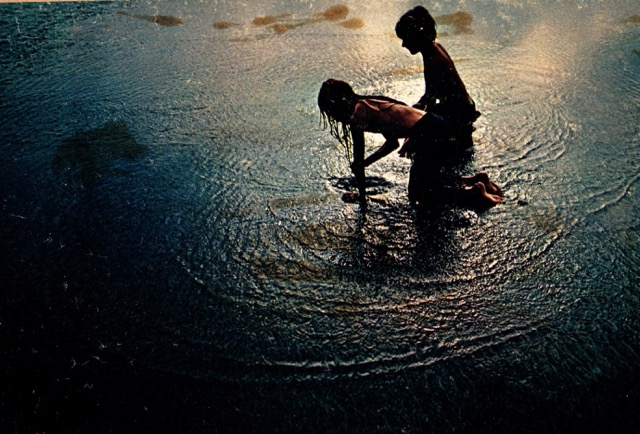
A woman reported: “Thinking about a whirlpool… shore, seals playing on the rocks, boats in distance… beach with men fishing in surf, sound like waves… little pond… has statue of boy fishing.” She chose the target, associating her thought of tinsel with the shiny waves in the photo.
A woman reported:
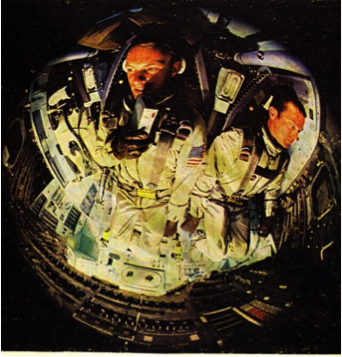
“…a hole in the center, a lavender ball, tiny image, mostly black with a little white… thought of a carousel, figures twirling in a whirlpool… like being taken into the sky far away… deep green-brown avocado, whirlpool, flesh colors… a cage of pigeons that was crowded… faces, flesh color, or people, but twirling at a distance.”
The target was a circular photo of astronauts crowded inside a space capsule, surrounded by blackness. She named the flesh color of the astronauts, and had images of a ball, of being crowded, of twirling and traveling, yet she was confused by being still while moving at great speed — which fits the immobility and constraint of astronauts in a ball traveling at tremendous speed.
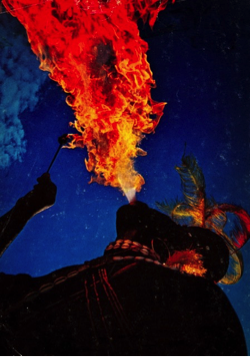
A man reported:
“V for victory… flame, Superman, flying high in the sky… mop ending is on fire… cigar in your mouth, wonder if you’ve bitten off more than you can chew… a rocket ship… Coal, heat… a volcano, it explodes, lava bursts forth… I see red and blue, bar lightning and the hand of a skeleton.”
Seeing the target among the controls he said: “Flames remind me of a volcano, person is like a mountain of the volcano… blowing flame out like cigar… flame exhaust of a rocket ship… superhuman feat, Superman.” He chose the correct target and gave it the highest possible likelihood.
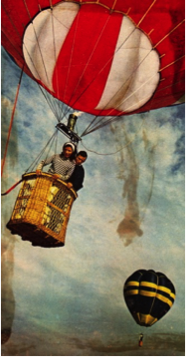
A man’s imagery included:
“…shape of a ball, red or orange… a baseball, aware of the threading used to tighten the skin on a baseball… blue sky in background, picture of a summer day… a boat, looks pretty old and seems like it has one or two sails… Airplane flying overhead. ESP card with the circle… automobile tire, just the tire without the wheel, glazed donut… basketball, a watermelon changed into a torpedo or bomb… acrobat doing a somersault through the air…”
Seeing the target — a hot-air balloon — he linked the basket to “the dish,” the rope and spider hanging down to the basket hanging below, the ESP circle to the white part of the balloon, the yellow taxicab to the yellow basket, the baseball threading to the strings on the balloon.
Sometimes target information seems to appear in someone’s imagery, and the target can be chosen correctly by independent judges, but is not chosen by the person in the experiment. These cases weaken an experiment, but they can be interesting and suggest how psychic information can come into awareness without being recognized.
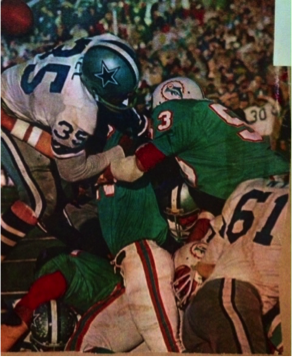
A psychology student loved baseball and hated football. His target was a football game, which he disliked intensely when he saw it. His images included “a horse racing… the word DEFENSE, related to psychology, not military… a man in a sweat suit… some batting statistics for one of the Phillies — something about the number 5116.” The numbers 5, 1, and 6 are very large and prominent on the backs of two football uniforms in the foreground. I said, look at the numbers! He insisted that baseball was totally different from football and ranked the picture last choice. Yet he incorporated enough information for two independent judges to choose the target correctly.
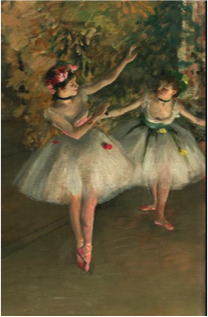
A highly creative, fairly hypnotizable actress, in therapy for stage fright, became very uncomfortable in the Ganzfeld — too hot, too cold, like going to the bathroom, like throwing up, over and over. She had almost no imagery, and judged the target picture of dancers on a stage as her last choice. Only after feedback did I think to ask her what her stage-fright symptoms were. They turned out to be exactly those unpleasant physical symptoms — which she had not associated with the stage picture.
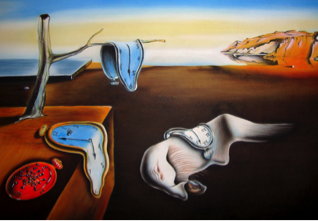
A husband-and-wife team acted as sender and receiver. She had just come from the dentist. The target was a surreal photo of grey stone carvings of bizarre elongated figures whose faces had gaping mouths, reminiscent of Dali’s melting clocks, but with melting open mouths. During the session, she kept yawning. She reported seeing a landscape “like Dali”… grey, puce, grayish (the correct colors)… “the Dali thing again.” She disliked the picture and ranked it third of four. She didn’t notice the Dali correspondences, and I didn’t notice that all the yawning might have related to the yawning faces, until after the judging.
ESP does not always do what it is asked. There is evidence of scanning the whole pack of possible targets with unfocused psi. A favorite control picture may draw attention rather than the target. A subject chose the target correctly in four of his five sessions — but he was most confident in the one session where he was wrong.
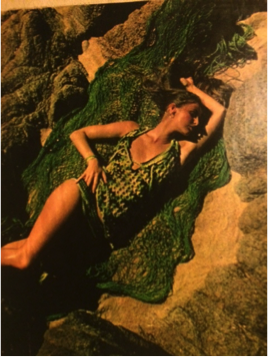
This time, he saw “the White Rock girl.” This was a control picture, not the target. When he saw it he exclaimed: “There she is — the White Rock girl!” He thought it was the easiest, most compelling decision of his five sessions. He didn’t get feedback until he had finished all five, so he didn’t know he had chosen the right target every time except for this one.
Can ESP scan the whole pack?
- Improperly directed ESP may glance at the controls in a pack as easily as the target, without a sender’s influence.
- ESP may glimpse all the pictures in the future judging, rather than the target the sender looks at in real time.
If ESP is not focused only where the experimenter wants, scanning the entire pack can muddy the waters. The “White Rock girl” may be an example of psychically scanning the whole pack and having attention caught by the best-liked picture instead of the target. Formal testing of the scanning hypothesis depends on judging ability with free-response targets. Palmer, Bogart, Jones, and Tart (1977) found significant evidence for displacement onto control pictures of the target pack — found by a judge who had experienced a Ganzfeld session, but missed by one who had not. Child and Kelly (1973), using ESP cards arranged with an unbalanced number of each symbol, found the more frequent symbols were called significantly more often — for hits and, separately, for misses — as if the response pattern depended on a global psychic scan of the cards in each run.
Here is an anecdotal example that looks like scanning the entire pack. The subject chose the correct target after a long, careful examination, because there were more correspondences to it — but there were striking matches between his imagery and all four pictures.
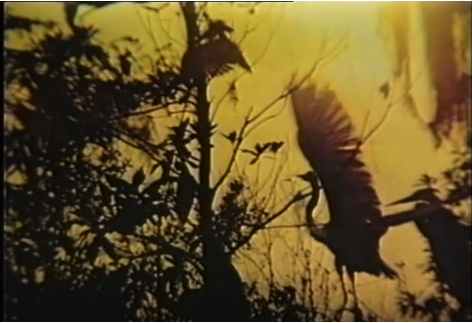
As soon as he saw the first control picture, he said: “That has to be it! I saw a photographic likeness to part of this picture — birds in black silhouette.” His stream of consciousness had included a BIRD-GOD, wings of a bird, palm fronds, flapping wings, a white feather, a hovering bird, a dove flapping its wings. I asked him to wait until he saw the other pictures.
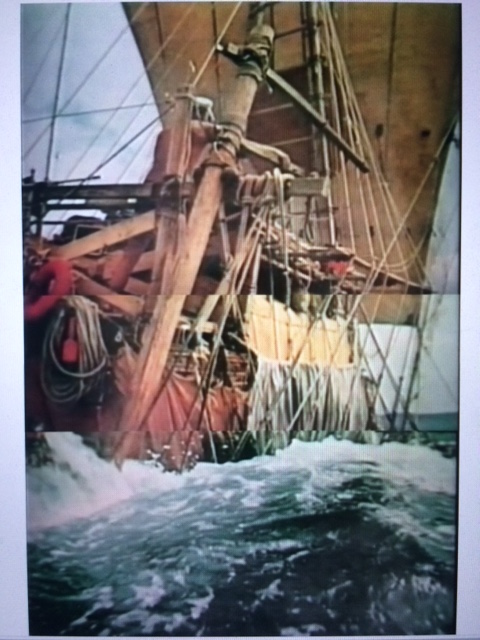
His correspondences to the next picture — a wooden sailing ship with many ropes — included a fishing line, a fishing pole, a pulley contraption, deep-sea fish, rope with a hook.
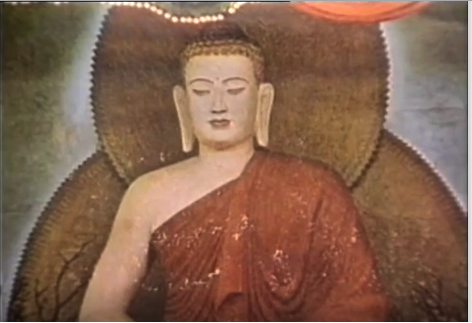
The third picture — a giant Buddha in a temple, lit candles and piles of fruit in front — was actually the target. Besides the Indian BIRD-GOD, his stream of consciousness included a molten pot, lava flowing (there is fire in the picture), a palace or temple dog, a ballooning figure, a shape he associated with the Buddha’s large dangling ears, an orange wedge at the top, a rope of lights, large circles with a figure inside.
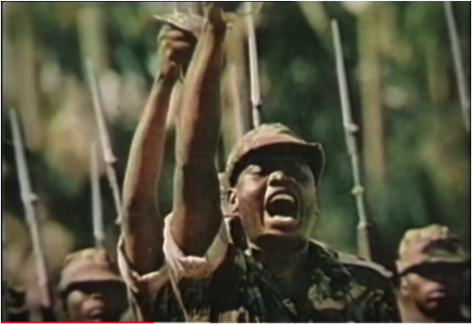
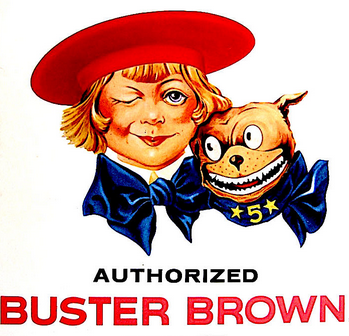
Correspondences to the fourth picture included “shiny metal… green like looking through leaves in the jungle… a black African figure — a gun pointing, an African with a spear — the face of the Buster Brown dog.” When he saw the leader of the soldiers in the picture, he said: “Doesn’t he look like the Buster Brown dog?”
After much thought, he gave the Buddha an 80 and the birds a 75, because there were more images associated with the Buddha — though he liked the bird picture by far the best. Notice how his image of an Indian Bird-God merges the target and the best-liked picture into a single image.
There are many examples of people who seem to scan the whole pack, focus on a favorite picture, or avoid a target when there is something about it they dislike. Here is a terrible target.
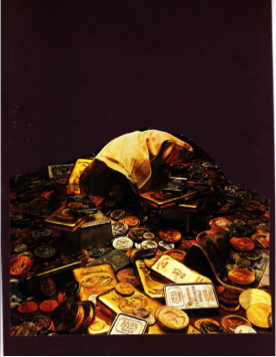
No one chose the heap of money when it was the target, or even verbalized any thoughts that might have related to it — because they assumed they were just thinking about their own personal concerns.
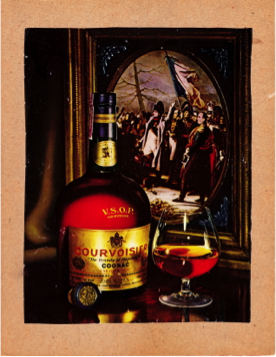
And here is a target that turned out to be terrible when it came up for an ex-alcoholic, who hated it, avoided it, and ranked it last choice.
The problem of repeatability
There is a crisis in mainstream science. More than two-thirds of published experiments with positive findings fail to show the same results when other scientists try to repeat them. The journal Nature published a survey that found more than 70% of researchers fail to reproduce published experiments. Even results in textbooks are failing to reproduce, in fields like psychology, medicine, and cancer research.
ESP research is often accused of not being repeatable, but it is in better shape than many other areas of science. Failed replications are published as easily as positive ones. When promising effects are found, the experiments are repeated a great many times by different researchers, and methodology is examined critically and refined.
- Belief in the possibility of ESP influencing results — the sheep–goat effect — has over 120 replication studies over 70 years.
- Ganzfeld experiments have replication studies over 40 years.
The sheep–goat effect is a measure of openness to the idea that ESP is possible: people who believe in the possibility (sheep) tend to score above chance, while those who believe it is impossible (goats) score at or below chance. First published in 1945 by Gertrude Schmeidler, it has held up for over 70 years; two meta-analyses — one of 73 studies (1947–1993), the other of 49 studies (1994–2015) — both found a small but real effect. That’s 122 different studies.
The Ganzfeld experiment was repeated more than 40 times from the 1970s to the early 1980s, with more than half showing significant positive ESP. Researchers considered it an exciting breakthrough toward repeatability with unselected subjects; others argued it was just a placebo that took responsibility for success off the person being tested. Replication attempts since then have been mixed — more successful when the experiment used selected, more creative people, such as artists or musicians.
Some reasons free-response tests may fail
- Small studies
- Bad targets
- Poorly constructed packs of pictures (not different enough from each other)
- The attitudes, personalities, and beliefs of experimenters
- Expectation, atmosphere, and experimenter effects
The size of the effect is small, so studies have to be large enough to detect it; too few experiments use enough trials, partly because it takes too long. A target is good in a pack if it is more often chosen when it IS the target and more often not chosen when it is not. The phenomenon is very sensitive to interpersonal dynamics. In one demonstration by Honorton, Ramsey and Cabibbo, half the subjects had “the red carpet rolled out” and were treated warmly — they scored above chance; the other half were rushed and treated rudely by the same experimenters — they scored below chance. A series by Taddonio manipulated expectation: one group was told ESP was easy and often found, another that it could never happen — and each group’s performance went in the direction suggested to them.
Variables that may separate positive and negative results
- Openness — to the possibility of ESP, and to primary-process thinking
- Expectation
- Mood and atmosphere
- Resistance
- Keeping the goal in mind
Even “unsuccessful” experiments can sometimes show predictable ESP — not in overall scoring, but by separating those who should be predicted to do well from those predicted to fail, on measures collected ahead of time. Openness to the possibility of ESP (the sheep–goat effect) has held up well. Openness to “primary-process thinking” may be a good separator: people whose dreams are typically wild, chaotic, and bizarre tend to do better than those whose dreams are logical and realistic. I once worked with a researcher whose 80-item questionnaire found the single best separator of hitters and missers was: “Do you prefer to sleep with your window open or closed?” — that was in the South, of course, where it wasn’t too cold.
Resistance to part of the procedure may separate those who avoid the target. I once ran a study with a post-hypnotic suggestion to draw a little tree in a corner. One person who did not draw the tree wrote, in the corner where she was supposed to draw it, that she had felt a compulsion to draw the tree but she resisted it! Later, she had striking correspondences to her target — a man practicing Karate; she even said “Karate” during the Ganzfeld — but she resisted seeing the connection because she had been thinking about joining a Karate class, and gave the target the lowest possible rating.
| Number | Targets chosen | % (chance = 25%) | p | |
|---|---|---|---|---|
| Own judging | ||||
| Resistance | 31 | 3 | 9.7% | <.05 |
| No resistance | 29 | 9 | 31% | |
| Independent judging | ||||
| Resistance | 31 | 6 | 19.4% | |
| No resistance | 29 | 12 | 41.4% | <.04 |
In an experiment that showed no ESP overall, separating those with and without some form of resistance to instructions created two groups: those without resistance scored above chance, those with resistance below. The resistance group chose the correct target less than 10% of the time (independent judges, under 20%); the no-resistance group chose correctly 31% (independent judging over 41%). 25% is chance.
Scanning the whole pack instead of focusing on the target can also decrease the success rate. A scientist came late and had to leave early; everything was rushed, and she had slept only two hours. She had been in experiments where she would see the target in the future, with no controls and no judging.
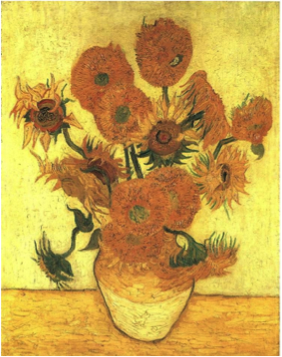
The target was a Van Gogh painting. As the sender opened the envelope and started looking at it, she said “opening flower — giant flower.”
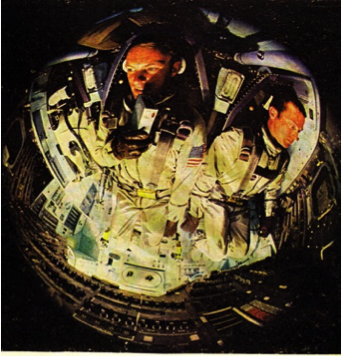
From a control picture, she named “astronaut, spacesuit.”
From another control, she saw “a horse, pointing right, a horse’s mane, the relief of a horse in fresco.”
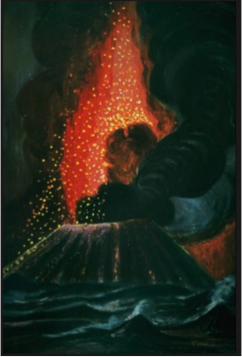
From a fourth control — a volcano — she saw “a triangle pointing to the top, an inverted funnel, spots, flame, orange flame, water.” She actually named three of the pictures, and had imagery of all four. She rated all four likely to extremely likely, and ranked the target third. She was confused that there was only one target — her imagery seemed to go to the future, when she would see all the pictures in the judging.
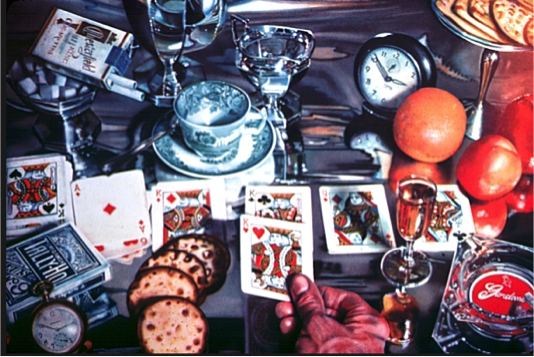
Here is a contrasting example of someone using ESP to hone in on the target. She was very goal-oriented, and expected she might see the actual target like a photograph. The target was a painting called “Solitaire,” by Audrey Flack, 1974 — the name, painter, and date printed on the bottom. Her imagery included the name of the painting (“he’s playing solitaire”), the numbers 57 and 4725 (note the 74 in the date), and — seeing the painter’s last name, Flack — “airplane, that’s flack,” because her father flew in the war and flak was shot at him. She saw a girl named Audrey (the painter’s first name). She named the Ace of Hearts (note the Ace of Diamonds, King of Hearts), red cards, a gold watch (note the gold watch in the corner), blue-and-white print, a red apple, a red cross-like symbol. She also picked up the sender’s thoughts — “Mexican,” “full house,” a Western theme — which were not in the painting but in his mind as he looked at it.
What may be necessary for success
- Openness to allowing unconscious material into consciousness without blocking it
- Keeping the desire for the target in mind — yet without striving for it
- Judging ability — recognizing connections even when they are distorted or only partial
Blocking may happen when the idea of ESP is rejected, when something causes resistance, when the target is disliked, or when a lack of openness to unconscious content is part of someone’s personality. Another variable may be the orientation to keep the goal in mind, yet stay relaxed and passive — to endure waiting and not knowing, without guessing and without striving. When the desire for the target is forgotten, ESP may wander, scan the whole pack, or notice a more interesting picture. And a third component is the ability to recognize connections from imagery to target even when they are not straightforward — the slanted angle of a roof, the right shade of green, a dappled effect, a texture: in other words, judging ability.
Concluding thoughts
- Free-response ESP in the lab can act in a way that is similar to what happens in real life.
- ESP may be happening more often than we think — whether it is noticed or not.
The Ganzfeld is just one of many ways to test for and observe ESP with free-response targets. There are others — remote viewing, dreaming, relaxation, meditation — that can work in a similar way to get images and thoughts relating to unknown targets. Observing how ESP operates in a controlled experiment, when the target is unknown, can lead to insights, surprises, and new questions, as can observing ESP as it happens in real life. The important thing I take away from this kind of research is that ESP may be happening far more often than we assume. It is not so easy to direct it to do what you ask — but not so hard to see it.