The Ganzfeld experiment
In a Ganzfeld experiment a volunteer subject is asked to perceive something in their mind’s eye that is hidden from them at a distance. There is an unknown target, chosen by a random process, and the goal is to get information about it at a distance. The target is often a picture.
© 2026 American Society for Psychical Research, Inc. New York, NY USA. All rights reserved. aspr.com
Perception at a distance
The way of “viewing” or sensing or perceiving the unknown information is sometimes called extrasensory perception (ESP). Obtaining information about something hidden in this way has been given many names, such as perception at a distance, or extraordinary perception, or extended perception, or remote viewing. The mechanism of ESP is not understood, and there are many ways it has been conceptualized. It has been thought of as telepathy, where the information is presumed to come from someone who is viewing the target while the subject is reporting what comes into their mind. It can be thought of as clairvoyance, where the subject is getting impressions from the distant target itself. It can be thought of as precognition, where the subject is getting information from the future when the experiment is completed and the subject is shown what the target had been.
Where the Ganzfeld comes from
Ganzfeld is a German word that means “whole field.” The Psychologist Wolfgang Metzger introduced the concept of the ganzfeld effect in 1930. Metzger conducted systematic laboratory research showing that when subjects stared into a featureless, uniform visual field, they reported visual anomalies, from geometric forms to complex imagery. Three parapsychologists, Charles Honorton, Adrian Parker, and William Braud, each independently adapted Metzger’s work with the Ganzfeld technique around the same time, as a procedure to explore free-response ESP research.
Quieting the senses
The Ganzfeld procedure that is used in ESP research is a visual and auditory partial sensory deprivation technique that uses relaxation, suggestion, and removes the information that usually enters our consciousness through our eyes and ears. Instead, eyes and ears are stimulated by a field of uniform light and sound and are deprived of the usual information used to orient to the world.
The Ganzfeld technique is an experimental way to produce a state of consciousness that resembles what’s called a hypnagogic state. Everyone naturally enters this state just before falling asleep. One may start to see static images that are not dreams yet are not like being awake. Internal images become more vivid and disconnected, more dreamlike. The idea of using Ganzfeld stimulation in an ESP experiment is to quiet the attention for which we normally use our eyes and ears, when orienting to the world, to allow internal images to enter awareness more easily. Without the external input from seeing and hearing, the mind allows other impressions to enter consciousness more easily. These impressions can be visual, auditory, emotions, ideas, feelings, or use other senses of the body such as sensing textures, touches, movement, or sensations such as heat or cold.
Inside a session
In a Ganzfeld experiment the volunteer subject is asked to perceive an unknown target that is hidden from them. A target is often shown to a “sender” who has no contact with the subject or the experimenter. The subject is isolated in a soundproof room with the knowledge that the sender will be shown a target and the goal of the subject is to allow information about the unknown target to enter their consciousness. The subject is asked to report all thoughts, feelings, and images that pass through their mind, with the desire kept in mind that some type of information about the target will enter their conscious experience during the Ganzfeld session. They are later shown four pictures, one of which is a copy of the target, and asked to rank the pictures in order of how likely they think each picture was the target based on the images and thoughts that came into their mind during the Ganzfeld session.
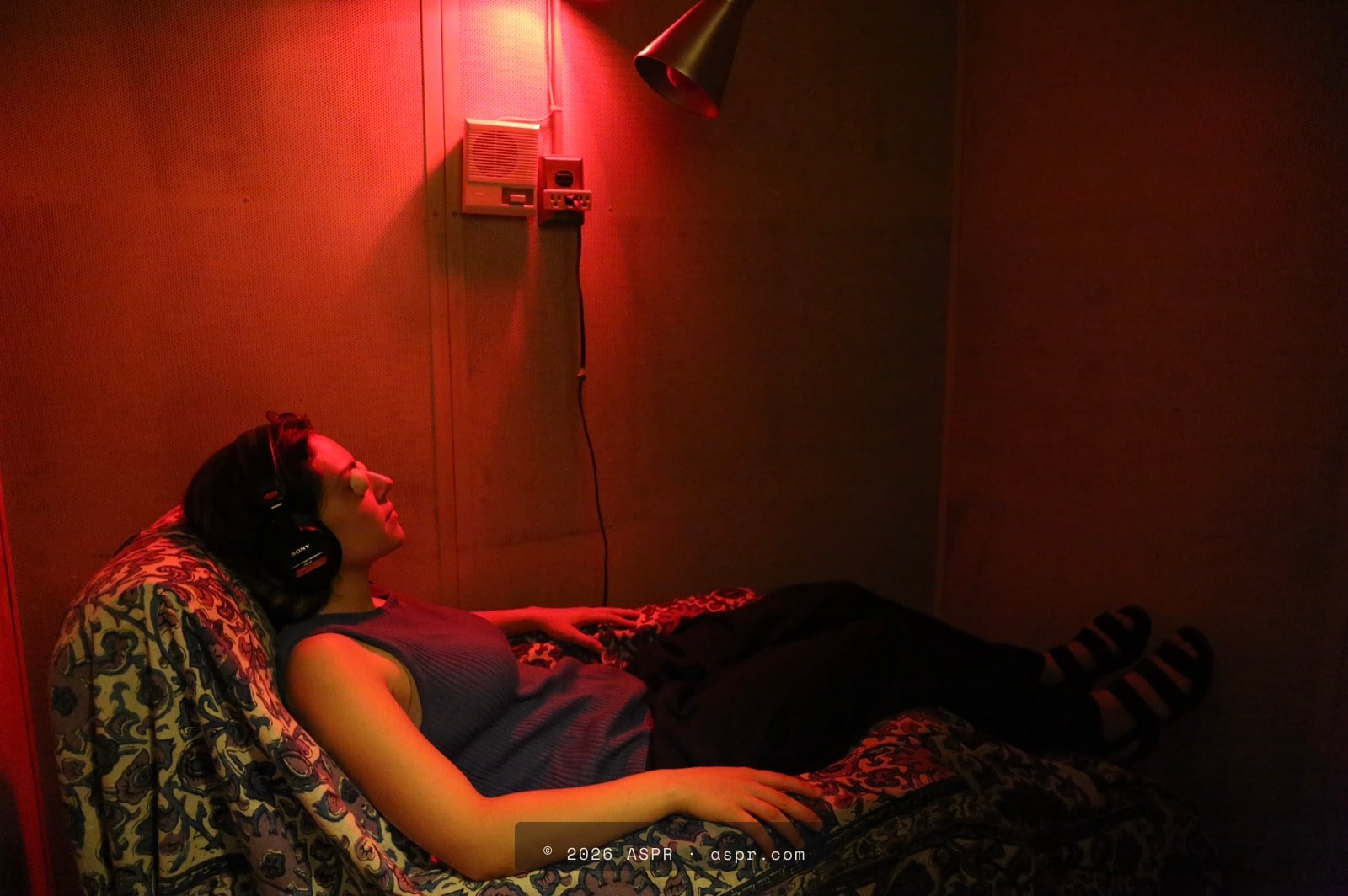
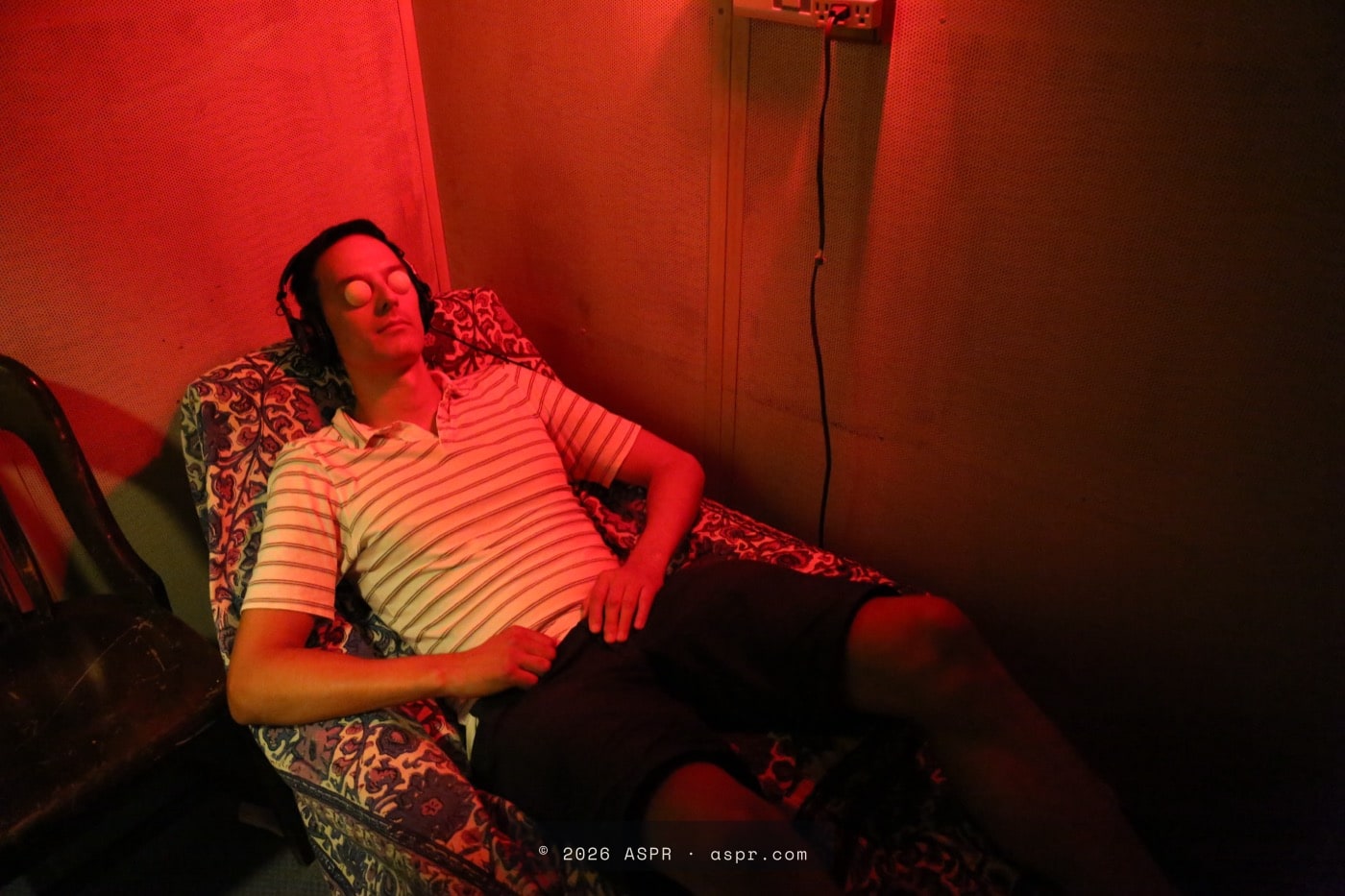
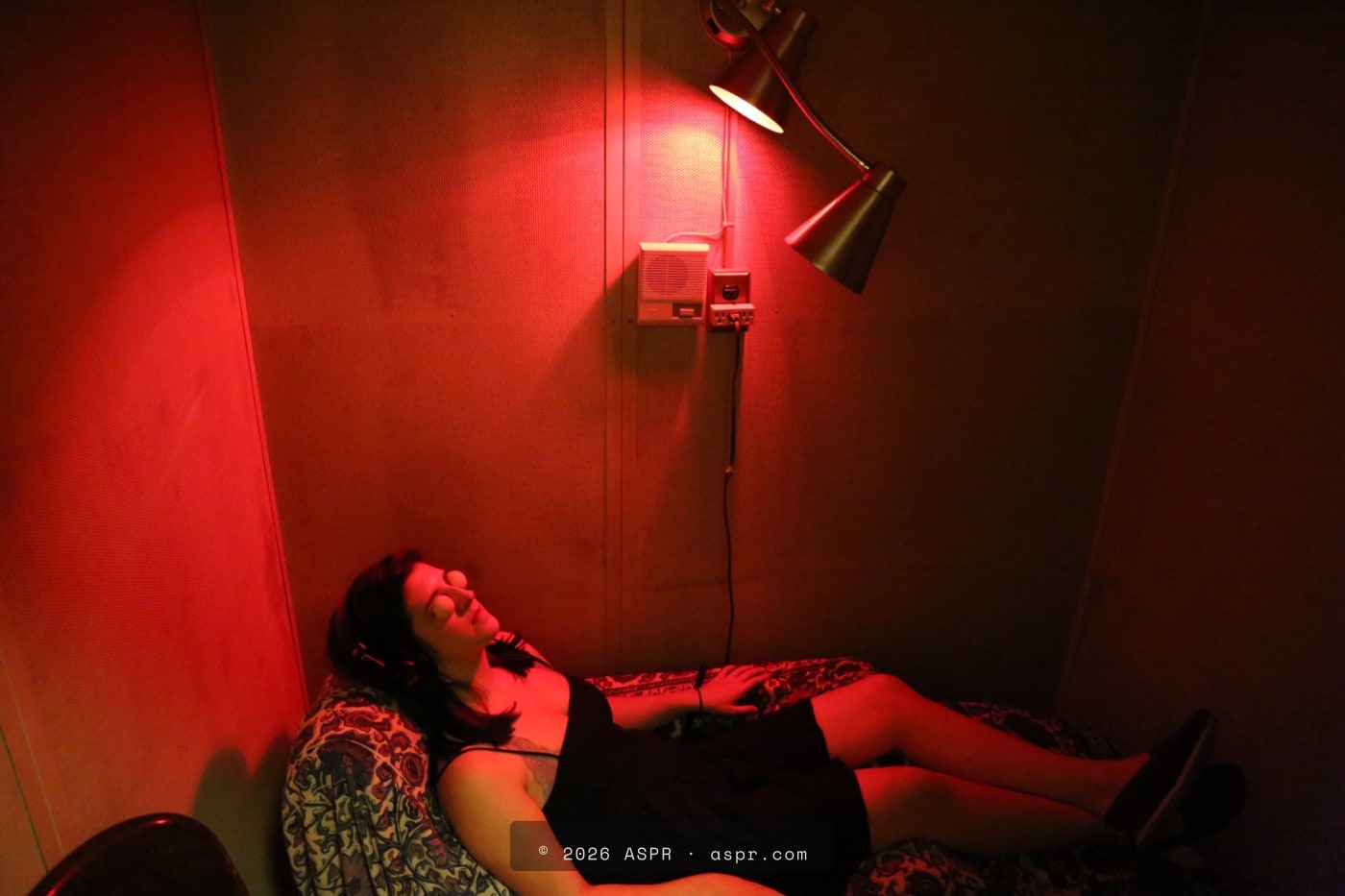
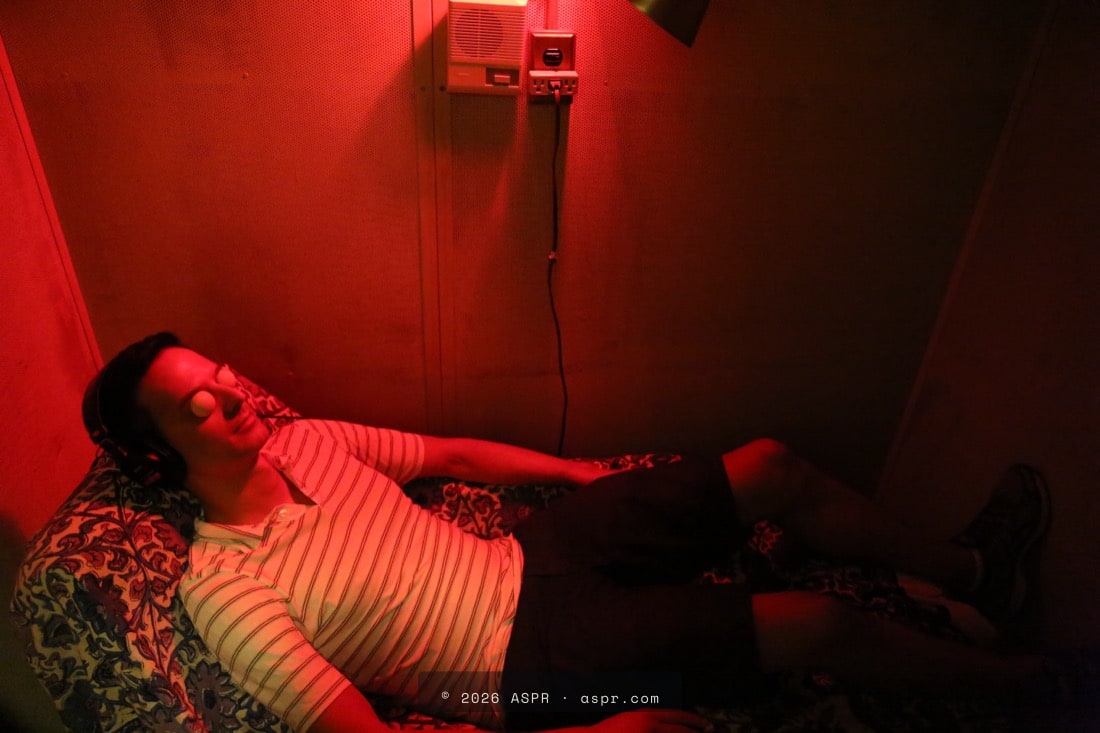
In a Ganzfeld ESP experiment, the subject sits alone in a soundproof room and relaxes in a comfortable chair. Ping-pong ball halves cover their eyes, and a red light positioned in front of them creates a uniform red visual field. Through headphones, the subject hears white noise—a steady buzz containing all frequencies, like the sound of an air conditioner. The mind has no patterned external input to focus on. At times, the red field may disappear and be replaced by neutral gray. The mind starts to allow internal imagery to appear in the field of vision, and to allow other feelings and ideas to enter consciousness.
© 2026 American Society for Psychical Research, Inc. New York, NY USA. All rights reserved. aspr.com
A volunteer in a Ganzfeld session at the ASPR laboratory Before the white noise begins there are taped relaxation exercises, then there is a suggestion to make a wish that information about the target will come at the appropriate time. Subjects are asked to observe and to report their stream of consciousness, without clinging to their images, without trying to get the message, just allowing whatever may appear to come in its own time. People are asked to “think out loud” and report the thoughts, images, and feelings that pass through their minds. They know that in a distant room, someone will be concentrating on a randomly selected picture, the ESP target, and their task is to allow images and thoughts that may contain information about the target to enter their awareness. The idea is that there is a goal, to get information at a distance, but there should not be any striving toward the goal, no trying, no guessing, just waiting, and reporting what appears. It is a difficult balance, to retain the desire for the information, but to wait for it without attempting to strive to get it. The experimenter can hear and write down what the subject reports through a one-way intercom in another room. At the end of the Ganzfeld period, the experimenter returns to the subject and reads back the written transcription of what the subject said.
After being reminded of everything they reported, they are asked if there are any other associations to their stream of consciousness. These added associations are also written down. The subject is asked to draw any shapes they remember that they may have seen whether they could interpret and name them or not.
© 2026 American Society for Psychical Research, Inc. New York, NY USA. All rights reserved. aspr.com
© 2026 American Society for Psychical Research, Inc. New York, NY USA. All rights reserved. aspr.com
© 2026 American Society for Psychical Research, Inc. New York, NY USA. All rights reserved. aspr.com
Kept blind
The experimenter does not know which picture is the target and has had no contact with anyone who does. The experimenter has no contact with the sender, who views the target picture in a distant room during the Ganzfeld session, or with the person who randomly selected the target from the picture pack and brought it to the sender. In this way, the experimenter remains “blind” to the correct choice. The experiment is “double-blind” in that neither the subject nor the experimenter has contact with anyone who knows what the target picture is.
Choosing among four pictures
The experimenter takes the subject to a room and shows them duplicate copies of four pictures that had been arranged in a pack of pictures to be as different as possible from one another. Only one of the four pictures is a copy of the target for the Ganzfeld session that had been chosen by a random process, the other three are controls. Duplicates of the pictures of the target pack for the session are used to make sure that there can be no sensory cues about the target, such as handling cues.
After seeing the four pictures in the pack, and after again reviewing what they reported in their Ganzfeld experience, subjects are asked to choose the picture that seems most likely to be the target. They are asked to arrange the other pictures in decreasing order of likelihood of being the target.
At the end of the experiment, the subject and the experimenter learn which picture was the correct target.
Reading the results
By chance, the target should be chosen correctly 25% of the time when there are four pictures in a pack. An experiment must use enough trials, with the number of trials specified ahead of time, to have a possibility that correct choices might exceed chance expectation by a large enough amount to demonstrate an effect. If the probability is less than 5% that the number of correct choices was due to chance then the “null hypothesis,” that there was no ESP operating in the experiment, can be rejected.
The Ganzfeld experiment was repeated more than 40 times in the 1970’s to early 1980’s with more than half the experiments demonstrating significant positive ESP overall. At that time, researchers considered it an exciting new technique for ESP research, a breakthrough in the path toward repeatability with unselected subjects. Others argued that it was just a placebo, that it added nothing necessary for success but provided a ritual that took the responsibility for psi success off the person being tested – making it possible for them to believe that it was not the person but the technique that was causing the ESP.
What an “unsuccessful” experiment can still show
Even if no ESP is found statistically because correct choices of target exceeds chance expectation by a large enough amount, much can still often be learned in a Ganzfeld experiment. “Unsuccessful” experiments with unselected people without overall positive scoring in the ESP test can sometimes also show predictable ESP in another way. Collecting information about possible relevant variables may reveal ESP within a non-significant study that would remain hidden without asking for the added information ahead of time.
For instance, the target may be chosen correctly only 25% of the time, yet a relevant variable such as dream recall frequency, belief in the possibility of ESP, or a measure of cognitive strategy in getting imagery in the Ganzfeld may be able to separate those that succeeded and those who failed to choose the target correctly into two groups, and show significant correlations with ESP success in the predicted directions using the relevant variables.
Ganzfeld mentation may also include free-floating ESP information that does not improve the experiment’s overall success but is fascinating to observe, much like spontaneous cases. The subject may begin to report information about something that happened in the experimenter’s life, or what is happening in another room, for instance, that looks like misdirected psychic functioning.
Why free-response tests fail
Free-response ESP tests can fail for many reasons. Because the effect size is small and does not occur consistently, studies must include enough sessions to detect it. Experiments with too few trials are less likely to produce significant results. However, few free-response studies use enough trials to increase the likelihood of detecting ESP because running studies that are large enough takes considerable time.
Another way an ESP test can fail is that a target picture can be bad. A target is good in a target pack if it is more often chosen when it IS the target and more often NOT chosen when it is NOT the target. A dominant picture in a pack that most people will be drawn to might cause a target pack to be bad. If a picture tends to be chosen whether it is the target or is not the target, it is a bad target. If a picture tends to be avoided whether it is the target or not the target, it is also a bad target.
Target packs can also be constructed badly. Pictures might not be different enough from each other in a pack, so that it is hard to judge between similar pictures. Pictures within a pack should differ in content, color, shape, movement, emotion, and so on. It is difficult to construct a pack of pictures where each picture differs from all the others in so many ways. There is usually overlap where at least two pictures in a pack have something in common.
The way ESP phenomenon manifests is very sensitive to interpersonal dynamics. The attitudes and personalities of experimenters can differ to such an extent that an attempted replication of a successful study will differ in crucial interpersonal ways from the original study.
Overall, the Ganzfeld is one of many ways to test for ESP. It produces rich content that can be studied in many ways beyond a simple count of how often a target is chosen correctly, and one that many participants find fun and exciting.
Take part at the ASPR
The ASPR has a Soundproof room that is a Faraday cage which shields for electromagnetic radiation that is used to conduct Ganzfeld experiments. It offers a quiet, relaxed environment. The Society welcomes visitors to come and participate in these experiments. If you would like to be in an experiment, please contact the ASPR.