


Opening the volume…
Turn the page with the arrows either side, by clicking the page, or by dragging a corner.PDF opens the original document in a new tab.
Editorial Comments
"Editorial Comment" by William H. Button. PASPR • 1940.
Publication details
William H. Button. Editorial Comments.
This historical document is held in the ASPR’s digital archive as part of Proceeding Articles. Consult the original scan for pagination, illustrations and the author’s wording.
Searchable document text
Text extracted from the scan to help readers find passages. Automatic transcription may contain errors, especially in tables, names and older type. Page numbers below refer to PDF pages; a scanned spread may contain two printed pages. Use the original PDF when quoting or citing.
PDF page 1
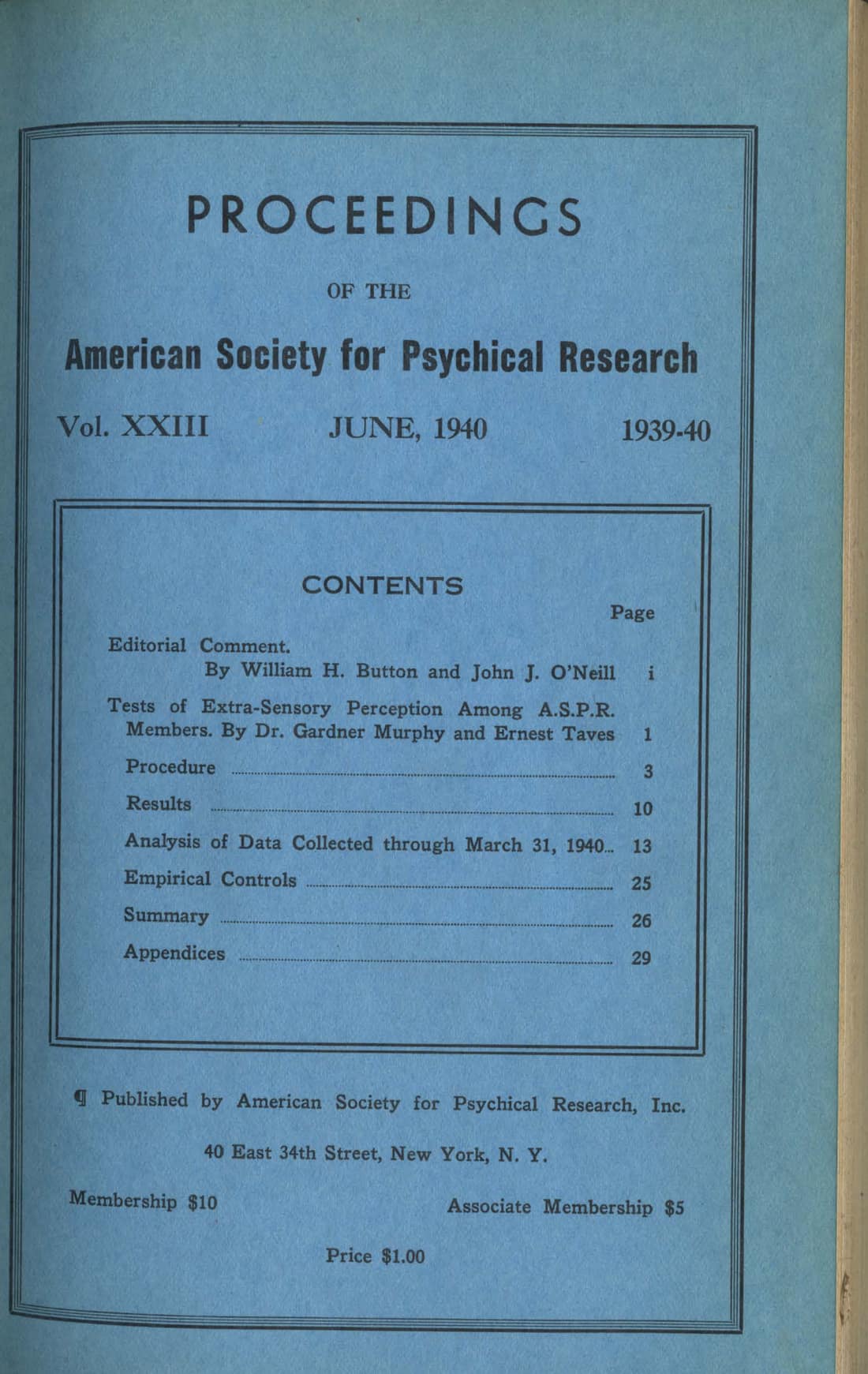
PROCEEDINGS
OF THE
XX JUNE, 1940 1939-40
CONTENTS
Page
Editorial Comment.
By William H. Button and John J. O’Neill i
: Tests of Extra-Sensory Perception Among A.S.P.R.
_ Members. By Dr. Gardner Murphy and Ernest Taves 1
re ROCOMET ER a lO hohe ie ene eae tye U1 Meany 3
oO GASES ONE AL a A on nie 10
Analysis of Data Collected through March 31, 1940.. 13
SrirvinicakGontrily ofa he ae 25
40 East 34th Street, New York, N. Y.
ie
My
oa
=
z
low
<
>
3
g
re)
p
=]
m
°
2%
2
<q
o
Le)
gy
n
<
Q
B:
Q
2.
w
oO
n
oO
p
La
Qa
a
I
5
bership $10 Associate Membership $5 ~
Price $1.00
PDF page 2
NOTICE TO MEMBERS
Members are desired to report as to facts and personal experiences |
relating to psychology and psychical research or to contribute to
critical discussions of material collected and published. These sub- —
jects include Apparitions, Telepathy, Clairvoyance, Premonitions,
Mediumistic Phenomena, Visions of the Dying, Coincidences, Illu-
sions, Hallucinations and all residual phenomena that tend to illustrate
obscure mental processes.
All reports and narratives of personal and other experiences will
be treated as private and confidential, unless express permission is
given to use them and the names connected therewith.
Every person paying $5 a year will receive the JouRNAL one year;
every person paying $10 a year will receive all the publications of the
Society for that year, including the Journat and the PROCEEDINGS. —
The JourNnAx is published monthly and keeps the reader informed
as to what is transpiring in the scientific world relating to psychic
research.
The Proceepincs are published as occasion demands. The Pro-
CEEDINGS aré more technical than the Journat and will be more | ~
important for those who wish to have detailed records. ‘
Back numbers of either the JourNAL or the Prockepincs may be
had at any time.
Editorial Comment
This report by Dr. Gardner Murphy and Ernest Taves
is published by this Society by authority of the Board of
Trustees and the Research and Publications Committee.
* XK * *K
This issue of the Proceedings of the American Society
for Psychical Research contains our first formal report of
the research in the field of Extra-Sensory Perception car-
ried on by Dr. Gardner Murphy and Ernest Taves. All
phases of the inquiry are not covered in this report. Addi-
tional results will be recorded in a subsequent issue of
the Proceedings.
The field in which this inquiry is being carried on is
still largely virgin territory awaiting scientific exploration.
Some small fringes of the area have been surveyed and
charted by the many scores of investigators who have en-
tered the field in recent years. Many items of knowledge
of intrinsic value have been recorded plus many other items
whose place in the larger pattern of knowledge still remains
to be determined.
‘There is no more difficult field in which to carry on
scientific research than that which embraces the inquiries
into Extra-Sensory Perception and other extra-normal phe-
nomena. The term “extra’’ is applied because scientists
have thus far failed to include these manifestations in the
generalizations of law and principles which cover the more
easily studied phenomena of the physical and biological
Sciences. Electromagnetic radiation in the range that has
Siven us our radios might well have been called “ghost’’
waves if their existence had been known before the days
of Faraday, Maxwell and Hertz.
In the experiments of Hertz an electric spark was cre-
ated. It lived its brief existence of a tiny fraction of a
Second and then gave up the ghost. Before the time of
Maxwell’s researches scientists would have appeared to be
PDF page 3
ii] Editorial Comment
fully justified in saying that there was no “ghost”, and ©
when the spark snapped out of existence, that ended every- —
thing for the spark. But Hertz designed a receiver which —
resurrected the ghost out of empty space and caused the ©
spark to once again live its brief existence, but in a new —
environment.
There is an interesting analogy between the phenomena
of electromagnetic waves and Extra-Sensory Perception.
When a spark is created, invisible waves are radiated into
the ether or into space. When a receiver properly attuned
to these waves is available, it can extract the energy of
the waves and transform it into an electric current which ©
will reproduce the spark. When an individual indulges in |
mental activity, something intangible may be given off —
which progresses through time and space. We do not —
know what the nature of this “something” is, but there —
is adequate evidence available that it can stimulate another —
individual at a distance beyond the range of the normal
sensory powers so that the second individual reproduces in —
whole or in part the thoughts generated by the first indi- —
vidual. This phenomenon is known as telepathy. When an ~
inanimate object is used as the “sender”, the phenomenon ~
is called clairvoyance.
The report by Dr. Murphy and Taves contains a small —
but valuable part of the evidence that a transmission of —
some kind takes place between individuals at a distance and ~
apparently between objects and individuals. Even if every- —
one were satisfied with the existing evidence that an extra- _
normal transmission of something takes place, the task of
the investigator would still be far from completed. We are —
almost completely without demonstrable scientific knowl- i
edge of the nature of the something that is transmitted. —
We do not know whether it has the form of waves, that
are transmitted like electromagnetic waves, or whether it
has a form completely different from anything we now
know about. We must learn what part of the living body
is responsible for the generation of the something that goes
i
Editorial Comment [ iii
out into space and we must learn what part of us acts as a
receiver and makes the telepathic material available to our
consciousness.
This approach to the problem may make it appear that
only a purely physical interpretation of the phenomena is
being considered and that all other interpretations are ruled
out, or in other words that participation in the phenomena
by extra-physical entities, or “spirits” is not being consid-
ered. Such is not the case. No agency of transmission is
ruled out. Science works from the known to the unknown.
We know a great deal about physical phenomena. When
we have attained a sufficient mastery over the purely phy-
sical phenomena involved in Extra-Sensory Perception, we
have provided ourselves with an important route for pene-
trating into the realms that lie beyond.
The work reported in this number of the Proceedings
is entirely consistent with the findings of other investigators
which indicate that telepathic and clairvoyant transmission
of intelligence is a natural phenomenon, the reality of which
has been amply demonstrated, but that the ability is not
uniformly distributed. A large number of persons can
demonstrate telepathic ability to a limited extent under
some highly specialized circumstances, and a smaller num-
ber can demonstrate it under a wider range of conditions.
A rare individual can be found in every sufficiently large
group who will give an astounding demonstration of sen-
Sitivity to telepathic transmission. This distribution cor-
responds to the distribution of normal and abnormal char-
acteristics, mental and physical, in most randomly selected
groups.
The work of Murphy and Taves indicates that ordinary
Subjects working in an ordinary mental state with statis-
tically measurable material can manifest in experiments,
similar in structure but differing slightly in content, large
deviations from chance that are statistically significant
while in others they do not average significantly above
chance expectations.
PDF page 4
iv] Editorial Comment
In one experiment in which the results are statistically _
significant, the deviating experimental factor was the use |
of the color red, or the red-white combination. ‘
The scores on the simple choice of red or white cards ©
are significantly low, not merely low enough to arouse inter-
est, but so extremely low that such a result would be ex- —
pected to appear by chance only once in the course of 4,000 —
such experiments. This was due to uniformly low scores by —
all subjects tested and not to a large deviation by any one —
individual—a social factor associated with possible antag- —
onism to the color red may be involved but as yet no adequate —
hypothesis is available. '
In one card reading experiments the group made higher —
than chance scores that are statistically significant and —
could be expected by chance but once in 670 such experi>
ments. This high average was due largely to a few indi- | '
viduals who made very high scores. One individual who 1
made one-tenth of the calls in the test scored one-third of —
the total deviation above chance, thus reducing the total 4
“significance” although indicating that the group did mani- ’
fest some small ability to score above chance. J
Witi1aAM H. Button, President
Joun J. O’NerL1, for the Research
and Publications Committee.
Explore related records
- Tests of Extra-Sensory Perception — Gardner Murphy
- Centennial Compilation of the contents of the Proceedings and the Journal of the American Society for Psychical Research 1885-1984
- The Discovery of Gifted Sensitives — Gardner Murphy
- Physical Phenomena at a Private Circle — William James
- Personality Appraisal and the Paranormal — Gardner Murphy