


























Opening the volume…
Turn the page with the arrows either side, by clicking the page, or by dragging a corner.PDF opens the original document in a new tab.
Experiences Centering in the Young Family
"Experiences Centering in the Young" by Oscar E. Young. PASPR • 1920.
Publication details
Young Et al.. (1920). Experiences Centering in the Young Family.
This historical document is held in the ASPR’s digital archive as part of Proceeding Articles. Consult the original scan for pagination, illustrations and the author’s wording.
Searchable document text
Text extracted from the scan to help readers find passages. Automatic transcription may contain errors, especially in tables, names and older type. Page numbers below refer to PDF pages; a scanned spread may contain two printed pages. Use the original PDF when quoting or citing.
PDF page 1
Experiences Centering in the Young Family. 287
EXPERIENCES CENTERING IN THE YOUNG
FAMILY.
REPORTED BY OscAR E. YOUNG AND OTHERS.
Edited by Walter F. Prince.
The editor, speaking for convenience in the first person, testi-
fies as follows: ia
Mr. Oscar E. Young, the principal author of the narra-
tions which follow, is very well known to me. I was in
‘school with him from my 16th to my 18th year, at what is
now known as Kent’s Hill Seminary in Maine, we roomed at
the same house, the residence of my aunt and her husband, the
Rev. C. W. Blackman. I knew him intimately then, though he
is, I judge, about two years older than I. Our acquaintance was
interrupted for a considerable period, though I often heard of him
through relatives, and always favorably. We have corresponded
for perhaps the last eighteen years. Thirteen years ago I spent a
week in the old homestead in Fayette, Maine, where a number of
the incidents to be related took place. He proved to be the same
frank, fearless, absolutely honest self of former days. I think
that it would be impossible for him to pretend what he does not
believe. I surmise that his way would have been smoother some-
times if he had conformed more to the prevailing sentiment of
his environment, but he is as conscientious in his nonconformity
as others may be in their conformity. He is naturally and by
practice inclined to be cautious and critical. He is as exacting as
Thomas of old in his demands for evidence, but as the Lord was
lenient with Thomas, so I hope he will be with my friend Young.
He has been a teacher for many years, much of the time as prin-
cipal of high schools. I never heard a whisper against his integ-
rity. It was at my suggestion that he came into communication
with the Society for Psychical Research.
The bent of Mr. Young’s mind is indicated by a passage in a
letter of his dated July 6, 1909.
I am greatly interested in the investigations of the Society, and in
an amateur way have been working along similar lines myself for
PDF page 2
288 Proceedings of American Society for Psychical Research.
upwards of twenty years, as occasion offered. I am convinced of the
genuineness of many of the phenomena, but do not yet accept the
spiritistic solution. My mathematical tendency. demands a more
positive demonstration.
In the summer of 1918 I again spent several days in the
pleasant old homestead, renewed acquaintance with the excellent
Mrs. Young, and the now grown children, several of whom have
places in the narratives. At the same period I visited Mrs. Katie
B. Y. Adams and her husband, and my impressions of the good
sense and good faith of both, derived from correspondence, were
deepened.
Professor Charles F. Howland, a corroborator of several of
the incidents, I knew well when we were young men in the pre-
paratory school, and by reports since. His integrity is unques-
tionable, I believe. His testimony was given at the cost of some
personal distaste, as would appear from a letter from Mr. Young,
dated May 1, 1909.
Both of us [formerly] did considerable experimenting in te-
lepathy and animal magnetism, as I have already told you. Later he
went to New York, New Jersey, and finally to Oregon, and for many
years I saw little or nothing of him, and our discussions of such
matters gradually ceased. The last time he mentioned it was to say
he was gathering material to annihilate my growing tendency to con-
sider discarnate, or rather ex-carnate, intelligence possible or prob-
able—but it never came.
There seems to have long been a certain trend in the Young
family, some would say to superstition, and others that there was
something in the makeup of many of them which constituted them
more or less conductors of supernormal influences. Mrs. Alice
Young Tracy, a cousin, testifies to this tendency, in a letter to
O. E. Young, written in 1917:
About Aunt Elenora’s being spiritualist if one might judge from
her letters should certainly say she was. Once she said in one, that
she shouldn’t dare tell people what she saw and heard. I expect in
the long, long, hours she spent alone when John and Ben (her sons)
were away from home, she must have found it a great comfort.
)
|
Experiences Centering in the Young Family. 289
Father used to hear voices and have what he called impressions about
things. He told Mother the winter he died that if he had heeded the
impressions he should have been much better off every way. But
Father always tried to overcome them because if he mentioned what
he saw and heard some people called him superstitious and he was
very sensitive about it.
We have an old Soldier in town that went to the civil war when
he was very young, and had a most dreadful experience in more
than one prison. His people heard. from him occasionally for some
time then not at all and as time went by and no word came they
became very anxious. One night father had a dream, he went to the
prison, saw this young soldier and saw him get away and followed
him so that he knew he was safe. The next day he told Mr. Robin-
son (That was the people’s name) and he said you need not worry
for he is certainly coming home, well as you know travel between the
north and south at that time was very uncertain and the Robinsons
neither saw nor heard anything more. Well of course they told what
father had told them and people laughed and guyed father but one
day what was left of the lad came home. Yes there are quite many
instances that we could tell you and I could write them out for you
sometime if you wish. Sadie and I both have had some strong “‘ im-
pressions ” and a medium told me Sadie was a born medium.
She has told people strange things and when asked why she said
so and so she would say she didn’t know, but she knew she was right
and she was. Uncle Malo. used to say that there was a strain through
the family that heard and saw and dreamed things before they came
to pass. There was one ancestor who dreamed he went down to his
barn (where he had been threshing beans the day before) and that
the Indians scalped him, he told his wife in the morning and she
begged him not to go to the barn that day to finish his beans, so
finally he concluded he would go down and cover them from the hens
and go to one of the neighbors of an errand. Well, the Indians were
in the barn and they scalped him. Once when father was on:a vessel
in the Bay of Chaleurs he was standing at the wheel a voice said,
“Frank you are going onto a ledge,” and he ran and threw.a sinker
over the side and all seemed all right and he tried that the third time
and found he was going onto a ledge, and oh! there were lots and lots
of instances, as I said before....
. Auicr Y. TRAcy.
PDF page 3
290 Proceedings of American Society for Psychical Research.
In a letter to me, dated March 7, 1918, Mr. Young himself
says: :
There seems, as you say, to be a mediumistic streak running
through the whole family. As far back as I can definitely remember
our immediate family, it consisted of three brothers, William, Joshua
(my grandfather) and Levi. There were one or more girls whom I
never knew. Uncle William married three times. I judge he was
the oldest brother. By his first wife he had Malorum, Frank (or
Franklin) and Elenora; by the second, Gilman and Parker; by the
third, Fred. Frank Young was Alice Tracy’s father, and she has
mentioned several of the others. Frank and Elenora turned Spirit-
ualists. I judge. Uncle William’s children are all dead but Parker,
whose mind has failed. I am not quite sure about Gilman, but think
he is dead. Uncle Levi had: but one son, Augustus, also dead. I
never heard of the family weakness cropping out in him, or any of
his family.
Coming down to Joshua, my grandfather, I have heard that he
“got sanctified ”, as the saying is, at a Methodist campmeeting when
young and fell into a sort of a trance, but I know nothing about the
particulars. He became a Universalist shortly afterwards, and
always remained so. Uncle Levi, a lifelong Methodist, also turned
in the same way just before his death.
Grandfather had three sons, Chandler (father), Joseph, and
Imery, my namesake, who died at twenty. Father always inclined
to Spiritualism, but had no unusual experiences as far as I know, and
had no contact with Spiritualists except the cousins before named.
I judge he was simply in a receptive condition—but received nothing.
What cranks his children have proved you know, possibly better than
I myself.
Uncle Joe was bitterly skeptical in regard to spirit return until
his latter years, when I judge he altered his opinion much before his
death, though I do not know that I talked with him on those lines for
quite a few years. I judge mostly from what Katie and his daughter
have told me. Addie, I think, is a strong believer in spirit return
now, though a few years ago she was strongly antagonistic.
I am still wondering why I get no message from Uncle Bray, as
per agreement renewed after we went to bed on the last night we
slept together, before I bade him goodbye forever early the next
Experiences Centering in the Young Family. 291
morning. He was powerful mediumistically, though not fully devel-
oped by any means. Did I ever tell you about his making a speech
of ten or fifteen minutes from the rostrum at a big Spiritualist meet-
ing in Boston one night, under control? He said he did not know
what the devil he said, he couldn’t remember, but the audience
cheered him to the echo. As I remember, he did not know why the
man in charge called him to the platform, as they were strangers. I
think I told you how certain influences tried several nights in suc-
cession to make him write verse, for which he had considerable apti-
tude, and would not permit him to go to sleep. Finally he said aloud,
“T’ll write all the poetry you want me to in the daytime, but [’ll be
damned if I’ll get up in the middle of the night to do it,” and was
never troubled in that way afterward.
The following paragraph from a letter by Mr. Young to Dr.
Hyslop, may serve as a direct introduction to the incidents which
follow :
You also ask for any further experiences I may have. Whether
there will be any, the future must determine. There have been many
indeed in the past, tho by far the larger part were crowded into the
periods that included my parents’ death, viz.: 1890 and 1913. If
memory did not fail, I could talk right around the clock while telling
the things inexplicable that have happened in the family in the last
twenty-five years. Many are no doubt capable of very prosaic ex-
planation—if one could only hit on it ; many others, I believe, are not.
Still, it is the mass of material that is convincing, rather than the
quality. Most that seemed to me outside the ordinary scope of mani-
festation, or that were capable of being corroborated, I have already
sent you.
~ I began investigating Spiritualism in 1882 and soon began having
unusual experiences (for me). ‘These culminated just after Father’s
- death in 1890. Katie began to go under control about the time of my
marriage, about a year later, thus turning Mother from a bitter
opponent to an ardent supporter of spirit return. My wife, strongly
mediumistic, has' always been bitterer still, consequently when
Mother and Katie went away for good a year or so later, the in-
fluence to a great degree left me for more congenial surroundings.
The. following letter, relating to the endowment and experi-
PDF page 4
292 Proceedings of American Society for Psychical Research.
ences of the writer and of the family to which he belongs, has
interest. So far as the visualizing exploits of Mr. Young are
concerned, the unusual vividness and persistence of some of the
images in his memory are the characteristics psychologically most
worthy of remark. .
Souts CHESTERVILLE, Marne, May 31, 1917.
Dar WALTER:
Your letter of inquiry was just received. Would suggest that you
apply directly to my sister, Katie B. Y. Adams, 21 Green St., Win-
throp, Maine, for her experience in regard to the apparent reappear-
ance of my mother since she left us. She is in very poor health, 1
believe but I think she would respond. i
I have heard her tell many such instances; most of which I have
now forgotten. One instance I recall was the first time I spent in
the house after mother was laid at rest. I slept in the little room
up stairs that she occupied many years and to which she was much
attached ; so much so that she did not like to have it used except by
those to whom she was greatly attached. This was after increasing
weakness and the necessity for watchfulness during the night made
it advisable she should occupy another room on the first floor. So
far as I know, no one but myself and my cousin slept there—and she
did not sleep much.
To return to the instance under consideration: Katie told me I
might sleep in either of the upstairs rooms I chose, but she thought
mother would like to have me there. I told her I should sleep there.
Katie answered, “ All right, but I should not wonder if mother came
to you.”
I said I hoped she would or something of that sort and went to
bed. As a matter of fact I was undisturbed by her, either then or
when I slept in her room at any subsequent time—or elsewhere.
Nevertheless, Katie after inquiring in the morning, told me she saw
mother come out of the last room she occupied and go upstairs some-
time in the early morning hours—or at least believed she did.
I remember also that Katie told me of mother coming to call her
one morning and asking if she were going to lie in bed all day, this
in full morning light. These are all that I now recall, but I know
that she has told me many—or at least several—other instances when
she believed mother had manifested, in one way or another. , Indeed,
y—
Experiences Centering in the Young Family. 293
the apparently supernormal experiences she has told me first and last
would fill a bigger book than your “ Doris Case.”
I told you, I think, that my wife, herself a sensitive, is opposed
to anything of the sort. There is a strong strain of Scotch blood
there, and the whole of her mother’s family seem to have a little of
the proverbial Scotch gift of second sight, if one may credit the
stories I have heard. They are all strong on visions, apparitions and
warnings, especially the last.
As might be expected, some of my children also seemed to be
somewhat psychic when small. How much of it was due to childish
imagination, of course I cannot say. Whether such conditions still
exist with any of the family, I do not know, and knowing how
their mother feels, though why is beyond me, I do not feel much
like asking.
I seem to have nothing abnormal in my makeup in later years,
though I imagine this is due to environment, except the faculty of
seeing with my eyes shut and, occasionally, hearing without the use
of the physical ear. Neither of these peculiarities developed until I
was about thirty.
When I began reading up on crystallography, I said to myself,
“Here is something in which I can develop myself.” But I cannot ;
I have tried quite a few times, to meet with complete and utter fail-
ure. And yet these pictures will pop up before my mental vision
almost any time when I am quietly resting with my eyes closed,
especially when about to fall asleep, though sometimes when broad
awake and working or thinking of something else and with eyes wide
open. ‘The pictures are perfectly distinct and lifelike, as real as
anything I actually do see, yet I never mistake them for anything but
mental pictures. ‘They never come when I am thinking of anything
of that sort nor can I call them up by any effort. Usually they are
landscapes or figures, the former often familiar. Usually the figures
are motionless, though not always ; they never seem to speak.
It has just occurred to me that I did once have a mental picture
when a boy not more than nine or ten years of age, that of my aunt
Lizzie with her nose all eaten away as if by a cancer. Aunt Lizzie
is still ‘alive, though feeble, but I have not seen her for some
years. I do not know of anything of the sort actually developing,
though I think 'I have heard her father died of a cancer before my
remembrance.
PDF page 5
294 Proceedings of American Society for Psychical Research.
My first “ vision” was a very prosaic scrub pine tree, with sev-
eral prongs and the limbs from them all crossed up, apparently about
fifteen feet in height. I would have recognized the tree at any time
for months afterward, had I come across it—but I never did. An-
other early picture was of an exceedingly homely boy of perhaps
twenty, dressed in a brown suit. He was tall and slim, had a very
long neck, a smooth shaven face, red and very pimply, with wide
cheekbones and one outstanding ear. The other was concealed by a
manifestly new white straw hat with low, flat crown and a flat, nar-
row brim, much too small for him and set at an angle of about forty-
five degrees. I cannot say what color the eyes and hair were, though
I think they were dark and I should say the hair was cut short. I
did not know him, although he somewhat resembled a young fellow
I knew at Long Island. He did not look particularly intelligent when
I first seemed to see him, but as I looked, he smiled a whimsical
half smile that caused deep, semi-circular wrinkles to appear around
the corners of his mouth—and very slowly and deliberately winked
at me. This gave him a very different expression.
Walter, what is the matter with me? Are “ Spooks” after me at
times? or am I “ buggy?”
As always,
O. E. Youne.
INCIDENTS.
I. “Tae Wurre Krrren.”
An extract from a letter from my sister, Katie B. Young Adams,
dated May 7, 1915, in answer to an inquiry caused by the allusion to
the kitten’s recent appearance noted in a previous letter. Paren-
thetical remarks are mine.
Now the story of the little white kitten is not long, but runs
through quite a period of years. At first we used to catch fleeting
glimpses of something white flashing in a corner or under a table and
mother thought it resembled a dove, but later it became plain enough
at times to discover its form, which evolved into a snowy white
kitten.
When we first began to connect it with any coming event, or even
to attach any especial importance to its periodic visits, I do not feel
able to recall, but very shortly before Uncle Joe’s death it ran through
a ae
‘*
x,
Experiences Centering in the Young Family. 295
a door—the front one—past mother as she was looking out, through
the sitting-room and disappeared.
She called me to look after the pretty white kitten, but I could
not find it—although she declared it ran under the bed. A systematic
search failed to reveal it.
About a month before Uncle Cyrus died, I was sitting one after-
noon by my bedroom window, sewing; all at once I caught a flash of
white and raised my eyes just in time to see distinctly the little white
cat run under my bed. I got up and hunted, but could find no trace.
The next day I was in the same place and raised my eyes to see him
distinctly, sitting on my hassock.
Mother came in just at that time and said, “ Oh, look at that
kitten.” With a flirt of its tail it disappeared into a corner.
It reappeared occasionally, but not so plainly, until a few days
before Uncle Bray died I found it sitting on the footboard of my bed.
I went to speak to mother, but she was sleeping and I did not dis-
turb her. When I came back the kitten was gone.
The night that William (our cousin) died, Mother asked if the
kitten lying on her quilt was Timothy. Now Timothy had a lot of
white on him, and I thought in the dim light it was he, and said so,
but when I stooped over to pat him my hand touched the quilt and a
flash of white by my knee was all to reveal its identity. There was
no cat in the room.
A day or two afterward I was sitting by mother alone in the
room. (This could not have been a week before mother’s death.)
_A white kitten jumped into my lap and laid [sic] down. I could
both see and feel him—I did not touch him. I felt I knew the mean-
ing of its visitation and sat peffectly still, with my heart in my
mouth. All at once mother opened her eyes and pointed to me.
““O, Katie, see the white kitten.” -
When I saw it this winter it was farther from me and less dis-
tinct. I don’t believe it means anyone very near.
Superstition it may or may not be. Where it comes from or
whither it goes, I know not.
The above explains itself. I was making a typescript for filing
and send a copy, on the chance it may be of interest to you.
. O. E. Youne.
South Curstervitie, Mr., May 12, 1915.
PDF page 6
296 Proceedings of American Society for Psychical Research.
SoutH CHEsTERVILLE, Mr., May 24, 1915.
Pror. JAMES H. Hystop,
New York City.
Dear Sir:
Your favor of the 16th instant duly came to hand. Before at-
tempting to reply to your questions, allow me to correct two errors
into which you seem to have fallen. First, if a wife and numerous
children are to be considered, I am scarcely entitled to the prefix
“Miss”. Second, the account of the White Kitten.was my sister’s
and not my own. The account I sent you was an extract from one
of her letters, “ verbatim et literatim et punctuatim”. I know no
more about the incident personally than you do now.
So far. as I know at present, nobody but Katie and Mother ever
saw the little cat. Certainly I never did—tho I did have one or two
experiences twenty years ago with another, a huge black fellow. My
sister saw that at least once, as well, and actually claims to have re-
ceived a scratch from him that was there the next day—when the
presence of a real cat was a physical impossibility. ‘This is almost
too astounding to believe—tho I saw him leap eight feet and vanish
through the crack of a door not over half an inch in width, and with-
out a sound. Now for your questions—so far as I can answer, my-
self. I am writing to refer them to my sister, with even date.
As for approximate dates of the kitten’s appearance, I can not
give a very close approximation; perhaps Katie can do better, by
comparison with the death of the various persons seemingly indi-
cated. Uncle Joseph Young, my father’s only surviving brother,
died at East Livermore, Maine, ten or eleven years ago in June;
eleven I think. Uncle Cyrus Tobin, my mother’s only brother, died
six years ago in June, at Jay, Maine. “ Uncle” Bray Young, my
mother’s cousin and my father’s second cousin (tho Father and
Mother were not related) died in Topsfield, Mass., some time in the
winter of 1912. Mother died at Winthrop, Me., March 11, 1913;
and cousin William Tobin, at Jay, almost a week before. This is as
near as I can come.
As far as the cat Timothy is concerned, I never saw him many
times and my recollection of him is not very distinct. I remember
him as a medium sized (no joke intended) gray tiger, a shaggy
mongrel “coon” with throat, breast and under-body white. I have
never known my sister to have a white cat or one that could readily
Experiences Centering in the Young Family. 297
be mistaken for one in any light, Timothy probably comes nearer to
it than any other. I should think the chance of a mistake by any one
jn a normal condition must be slight. At its last noteworthy appear-
ance, the light was dim, Mother very near her end, and my sister of
course worn out and no doubt in a nervous condition. According to
her description Timothy must have been from a third to a half’ the
larger.
You ask me to obtain statements from Cousin Addie and her
mother, Aunt Gustie Young, in regard to Mother’s alleged appear- .
ance immediately after her death. I have seen them but twice since
then, and circumstances were not favorable then. I will try to attend
to the matter before long, as it seems you are to publish. If you will
let me know when and in what, I may be spurred to extra effort in
order to get around in season. Aunt Lizzie Tobin I see almost never ;
neither do I feel at all certain how she might receive such a request
from me.
Later arrived Mrs. Adams’s replies to the same set of ques-
tions. ‘These were dated from Winthrop, Maine, June 13, 1915.
My Dear Oscar: I’ve kept meaning to answer your letter but
some way it has seemed to come hard.
Now before I go further I’ll answer in so far as possible the
questions as quoted by you from Dr. Hyslop.
Of course I’d no idea of writing scientifically or for aught than
your own personal perusal, but had it been otherwise I could have
changed no part of the story of the white kitten.
Now as to query 1. If to approximate the time when the ex-
periences took place means the dates, I must say decidedly that I’ve
no idea when it was. The only way would be to ascertain at what
time the deaths mentioned occurred and even then it would be some-
thing of guesswork, as sometimes it was months and sometimes
weeks. Only previous to Mother’s death did it become a matter of
days, and in that instance less than two weeks previous to the demise.
2. We have had all sorts of cats but more black and gray than
any other color, coon [a long-haired shaggy variety, said to have
originated in Maine, or at least to be most frequently found in that
State. W.F. P.] at that. The White Kitten has short hair. Fur-
thermore, there has at no time been a white cat on the street.
PDF page 7
298 Proceedings of American Society for Psychical Research.
3. Timothy, as you should remember, was a very thin tiger-grey
kitten with big ears and preternaturally big, solemn eyes. He was a
“coon” and had a habit of sitting before mother and gazing un-
blinkingly into her eyes for minutes. She in turn would look at him
and say, “Tim knows.” But what she thought he knew I never
could quite determine. Timothy had a white stomach, a white spot
beneath his chin, and three white feet. He sickened and died in less
than a month after mother’s death, as did the other two, all three
being gray cats. I’ve no way of verifying this matter other than by
my unsupported word.
I too regret that we have no record of my mother’s experiences,
for she had many and as anyone who knew her would remember she
was not of a type ordinarily termed nervous or imaginative. She
certainly was a wonderful woman and possessed of a powerful mag-
netism which still pervades the house. I feel rather keenly in these
matters and as you know I am not given to relating them but I have
spoken of my superstition (?) to some few others aside from your-
self. I don’t know where Miss Gordon is or how much she might
remember.
Now to revert to the White Kitten. While I was boarding at
Mr. Blackman’s [while at school at Kent’s Hill. O. E. Y. The Rev.
C. W. Blackman, an uncle of mine. W. F. P.] a white cat attached
itself to me, one of the daughters of the family’s pet, who never de-
meaned herself by producing other than white offspring.
This kitten was very shy, and staid in Laurie’s [a white colt my
father sold our friends the Blackmans. O. E. Y.] crib most of the
time, but soon after I went there she came one night to my bedroom
window, making the most pitiful cries until I took her in. From that
time she was ubiquitous, and Mrs. Blackman used to say:
Katie had a little cat, whose coat was white as snow,
And everywhere that Katie went, the cat she gets there too:
This cat was Bonnybelle, and a perfect nuisance she became.
“You can imagine something of the feelings of your shy and bashful
sister sprinting down street to recitation with her head turned to
watch the diabolical frisking of Bonnybelle for whom sticks and
stones had no meaning.
Well, the upshot was I took the cat home in my arms wrapped
like a pickaninny in my mother’s brown shawl, while my dignified
a
Experiences Centering in the Young Family. 299
brother drove in silence with a face expressing volumes too emphatic
for utterance.
No one seemed pleased at the addition to the family but myself.
We didn’t need any more cats, but I had two reasons for joy. I had
gotten rid of the tag-tailing at school and I hadn’t broken poor kit-
tie’s heart.
Poor father couldn’t stand her wailing for her departed mistress
and gave her to one of the Wright boys on Moose Hill.
It took the whole family to catch and bag the cat, who meowed
with such vigor on the road as to make her new owner heartily sick
of his bargain. However, he got her to his home at last and shut her
in the cellar, which he had previously prepared—all openings being
securely stopped. Poor Bonnie wailed and refused to be comforted
or allow comfort to others. Next morning all was quiet and the cat
was never seen afterward.
All search for her place of hiding or exit proved fruitless; she
was never seen again.
For some weeks we looked for her back, but she never came, and
to this day I carry an uneasy conscience on her account.
Mother believed that there were “ animals in Heaven ” and that
Bonnybelle went Home. r
I’m not presenting this as an argument or proof, but to the best
of my knowledge and belief that is the only white cat the family
ever owned.
With much love,
KATHERINE.
Note by O.E. Young.
I remember the cat, Bonnybelle (a small white cat with a pale
Maltese spot on her head about the size of a quarter) at Blackman’s.
As Katie recalls it, I dimly remember her bringing it home, but
nothing more. I was away a good share of the time in those days.
Katie was probably about fifteen. O. EF. Y.
But the story of the White Kitten—not the substantial, but
the mystic one—was not yet complete. We have seen that it
made an appearance about a week before Mrs. Villa Young died,
the date of her death being March 11, 1913. But in or about
December of 1914 Mrs. Adams saw the White Kitten again. She
PDF page 8
300 Proceedings of American Society for Psychical Research.
did not mention this in her letter of June 13, 1915, just quoted,
probably because she was not asked about it. It was her brother
who gave dates of the appearance of the Kitten, and he seems to
have forgotten to include this in his letter of May 24, 1915. A
letter to Dr. Hyslop, dated from South Chesterville, Maine, Dec.
16, 1915, thus states:
DEar Sir:
I enclose a letter from my sister Katie, received to-day, which
included a letter from a friend, Miss Cora Roderick, of Topsfield,
Mass., which explain themselves. You will see that Katie associates
the death announced. with the last appearance of the “ Little White
Kitten ”, though that was about a year ago. The last time I saw her,
some three weeks ago, I asked her if there had been any event with
which she could connect it, but she answered, “ No, unless with my
own serious illness some time since.”
“Ed” was Edward H. Young, formerly of Topsfield but latterly
of some Boston suburb; just which I do not remember as he never
would write letters.. He was a second cousin on one side and a third
cousin on the other, but was regarded as highly as any relative of our
own-generation. Ed was the son of the “ Uncle Bray ” mentioned in
my sister’s account of the “ White Kitten” incident forwarded
earlier, whose death she believes was foreshadowed in the same in-
direct manner. I had never heard of Cousin Ed’s illness, as none
of the family would write save Uncle Bray himself, -while he was yet
living. ‘To the best of my belief, my sister was equally ignorant of
it. Ed has usually visited us about every other summer, the last
time being about a year and a half ago, when he was apparently in
good health and spirits.
The White Kitten seems to have come some time in advance, if
the two events are to be associated, but I give you the facts for what
they might be worth.
Very truly yours,
O. E. Youne.
Dear Oscar:
I intended writing you to-night but the enclosed letter will be
sufficient explanation why I do not—also the “ White Kitten’s ”
Experiences Centering in the Young Family. 301
mission. I was obliged to go to rehearsal tonight which will be my
Jast; and am quite “all in.”
If you have a chance you may let Fred know of Ed’s passing—I
will send a card to Aunt Lizzie.
With love,
es KATHERINE.
Tuesday night (Dec. 14, 1915.)
The “ enclosed letter” referred to is this: .
TopsFieLp, Mass., Dec. 12, 1915.
My Dear Katie:
I hardly know how to begin this letter. Our dear Ed passed away .
this morning with tuberculosis. When he was taken with it we
thought at first it would only take the right lung and we thought he
would get better as we knew of cases where they lived with one lung,
poor Aunt Maria had hope until a few weeks before he passed away.
I intended writing before but I was sick myself, we all have been
having severe colds. Aunt Maria is having one now, poor dear, she
does feel so bad, all she has got too. She says in five years they all
have been taken from her. I wish you would give me Oscar’s ad-
dress so I can write to him. I should have written to him before if
I had known where to send it. .I cannot realize that poor Ed. is
gone he was such a good man. You write to Oscar and let him
know. With love for you from myself and all.
From
Cora.
A week later Mr. O. E. Young wrote:
Soutn CHEstTErvILLE, Marne, Dec. 22, 1915.
Dr. James H. Hystop,
New York City.
‘DEAR SIR:
Tam enclosing some extracts from a second letter from my sister
concerning Cousin Ed’s death and the (assumed) connection of the
“Tittle White Kitten’s ” last appearance with it, reserving portions
of the communication of a personal nature. I notice I was right in
my surmise that she knew no more of his illness than I; also that the
PDF page 9
302 Proceedings of American Society for Psychical Research.
coming of the kitten this time might have presaged a sudden turn
for the worse, physically, rather than immediate death, had occurred
to her as it at once had to me.
In regard to the white kittens she speaks of, the first she has had
for thirty years and probably kept purely from psychic association
now, were a good deal less than half grown, and, I think, all the cats
they had. The one in their rent adjoining I have never seen.
It is a coincidence that immediately after the “ White Kitten’s ”
next to the last appearance and Mother’s ‘passing, “ Timothy ” and
their two smaller kittens all died very suddenly. I am under the im-
pression that the same thing occurred in one other instance, at least,
though I am not absolutely certain.
Very truly yours,
O. E. Youne.
The following letter from Mr. Young’s sister corroborates
and strengthens the case. It seems that neither of the two in-
formants knew any facts that would suggest the experiences.
Winturop, Marne, Dec., 1915.
My Dear Oscar:
I meant to have written you last week but was wrought up Sun-
day and Monday. I simply couldn’t. Tues., as you know, I received
word of Ed’s death and it was the explanation of my strange mental
condition. I had thought it might be something in connection with
either yourself or Addie; for I’ve learned to know these mental up-
heavals of mine mean something more than nerves.
Both my White Kittens died Sunday morning and a white cat in
the other part died Friday. So if there are any recurrent visitations
of the mystical White Kitten there is no chance of it being a “ really
truly cat.”
Later I shall ascertain if Ed’s illness assumed a serious nature at
any where near the period that the White Cat came to me, as I was
sitting at the piano.
I have been a good deal upset some way by Ed’s death and have
not been able to play or do much of anything else. You will know
how it affected me, I know, for I feel sure you were upset too. Had
if
Experiences Centering in the Young Family. —-303
I known of his illness previously I would have been in a different
frame of mind.
a As ever,
KATHERINE.
On Sept. 25, 1916, came a letter from Mr. O. E. Young, con-
firming the conjecture that the omen, in cousin Edward’s case,
nearly coincided with the contracting of the fatal disease rather
4 than with the death itself, and also put upon record a new ap-
pearance of the White Kitten.
On or about the 16th instant, the White Kitten was seen at my
_ sister’s house in Winthrop, this state, by my daughter Villa, now in
4 her twenty-first year.
s.
n he
I saw my sister for a few minutes yesterday, for the first time in
months, and she told me this. I did not have time to get full par-
ticulars. It seems Villa, who has been working in Winthrop again
of late, called upon sister Katie and while talking suddenly called
_ out, “ Look at the white kitten!” An instant afterward she added,
“Tt is gone now, but I thought I saw a white kitten come out from
under your skirt and run across the room.” My sister saw nothing
this time.
In response to a question from my sister, Villa added, “I thought
I saw it, and I have seen it before, too, plainly.”
“ When?” asked my sister.
“ Just before Grammie died.” ¥
_ My sister’s people have not as yet seen the pale visitor, but have
~ been disturbed nights by the meowing of a cat and the sound of its
steps, although utterly unable to find the animal or account for the
sounds in any way. |
We are utterly at loss to know to whom the warning refers, if
such it is. So far its visits have seemed invariably to point to a
death on the Young side of the family. So far as I know, the crea-
ture has never been seen except at my sister’s home in Winthrop,
though there was a huge black fellow that appeared here at the old
home when my sister was here, a girl.
Katie lias been to Massachusetts since I saw her and visited Aunt
Maria, Cousin Ed’s mother, with whose (Ed’s) death the last visit
of the Kitten was connected in her mind. Aunt Maria said Ed. was
PDF page 10
304 Proceedings of American Society for Psychical Research.
taken down with the grip between the fifteenth and the twentieth of
the month (December if I rightly remember), turning to tubercu-
losis and carrying him off about a year later. Aunt Maria was un-
able to give the exact date.
On the seventeenth of that same month the White Kitten came
apparently from under the piano, put its paw on my sister’s dress,
turned and walked away toward the end of the piano and disap-
peared ; just how or where she cannot say.
One thing Katie told me may be of interest : the grandson of Mrs.
Butler; the Boston medium, made his home with Ed. Young for
years. Mrs. Ed. Young managed Mrs. Butler’s summer hotel at
Winthrop for several seasons, and the two families have long been
intimate. After Ed’s death, but before a soul outside the immedi-
ate family knew it, Katie is informed Mrs. Butler had a communica-
tion from him. Of course the death was expected.
I thought I would inform you at once of this last visit of the
family forerunner before its hypothetical warning is fulfilled.
Sincerely yours,
O. E. Youne.
The account of the last appearances of the White Kitten is
related below, in a letter by Mrs. Adams to Dr. Prince, dated
from Winthrop, Maine, Sept. 14, 1917, together with their sup-
posed fulfilment. It will be seen that there is one discrepancy
between this and the account of her brother. The latter says that
she did not see what the girl Villa saw, but Mrs. Adams asserts
that she did. But we have all along been insisting on the liability
that error will creep into second-hand reports, and must not shirk
that fact now. It is more likely that the first-hand account is
correct, though unfortunate that it was not written out at the
time.
Dear Sir: As the data in regard to the appearance of the White
Kitten are to be printed in the Journal I have thought it might be of
further interest to you to know any recent development.
Between Aug. 20th and Sept. 15th, 1916, I, at several times, saw
the White Kitten under different circumstances. At one time in
broad daylight, while entertaining several guests, the frolicsome
kitten persisted in playing about one end of the piano, to my ex-
treme annoyance.
‘The last date of its appearance at that time, was on one afternoon,
Sits daa en aiken aa
Experiences Centering in the Young Family. 305
during the week previous to the 15th of September. My niece was
calling upon me (one of Oscar’s daughters, by the way) and sud-
denly stopped her conversation with a little startled exclamation.
Looking up I saw she was much excited, as she was flushing and.
paling alternately. After a moment, however, she caught her breath,
saying, “ Aunt Kittie, did you see your white kitten? He just ran
4 out beside your feet and disappeared behind the chair.” I had seen
even as she did, but it was of too frequent occurrence to be startling.
Some few days later I went home with the same niece. During
a short conversation with my brother he asked if I had “been
3 seeing things lately”, when I told him of the last instance only, and
added, “ We may look for a death in the family within a year ; whose
‘can it be I wonder!” He laughed somewhat sarcastically and said,
“Don’t tell me your are foolish enough to think that has anything to
_ do with it.’ However, at my request he made a memorandum of the
- date and circumstance.
Since that time I’ve frequently seen the kitten and always im-
mediately after have been very much troubled by a vision of blood,
_ —trivers of it, and everything dyed with its color, leaving me nause-
ated and faint. This, too, occurred in conjunction with the kitten on
two other occasions.
On the morning of Aug. 31st, 1917, I received news of the death
of a cousin. I am enclosing the note written by his wife.
Will add that the two other deaths were result of hemorrhage at
last—altogether unexpected.
Very sincerely,
\ (Mrs.) Katie B. ADAMS.
Several attempts were made to get Miss Villa Y oung’s first-
hand statement. She did not respond, but the very silence under
such pressure to say something about her reported experience
implies that it occurred, rather than the contrary.
Here is the note to which Mrs. Adams has referred, which
apprised her of the death of her cousin Horace Tobin. It was
written in Fayette, Maine, and dated Aug. 30, 1917.
Drar Katie: Am writing to let you know Horace passed away
very suddenly this morning about five. The funeral is ten o’clock
Saturday forenoon, at the house, hope you can come. With love.
MaseEL.
PDF page 11
306 Proceedings of American Society for Psychical Research,
Horace had a very bad hemorrhage.
The husband of Mrs. Adams corroborates her thus, in a letter
from Winthrop, Jan. 5, 1918.
Mrs. Adams does not often speak of her dreams or visions, until
long afterwards, seeming not to attach much importance to them;
but on several occasions when she has been troubled by seeing blood
her appearance is most painful, and while fully conscious seems
spell-bound with horror. Pre
The last occurred but a short time before her cousin Horace died
very suddenly from a very severe hemorrhage of the lungs. Mrs.
Adams described the sight as “ rivers of blood, pools of it every-
where, trickling steams of horrible odor—blood—blood everywhere.”
She was very much nauseated and trembled violently for some
time. Her first words as she regained control of herself were, “ Who
now?” Meaning who is to die soon.
I cannot tell just how long this was before the death, but only a
short time. This. has occurred in three instances to my knowledge
and in neither case was there a possibility of her knowing there was
any reason for a death in that manner.
G. C. Apams.
The history of “ Bonnybelle” in its relation to the Young
family may have its importance. ‘T'o be sure, one may balk at her
apotheosis, involving also the dematerialization of her flesh, bones
and fur; and find it more credible to assume the existence of some
cranny, out of which she crept. Those who were familiar with
the premises prepared them to be cat-proof and examining them
afterwards were unable to find a place of egress, but it is not
difficult, here in this office, to imagine the existence of one, never-
theless, and I propose to do it.
It looks more than likely that there was some connection be-
tween the white kitten that mysteriously disappeared, and the
White Kitten that mysteriously appeared on a number of oc-
casions. T’o the standard psychiatrist, this would settle the mat-
ter. The memory image of Bonnybelle, the center of two
emotions, regret and wonder, came to the surface and objectified
itself at subsequent moments of excitement, ill-health or nervous
a Experiences Centering in the Young Family. 307
strain. Also, the good doctor would say, the fact that others
. pesides Mrs. Adams thought they saw the elusive beast, and even
two together, is explained by suggestion from one person to an-
other, by the contagion of hallucination.
Granted both assumptions, yet they do not do away nor ex-
plain the coincidences. Here is the table:
E Relative died. White Kitten appeared.
‘1. Uncle Joseph Young, prob-
men ably in 1904. Very shortly before.
2. Uncle Cyrus Tobin, June,
} 1909. About a month before.
3. “Uncle” Bray Young (re-
lated to both parents), winter
mor 1912. A few days before.
4, Cousin Wm. Tobin, about
_ March 4, 1913.
5. Mother (Mrs. Villa M.
Young), March 11, 1913.
6. 2nd and 3rd Cousin Edward
H. Young, Dec. 12, 1915; About the time when the fatal
stricken about Dec. 18, 1914. illness began, Dec., 1914.
7. Cousin Horace Tobin, Aug. Beginning about a year before,
30, 1917. recurrent until shortly before.
Same night.
About a week previous.
Even if the fact had been that just before a related Young or
Tobin died a member, or members, of this particular Young
| é family always went temporarily mad, the question WHY would
\ _ be just as poignant. It is the coincidence between the recurrent
hallucination and the external events which is of primary im-
~ portance, and not the condition of mind or nerves of the subjects
_ of the hallucination. Granting any pathological condition which
_ it is possible to imagine, it would not explain. And an acquaint-
ance with the family such as the compiler possesses would reveal
f th ce of data to support the supposition.
) a ae what ens very likely, that the particular form
of the hallucination was causally related to the memory image of
the kitten Bonnybelle whose disappearance was unaccounted for,
neither would that affect the puzzle of the coincidences. The
re
PDF page 12
—
308 Proceedings of American Society for Psychical Research.
very fact that this kitten seemed to be, like Enoch, “ translated ”
(though it does not appear that the members of the family, un-
less possibly the mother, believed that she really was) might make
her image a fit symbol to be employed by design. A snicker
breaks in at this point, but it shall not deter us from adhering to
the logic of the situation. We must be fair even to the spirit-
istic hypothesis.
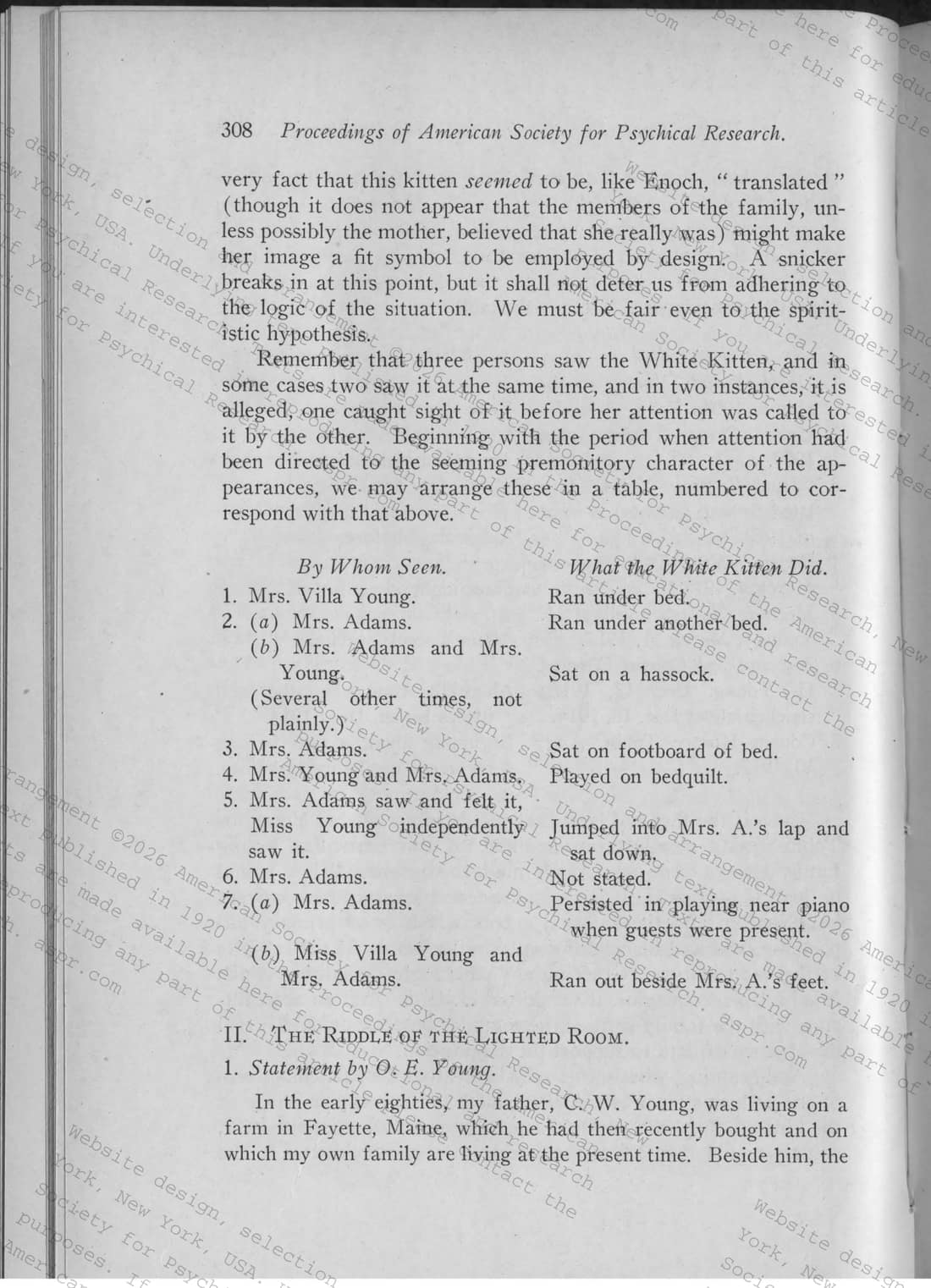
Remember that three persons saw the White Kitten, and in
some cases two saw it at the same time, and in two instances, it is
alleged, one caught sight of it before her attention was called to
it by the other. Beginning with the period when attention had
been directed to the seeming premonitory character of the ap-
pearances, we may arrange these in a table, numbered to cor-
respond with that above.
By Whom Seen.
. Mrs. Villa Young.
2. (a) Mrs, Adams.
_(b) Mrs. Adams and Mrs.
What the White Kitten Did.
Ran under bed.
Ran under another bed.
Young. Sat on a hassock.
(Several other times, not
plainly.)
3. Mrs. Adams. Sat on footboard of bed.
4. Mrs. Young and Mrs. Adams. Played on bedquilt.
5. Mrs. Adams saw and felt it,
Miss Young independently Jumped into Mrs. A.’s lap and
saw it. sat down.
6. Mrs. Adams. Not stated.
7. (a) Mrs. Adams. Persisted in playing near piano
when guests were present.
(b) Miss Villa Young and
Mrs. Adams.
Ran out beside Mrs. A.’s feet.
Il. Tue Riwpie oF THE LicHrEp Room.
1. Statement by O. E. Young.
In the early eighties, my father, C. W. Young, was living on a
farm in Fayette, Maine, which he had then recently bought and on
which my own family are living at the present time. Beside him, the
Experiences Centering in the Young Family. 309
family then consisted of my mother, Mrs. Villa M. Young, my sister,
Katie, then not far from eight years of age, and myself. The house
x was, and is, a typical one-story farmhouse of considerable size, well
" preserved though at that time it had been built something like eighty
: “years. With some people it had the reputation of being i haunted ‘i
: at least that inexplicable lights and noises were sometimes mani-
fested there. Indeed, they had occasionally been observed by mem-
pers of my family. > ae
-__ I was attending school at the Seminary at Kent’s Hill, eight miles
way. My room-mate during the latter part of my course was C. F.
towiand, then of the adjoining town of Mt. Vernon but now of the
we aculty of the Fall River High School. He and I were inseparable
x ‘and were regarded almost as brothers, not only by our families, but
our friends as well. One evening, as was frequently the case, we
"unexpectedly walked to my home in Fayette, arriving there not far
from ten o’clock.
_ My father’s house faced the south and had two large rooms on
~ the front, with two windows on the south in each, and a hall
between. At that time there was a bed in each of these, the east
~ room (toward the road) being occupied by my parents, and the west
one used as a spare one. As Mr. Howland and I came in sight of the
house, perhaps fifteen or twenty rods away, we noticed the west
~ room windows were brightly lighted, all the rest of the house was
F dark, the white cloth curtains were drawn.
; I jumped to the conclusion that there was company at the house,
_ probably my grandmother, and had difficulty in persuading my chum
from returning home immediately, late as it was. I succeeded, how-
ever, and we went in by the door in the east end, finding it unfast-
- ened, as usual.
My parents heard us come into the kitchen and spoke to us. I
stepped to their door, which was open, and asked if my grandmother
i were there. I was told she was not, and, in answer to further in-
quiries, that nobody else was, outside of the immediate family. When
; I declared that there was a light in the spare room Mother told me
* ‘that it was impossible, that they had retired not more than ten min-
utes before and neither she nor father had been asleep.
I had then not the slightest doubt but that the house was on fire,
and probably crossed to the spare room door quicker than I ever did
before, with Mr. Howland at my heels. We opened it and looked in,
PDF page 13
310 Proceedings of American Society for Psychical Research.
but there was only light enough filtering in through the curtains from
outside to show there was no one there. Everything seemed exactly
as usual.
I have no explanation to offer. None of the people mentioned
were Spiritualists, at least at that time. There have been more re-
markable occurrences in the house since, but I select this as one
having several living witnesses, I cannot speak positively of my
sister’s whereabouts on the evening in question as I do not remember
in regard to that, but I presume that she was on the second floor
‘where she usually slept. The light cannot be explained as a chance
reflection as the windows of only one of the front rooms were
illuminated.
O. E. Youne.
2. Corroboration by Prof. C. F. Howland.
_270 Rock Sv, Fai, River, Mass., July 3, 1909.
This certifies that I have read Mr. O. E. Young’s statement num-
bered II, and remember the circumstance perfectly. The statement
is accurate in every particular.
Signed,
Cuaries F. HowLanp.
3. Corroboration by Mrs. Villa M. Young.
The above is true in every particular. My son—the writer—Mr.
Howland and myself being the only living witnesses, as my daughter,
a little child, at the time slept soundly and knew nothing of the ex-
citement occasioned.
Signed,
Mrs. Vitiua M. Younc.
Further Statement by Mr. Young.
SoutH CHESTERVILLE, MAINE, July 26, 1918.
Dr. WALTER F. PRINCE,
New York City.’
Dear Sir:
Your letter of recent date, inquiring, in the case of the unex-
plained lighting up of the windows in the spare room of my father’s
house, seen by my friend, C. F. Howland and myself, if my little
Experiences Centering in the Young Family. 311
‘sister might not have been in there with a lamp, and have exting-
wished it and hurried back to her room upstairs undetected, is at
hand. (Whew! what an involved sentence!) Possibly possible, but
‘I consider that possibility, so infinitely remote as to be entirely
negligible. .
he room being a spare one was not often entered, and I can
conceive of no reason why my ‘sister should have been there late at
night after having retired much earlier. As she was young, about
eight, she always slept soundly in those days.
3 My friend and I were not expected. The farther south windows
were lighted when we turned into the yard, but no others, and our
entrance was from the east. The road runs north and south, so we
went straight to the door. This was unfastened, so there was no
; delay or warning of our coming. If my memory can be trusted—I
certain it can—the door was open for coolness and a newly risen
_ moon was shining on the end of the house, though not on the win-
_ dows that were illuminated.
The hall we entered ran parallel to the only stairway, the two
- doors being at right angles and not over eight inches separate them.
To get to the spare room with a light my sister must have passed the
open door of the room where her mother and father were lying,
within four feet of it. To get back from the spare room upstairs,
she must have walked the length of a twenty-two foot kitchen, passed
- the same door again, and gone the length of the hall by which we
were entering, some eight or ten feet and then have opened and
closed the chamber door and gone upstairs—all this without being
detected by either of my parents or by my friend and myself. All
the floors crossed were bare, and the stairs usually creaked
considerably. All this would have to be done in the dark, itself en-
tirely unnecessary, while we were taking the few steps across the
yard. Moreover, the first notice of our approach was our actual
entrance. This to me is utterly inconceivable. We must have in-
_ evitably met her face to face even if she could have done it in the
dark unheard. Again if the door was open we must have seen her
as she opened the chamber door, from anywhere in the yard. I
would almost be willing to swear that the door did stand wide open.
I forgot to state that no lamp was kept in the spare room. If she
had one in there she must have carried it in and brought it.out in
her hand, extinguished, and fled upstairs with it at railroad speed—
PDF page 14
$12 Proceedings of American Society for Psychical Research.
all without a sound that was heard by either of four people right on
the spot. It is unbelievable.
It is inconceivable that any child of eight years could perform
such a feat without detection, while we were coming in from the
road, opening or at least closing two doors behind her.
After all, my conviction rests more on the known character of
my sister, even as a child. I had never and have never known any-
thing sly, secretive, furtive or deceptive about her. If anybody
wishes to believe she could and did play such a trick he is welcome
to do so. J do not.
Sincerely,
O. E. Youne.
S. CHESTERVILLE, MAINE, July 29, 1918.
In my last, I forgot to give one quite important reason why I feel
certain my sister-had nothing to do with the mysterious light in the
spare room. This is that lights have again and again been seen, both
within and around the house, that could not be explained in a normal
way, seen by many different people, sometimes several at a time.
O. E. Youne.
III. Seeminciy CLarrvoyant (ExtTra-Corpus?) EXPERIENCE.
1. Statement by O. E. Young.
While teaching at Long Island, in the harbor of Portland, Maine,
I think in the winter of 1882 and 3, I had a singular and most un-
usual dream, if dream it could be called. My own judgment would
not pronounce it such, save for the apparent impossibility that it
could be anything else.
I had been unable to fall asleep for a long time; at last I arrived
at the very point of doing so. While midway between sleeping and
waking, as it seemed, I began to be dimly conscious of a succession
of sharp, cracking sounds which, in my half-doze, I hazily thought
was somebody in the kitchen, breaking up box covers to start the
fire; as the people where I boarded kept a store and frequently
burned boxes. Suddenly a heavy thump on the wall behind my bed,
almost over my head, made me broad awake in an instant. I was
fully conscious of the peculiar sound made by the yielding of a lath
and plaster wall, as under the blow of a fist.
Experiences Centering in the Young Family. as
I again lay wide awake for some time, but the sounds were not
‘repeated. I could even tell to-day just what and of whom I was
inking. At last, when beginning to grow sleepy again, I felt myself
ized by both wrists and my arms straightened down by my side,
neath the bed clothes. I did not resist in any way; indeed the
rce being exerted seemed absolutely irresistible. I saw nothing,
ough there was a window within a foot of the bed and the night
not dark. ‘Though a new experience to me, I was not fright-
ed; I remember now that my unexpressed thought was, “So you
t to take control of me, do you? Well, go ahead.”
Parenthetically, let it be understood that I was not a Spiritualist
‘then, indeed am not to-day. I was simply an amateur investigator,
familiar with the claims of Spiritualists and with some of the forms
of alleged manifestation. Furthermore, I was inclined to admit the
partial genuineness of many of them but skeptical as to their cause.
Next I felt myself taken by the shoulders and drawn diagonally
“across the bed, slowly and carefully. As my head began to move
‘off it, seemingly supported in the air, I had not a doubt that a moment
“later would find me actually in space, without visible support—and
then I lost consciousness.
The next I knew I was apparently standing on the platform of a
fairly large schoolroom, and something seemed to assure me it was
the next I would occupy. I marked it careftlly in consequence.
Among other things, I noticed the color of the paint, the number and
‘situation of the windows, the number of rows of desks. I also
noticed the odd fact that a certain number of rows, in a certain part
of the room, were shorter than the others, something I had never
“seen in any school-room. There were several pupils scattered among
the seats nearly all at my left. I counted them, but all I could recall
of that the next morning was that the number was odd between 14
and 20—consequently either 15, 17, or 19. The faces were not
clear like the other details; I simply saw there were a few pupils
there, though school did not seem to be in session. .
Some tall, narrow object obstructed my view at one point ; what
TI did not notice but concluded the next morning, from its shape and
size, must be a stovepipe, though I noticed no stove. Having noticed
this much that I now recall I seemed to lose consciousness again.
When I next recovered I was seated at a large table covered with
a green cloth. On it were lyirig a few loose papers and several
PDF page 15
314. Proceedings of American Society for Psychical Research.
books with brown manila covers. It was evening and the room was
well lighted, but the source of the light I do not remember; I think
I did not notice.
Directly opposite and looking at me was seated a man about
thirty years of age, though appearing older as if he had been dissi-
pated, wearing a black silk skull-cap. His eyes were rather small,
light blue and twinkling; his face was red and marked by fine
wrinkles ; and -he wore a short, reddish full beard with occasional
white hairs in it. He was a stranger to me, though he somewhat
resembled.an older man of my acquaintance. Just around the corner
of the table farthest from him, four or five feet from each of us sat
a third man, apparently studying, as his face was entirely hidden by
a book.
In spite of this fact I seemed to feel positive it was my former
chum and my most intimate friend, C. F. Howland. This young
man had entered Wesleyan University the year before, after trying
in vain to induce me to do the same, but he was then teaching in
the Middletown, (Conn.) High School temporarily.
I noticed this second room was long and quite narrow, not over
ten feet and probably less; I also have the impression that the wall
at my tight sloped part way to the floor, as if under the roof. Be-
yond my full-bearded companion, in the farther end of the room and
taking up most of ‘its width, I saw the foot of an old-fashioned,
yellowish hardwood bedstead similar to one I had often slept in at
my grandmother’s, with a high solid foot-board. Though I do not
actually remember seeing it, I feel certain there was another bed in
the end of the room behind me.
The odd thing about the apartment was that there was an alcove
about midway of it on my right, which might perhaps have been
formed by a large window and which gave the room something of
the shape of the letter T. I could not see into this alcove more than
two feet, but there was a bed made up on the floor of it, for the foot
came out in plain sight. This was covered with a red and white
patchwork quilt. These are all the details 1 remember at the present
writing. (May, 1909.)
The next day I wrote a letter of at least seven sheets of com-
mercial note to my friend Howland, describing my “ dream” most
minutely, I even drew plans of the rooms and located everything I
seemed to see (except the pupils in the schoolroom) not even except-
Experiences Centering in the Young Family. 313
e the position of the windows. I got a brief answer by return mail,
i in tach Mr. H. said he had been greatly interested and astonished
‘by my letter; he would tell me why when he saw me. With this I
d to rest content for the time being. I next saw Mr. Howland in
e June or July following; when he kept his word. He had my let-
in his pocket and offered to return it, but I did not take it and it
no doubt destroyed now. He informed me that I had sent him a
ry exact diagram of his room in the Middletown High ; everything
g precisely as I had described but for the fact that there was an
on post at the exact place where I had marked the supposed stove-
in my plans. Even the short rows of desks were correctly
ced. I think he told me they had previously been uniform, but
e of the front desks had been taken out to put in another and
ore crowded room. I had never been in the state of Connecticut
then, nor have I to this day. Furthermore, I never, until that June
{or July) day, had the slightest information in regard to the room I
‘apparently saw in my vision.
_ ‘The astonishing part is to follow. Mr. Howland told me that
when he received my letter, and for some little time previous, a
-yacancy had been looked for in one of the upper rooms in the Mid-
‘dletown High; that, when it actually occurred, he intended to try for
t himself and to induce me to apply for the situation he would leave
‘to be filled, were he successful. His plan further was that we should
both go back to Wesleyan later, securing a room somewhere and
" boarding ourselves as we had done at Kent’s Hill, taking in a third
man to reduce expenses still more.
E, He recognized neither the second room nor the third man from
my description—neither had he any particular room or person in
“view at the time. As I now remember, the vacancy did not occur
| 2 was expected; at any rate my friend’s plans were never carried
3 O. E. Youne.
pa Corroboration by Prof. C. F. Howland.
— 270 Rock Sr., Fatt River, Mass., July 3, 1909.
: ‘This certifies that the statement of Mr. O. E. Young, numbered
Ill is strictly accurate so far as my part in it is concerned, excepting
"one unimportant detail. I went to Middletown for the first time in
September, 1884. Therefore the letter which I réceived from him
PDF page 16
316 Proceedings of American Society for Psychical Research.
must have been written in ’85 or ’86. I regret that this correspond-
ence is no longer in existence to verify Mr. Young’s statement.
Signed,
Cuaries F. HowLanp.
IV. ‘Tar Rap anp Movine TurKEy WING.
1. Statement by O. E. Young. :
In May or June of 1883 (I think), I was teaching High School
at Monmouth Center, Maine, while my most intimate friend, C. F.
Howland, was teaching another at Monmouth Ridge, about three
miles away. We frequently visited back and forth, and often spent
the night together. re. ae
After we had made a call together one evening I remained over
night with Mr. H. It was probably after ten when we came in, at
any rate the people had retired, but we remained up until after mid-
night talking, keeping very quiet lest we should disturb somebody.
The household consisted of a middle-aged couple who occupied a
room on the first floor in quite another part of the house. I now
have the impression there was also an old lady, either bed-ridden or
confined to her apartment, who occupied the room immediately below
us, but am not certain. Be that as it may, in my numerous visits
there I never saw or even heard a sound from this lady, if such
there were.
Mr. Howland’s room was a typical farm-house spare chamber,
always in most perfect order and perfectly fresh and spotless. It was
of considerable size with bare floors, save for a rug or two, and un-
papered walls, and contained little or no unnecessary furniture, that
little of a plain, solid and substantial sort.
Against the wall and next to the one door stood a hard-wood
kitchen table with the outer leaf up, covered with a cloth. On this,
piled lengthwise against the wall in three piles, were eight books, all
of nearly the same size (about an inch thick). I remember one of
them was Allen and Greenough’s Latin Grammar. Two of the piles
were exactly of a height; the third, next the door, composed of two
books somewhat thicker, was slightly lower. On the pile farthest
from the door, leaning on edge against the wall, there happened that
night to be a large turkey-wing that had probably been used in dust-
ing, an apparently needless task. On this table we had placed a hand
lamp, nothing more.
Experiences Centering in the Young Family. 317
I sat next to the door leaning my left elbow on this table. Mr.
Howland sat in front of it, five or six feet away, and there was a rug
before the table on which his chair stood in part. We had started to
get ready for bed and stopped, and we were facing each other and
‘talking earnestly in an undertone. Suddenly there came a loud
“thump that echoed through the silent house like a blow of a hammer.
BL was startled for an instant, but jumped to the conclusion that my
friend had‘removed a shoe and dropped it on the floor. On recover-
ing I said to him laughingly:
“That was a good one, wasn’t it?”
“JT should think it was,” he answered, in a tone of surprise.
« What was it?” .
“Your shoe, was it not?” I replied. He rejoined that it was on
his foot or in his hand, I cannot remember which, and I then saw
this was true. My impression is that one shoe was in his hand and
the other on his foot.
“Do you know where that was?” he said to me.
: I said no and asked him if he did and he said he did. When I
“asked him where, he answered that it was on his chair as he dis-
“tinctly felt the jar of it.
_ “ Now what was.it ?”
I gave him the. only solution I could think of, that the glue in the
chair started somewhere. He simply stood up and aside and said
#4 to me,
“Make it do it again.” ;
-_ L accepted the challenge and crossed over. Standing the chair
“first on one leg and then another (a hard-wood dining-chair with a
"solid seat) I threw my weight upon the back of it and tried to make
it crack again, but in vain. When I had satisfied myself it could not
F be done, we resumed our seats as before.
We were barely seated again when the turkey-wing began to
- move. It slid slowly along the length of the three piles: of books
4 toward me, still leaning against the wall, a distance of somewhat less
than a yard, wavered an instant and fell over on the table on its con-
" cave side, away from the wall, and lay still.
I thought it a trick of the man of the house, as I knew he was a
joker; so I whirled and opened the door at my right. The hall and
stairs were tenantless and there was not a sound. Next I looked for
Poa string or other method of moving it, but found it guiltless of any-
PDF page 17
318 Proceedings of American Society for Psychical Research.
thing of the sort. Then I examined the wall, but the plastering was
perfect. My impression now is that I turned up the table-cloth and
.moved the rug on the floor.
Mr. Howland watched my investigations, but I do not remember
that he took any part in them. At any rate they were fruitless. I
could find no evidence of any trick, and I never suspected Mr. H.
had any conscious part in the moving of the wing. I know it could
not have been caused by gravity, and it certainly. was not caused by
a jar; there was none.
O. E. Younc.
2. Corroboration by Prof. C.F. Howland.
270 Rock Sv., Faty River, Mass., July 3, 1909.
This certifies that I have read very carefully the statement of Mr.
O. E. Young numbered IV, and can vouch for its correctness in
every detail. It might be well to add that we had just returned from
an evening call at the house of spiritualists, and while we were not
believers in spiritualism, we were intensely interested in the phe-
nomena which we had witnessed, and equally desirous to discover
their cause. We were sitting in my room discussing the subject, and
our mental faculties were abnormally keyed up. My solution of the
mysterious events has always been that we were in such an acute
psychic (or possibly electrical) condition as to exert this influence
over material objects.
It would, perhaps, be well for me to bear in mind that Mr. Young
asked me to vouch for the correctness of his statements, not to at-
tempt to explain them.
Signed,
Caries F. HowLanp.
Mr. Howland’s three statements are the more impressive when
one considers that he has for some years disliked “ dabbling” in
occult matters, and is decidedly unfavorable to spiritism.
The fact of telekinesis, in the last case, he seems not to doubt,
but his ‘‘ solution ” is that the young men were in “ such an acute
psychic (or possibly electrical) condition as to exert this in-
fluence over material objects.” Now in itself the term “ psychic
condition ” or “ electrical condition ”’, is just so much a solution
as the term “biological condition”, ‘kinetic condition”, or
Experiences Centering in the Young Family. 319
‘yortical condition ” would be. Unless some light can be thrown
on the adaptation of a formula to perform the work assigned
it, it is meaningless by itself. And “ psychic condition” is a
so elastic that it fits as little as you please or as much, includ-
spirits ad libitum.
A Trug MepiuMistic PREDICTION.
Statement by O. E. Young. -
In eighteen ninety-one, and for some years subsequently, Hon. L.
T. Carleton, of Winthrop, then County Attorney for Kennebec and
Chairman of the Maine Fish and Game Commission, was con-
ing a somewhat important law case for me. One fall during
time, perhaps in ’93, it became advisable that I should consult
th him at the earliest possible moment.
There was then no direct public conveyance between Winthrop
d my home in Fayette ; even the mail service was such that it fre-
tly required two days to get a letter through, though the actual
stance, direct, was only seventeen miles. So I started by team, the
y being ‘Tuesday. There was not a telephone in Fayette.
_ I found Mr. Carleton away in the woods on a hunting trip—and
eain no connection direct. Mrs. Carleton informed me her husband
ht be back Saturday night, but it was quite uncertain. When I
ked if it were not possible he might return earlier, she answered,
“Oh, no. He said he certainly should not return until then and
might stay considerably longer. ‘The earliest possible time you
see him here will be on Sunday.” She also added something
out Mr. Carleton being all tired out and needing rest.
I returned home, considerably disturbed in mind. That same
ening my sister, Mrs. Adams, who was stopping with me, went
er the alleged influence of her usual control, “ Neverfail”, in the
ence of my mother, Villa M. Young, and myself. She told me,
the broken English usual with many mediums that if I would go
to Winthrop again Thursday I could probably see Mr. Carleton then,
I objected that I had positive assurance that he would not be
me until Saturday night. It was useless ; the Indian control was
bborn, I have forgotten the sobriquet he applied to the attorney,
ne he always called him by, but he answered in substance,
“You go, you see um. He say, ‘ No clear off to-morrow, guess
“me go home.’” (It had been misty and threatening for a day or
two.)
PDF page 18
320 Proceedings of American Society for Psychical Research.
It did not clear off Wednesday, but I would not take a trip of
that length on such apparent uncertainty. Sunday I went down and
Mr. Carleton was at home. I asked him when he got back and he
said, “ Wednesday.”
“ But Mrs. Carleton told me you would not be home till Saturday,
anyway,” I told him.
Mr. C. yawned and answered,
“T did not intend to come till then, but, as the weather was, I
thought I had had enough of it.”
There was absolutely no possible way, normally speaking, .in
which the news of the lawyer’s sudden change of plan could have
reached Fayette, at the time it was declared by what purported to be
a spirit of an Indian, dead for many years, a man none of us ever
saw but once and never knew by name.
O. E. Youne.
2. Corroboration by Mrs. Villa M. Young.
I remember the occurrence perfectly and would say in addition
to the test as given above, the matter was not mentioned to my
daughter until after my son’s return from Winthrop.
Signed,
“Mrs. Vina M. Younc.
VI. Verrpical MEDIUMISTIC COMMUNICATION.
1. Statement by O. E. Young.
One summer, probably that of 1893 or 4, my sister, Mrs. Katie
Adams was living in Malden, Mass., while I was one of the proprie-
tors of Fayette Creamery, in Maine. My sister had quite recently
developed considerable mediumistic power and was frequently con-
trolled by alleged spirit agency, though I had never seen her under
those circumstances at that time. To the best of my knowledge and
belief, she has never accepted compensation for such communications
or even permitted them in the presence of anyone outside the family,
or one or two personal friends in some instances, and has discontin-
ued them entirely for some years on account of poor health.
Both of us being much interested in such matters, much corres-
pondence relative to them passed between us. Finally I wrote her
as follows:
Experiences Centering in the Young Family. 321
“Tf you are really in communication with father, ask him to give
a test for me in proof of it.” 3
In her next letter to me, my sister wrote substantially as below.
I quote from memory, as the letter was not preserved, but am posi-
as to the statements it contained.
“Tam not a test medium but I have received the following, pur-
ing to come from father. You may have it for what it is worth.”
THE COMMUNICATION.
“He says that during the winter mother and I were in Massa-
chusetts, you were teaching on Gordon Hill (in Chesterville, Me.),
and he was living in Fayette alone, one night when you were at home
with him, you and he slept in the sitting-room, in separate beds, you
occupying the one next to Mr. Baker’s. You talked for some time
fter retiring, mostly about your writing, and he asked why you did
‘not get up a lecture and then asked you if you had ever written any-
thing of the sort. :
_ “He says, instead of answering, you got up, lighted a lamp and,
without stopping to dress, went to your trunk out in the entry and
eturned with a bunch of manuscript. This you read to him, after
etting into bed again. He says it was quite long and, as nearly as he
remember, it was about the creation and the end of the world:
t all this does not amount to anything. but that it is the best that
e can do.”
Everything actually happened, exactly as stated, though I had not
thought of the matter for years. Father was always particularly
desirous that I should make a writer. The manuscript referred to
4 was an article on the Nebular Hypothesis, with some speculations as
to the possible fate of the solar system and was written, while I was
rincipal of the High School at Monmouth, Maine, a few months
before I read it to my father, as stated above. I still preserve it.
‘There were more details given, though I have forgotten the others,
_ but all were correct. The last touch about it “ not amounting to any-
thing ” was particularly characteristic, as father always depreciated
anything he did himself, often in those very words.
I do not remember how my sister received the communication ;
_ they used to come to her in several ways. If I ever knew I have for-
gotten. My mother and sister did not return from Massachusetts
PDF page 19
322 Proceedings of American Society for Psychical Research.
until some weeks after the events,mentioned in the message took
place, and my sister was a child of about ten years at the time.
I am positive I had never mentioned that evening’s events to any
living being. ‘They were too trivial, even if I had ever thought of
them again. It is very doubtful if my father ever did, either ; there
seems no possible reason why he should, and quite possibly he, too,
had forgotten them by the time my mother and sister got home, some
weeks later. Gordon Hill, where I was teaching, was less than two
miles from home; so I used to spend Saturday and Sunday with
father, to keep him from getting lonesome, and I also spent every
Wednesday night at home. The communication was received some
three years after Father’s death and about ten years after I read the
manuscript to him.
O. E. Youne.
2. Corroboration by the Husband of the Psychic and by Her Mother,
written by the former and signed by both.
The above is a very clear statement of the test given to the me-
dium Katie Adams by the spirit purporting to be that of her father.
At the time the medium was perfectly entranced, seated in a reclining
chair in our own room, with only Mrs. Young and myself present.
The Indian took control and in the usual dialect said the Big White
Chief wanted a paper and pencil, this being produced I was asked to
write down the communication practically as given above. To show
same to medium when she became conscious and tell her to give it
to her brother in her next letter as the test asked for. Mrs. Young
knew nothing of the matter therein mentioned previously.
G. C. ApaMs,
Mrs. VitiA M. Youne.
3. Corroboration by the Psychic.
I knew nothing whatever of the subject discussed by my departed
father, having never heard him speak of the matter in life.
Katie B. Apams.
This incident is weakened by the fact that the original record
of the words supposed to come from the deceased father was
destroyed, so that memory has to be depended upon. But it is
Experiences Centering in the Young Family. S23
rrengthened on the other hand by the concurrence of four mem-
es that the words were substantially as stated. And there is
ther important consideration, too often neglected. That is
hat even in cases where the memory of one person is the sole
endence, and where that memory is less immediately clear as
details, the memory is often invincibly certain that at the time
the person was struck by the close correspondence between the
yocal or written deliverance and the external facts.
Of course it is open to the reader to suppose that the father
had told Mrs. Adams of the night incident, and that the memory
of it had subliminally survived in detail, in spite of Mr. Young’s
nion that this was unlikely, and Mrs. Adams’s conviction that
‘she had never heard it.
VII. THe Mysterious Hann.
1. Statement by O. E. Young.
In the early nineties I was living on a farm in Fayette, Maine.
Besides my wife and one, or perhaps two, infant girls, my household
sisted of my mother, Mrs. Villa M. Young, my sister, Mrs. Katie
ams, her husband, G. C. Adams, who was working for me, and a
ung man named Zoeth Rich, who had been a pupil of mine in
Portland for several years and was then boarding with me and at
work i in the neighboring creamery.
It may be well to note that I was then making a study of various
“kinds of psychic phenomena, my sister having within a year or two
veloped mediumistic powers sufficient to change my mother from
lifelong Universalist to a Spiritualist. Mr. Rich had also begun
+4 © go under control while with us. Except for my mother, I doubt if
be ey of us really believed in spirit return, even the mediums. My
wife was also mediumistic, but for some reason had taken a violent
P ejudice against everything of that nature.
One evening my mother and I were in my sister’s room with her,
“my wife being alone with the children in another part of the house.
The men had not come in, We had not lighted up, though it was
twilight, for the curtains.of the three windows were rolled high and
e of them faced the west where the sky was still red from the
nset, There was also a little light from the stove. The room was
‘not dusky enough so a person would not have been instantly recog-
PDF page 20
324 Proceedings of American Society for Psychical Research.
nized in any part of it. It was nearly square and approximately
fifteen feet on a side. The accompanying diagram will show our
positions, as well as that of the doors, windows and various articles
of furniture.
We had been talking over some of the recent manifestations, in
which we were all much interested. I was sitting within two feet of
a closet, whose doorway was closed by two thick, garnet-colored cur-
tains. ‘This closet was the width of a door, ten or twelve inches in
depth, with shelves about the same distance apart, from top to the
bottom, each shelf packed solid full of books. It was lined with un-
painted old growth pine boards, running up and down, and backed
against a larger dark closet, or pantry, sheathed in the same way,
but boarded at right angles to the other. There was not even a pin
hole through this wall. The portieres probably touched the shelves
and, as the west window was directly opposite, they were in the best
lighted part of the room.
In a pause in the conversation a hand was suddenly thrust out
between these curtains, a little above my head and almost in front of
me, palm downward, waved as if in salutation and then quickly with-
drawn. I had perfect control of my nerves at the time, unexpected
as was the manifestation, and refrained from the slightest motion,
even the turning of the eyes. It had instantly flashed through my
mind that here was the desired opportunity of finding out whether
our “spooks ” were all imagination or were real enough to be seen
by more than one person at the same time.
“There,” said my sister an instant later, (she was directly facing
the closet and I saw she was looking exactly where the uncanny
object had appeared) “I just saw a little white hand waved between
the curtains of that closet.”
“Why I thought I saw something white there, too,” said my
mother, who was slightly farther off and whose eyesight was some-
what impaired.
Then for the first time, I spoke.
“ Between which shelves ?”
“The fifth and sixth,” answered my sister, after looking again.
It was between the fifth and sixth shelves, counting from the
floor, where I had seen the hand, the portieres, which trailed on the
floor, beginning to separate slightly just above. It may perhaps
Experiences Centering in the Young Family. 325
{ h ave been the fourth and fifth shelves, but at any rate our count was
- the same.
; ;
t 1, 2, 3, windows ; 4, door to kitchen; 5, closet ; 6, door to hall; 7,
“bed; 8, stove; 9, Mrs. Young; 10, Mrs. Adams; 11, Mr. Young.
_ There was no doubt some other furniture in the room, as, for in-
“stance, other chairs. Probably a commode, perhaps a stand or a
4 bureau, but I do not now remember just what or where.
_ The hand appeared to me as large or slightly larger than my
own, (I wear a ten glove) and seemed as real as my hand possibly
could, except it was white as milk. Considerable wrist was dis-
played, but I noticed nothing like a sleeve. No doubt it looked whiter
against the dark curtain. Where it appeared, there was barely room
‘enough for it to be thrust out between the portieres, but neither of
them moved in the slightest degree, nor was there any sound. I
could have easily taken hold of the hand, had I thought of it in
"season, by simply raising my own arm. A year old child could not
have been concealed among the books in that closet, in any position
4 whatever ; hardly, even, if the books had been removed.
_ I might add that a few days later, my sister, under the alleged
control of “ Sitting Bull?” asserted that this was a materialized hand
and that it belonged to him. I expressed doubt as to that, because
“the hand was too white for that of any white man, let alone that of
_ its Indian claimant.
PDF page 21
326 Proceedings of American Society for Psychical Research.
“My hand was whiter than yours,” rejoined the medium, in a
tone of indignation, and the controlling influence ceased.
In a strange place,.among professional mediums or strangers, I
might shout “ Fraud” as loudly as anyone. In my own house, before
my nearest relatives alone—what can I say?
O: E.. Youne.
2. Note by Mrs. Adams.
Sitting-Bull evidently never overcame his indignation at your
remark as I have never felt his influence since that evening.
Katig B. ADAMs.
3. Corroboration by the Other Witnesses.
The materialized hand was seen distinctly by us both. Large and
compelling, its pearly whiteness gleamed against the crimson back-
ground as for one short instant it seemed to beckon us toward the
Spirit land.
Katir B. ApAMs,
Mrs. Vita M. Younc.
4. Note by W. F. Prince.
Note by W. F. Prince in letter to J. H. Hyslop, written from
Pittsburgh, May 5, 1909:
I observe that the position of Mrs. Adams (as described to me
and shown in a diagram), who, as the member of the family exhibit-
ing mediumistic powers, would be the one to be most suspected, if
any, was such as to make it incredible that she could have employed
machinery of any sort. * * * As to O. E. Y., who sat next, I am con-
fident that he wouldn’t, and it would have been a skilful juggler who
could. I examined the closet, which they tell me is unchanged, and
know that no human being could have been concealed in the closet.
It is shallow, and the books must nearly if not quite have touched
the portieres.
VIII. Sreminc RicrprocaL CLAIRAUDIENCE.
1. Statement by O. E. Young, ina letter to W. F. Prince from South
Portland, Maine. May 1, 1909.
I will wind up the crazy letter by one other incident, perhaps a
Experiences Centering in the Young Family. . S27
doubtful coincidence in time, that might show that Mother and I
were sometimes en rapport. It is this.
While at Tenant’s Harbor teaching, I was constantly expecting
pad tidings from her, she was so feeble, though much stronger than
now, knowing the machinery was worn out by forty years of racking
ugh. One night, I think the second winter, or perhaps late fall, if
, three years ago. I was awakened from a sound and dreamless
ep by my mother’s voice calling me, apparently from the foot of
e stairs just outside my room. I think I answered ‘“‘ What ?”, think-
ing it was really she. At any rate I woke up, sitting up in bed with
that idea, waiting to see what she wanted. It was a minute or two
pefore I realized the impossibility of the thing, as I really thought
hen she was calling me. Of course I heard nothing more.
I confess that I was superstitious enough to be a little more anx-
jous than I was wont until I heard from her a few days later, that
e was in her usual (ill) health. The next time I visited Winthrop
happened to remember the occurrence, and told it to my sister after
other had retired. Judge of my surprise when she said,
“ Mother did call you one night last fall, and scared me like every-
thing. I did not know what the trouble was and asked her. She told
e she thought she called you and you answered ; that was all.” No
‘one until then thought either was anything but a dream, so no dates
"were kept. I confess I now believe the dreams were coincidental ;
that she actually called me and I actually answered. If that is super-
stition or insanity, make the most OLdee we = :
Be O. E. Youne.
2. Statement by Mrs. Adams, Corroborated by Her Husband.
One night about eleven o'clock after retiring but before I had
fallen asleep I heard my mother, who slept in the room adjoining
that occupied by myself and husband, call twice.
The first time I could not understand what she said, although she
“spoke loudly enough to awaken Mr. Adams; but the second time we
eard her call very distinctly “‘ Oscar”.
Arising I went to her bedside and asked her what she wanted.
Sitting up in bed she answered excitedly, “T’ve been dreaming about
_ Oscar and called him so loudly I woke myself up; and I never heard
him more plainly in my life, he answered ‘ What ’?”
Mother was somewhat worried over the occurrence until she re-
PDF page 22
328 | Proceedings of American Society for Psychical Research.
ceived a letter from my brother saying he was in his usual health;
and so the matter was dropped, nothing being said to anyone.-
This happened during the fall of the year while my brother was
teaching at Tenant’s Harbor.
Katis B. Y. ADAMs,
G. C. Apams.
3. Corroboration by Mrs. Villa M. Young.
The above account is as I remember it in every particular. I was
much alarmed at the time as I feared my son was ill, but I mentioned
_ the matter tono one. Of this I am positive.
Vita M. Younc.
4. Note by O. E. Young, Applying to Both the Above Certificates.
Above was written without knowing what I had written and with-
out talking the matter over with me. According to my recollection it
was in the winter term, but I was at the Harbor all the year. At any
rate it was the same term, as my sister and I talked the matter over
the next vacation and we fixed the dates approximately. We thought
probably the two coincided.
, O. E. Youne.
IX. CorncipENTAL VisuAL HALLUCINATION.
1. Statement by O. E. Young from Letter to W. F. Prince.
May 1, 1909. Written from South Portland, Maine.
* * * The day your letter reached South Portland, Thursday,
Apr. 15, something happened in the evening. That day, possibly the
day before, I had received the corroborations and the news that the
bad weather was affecting mother unfavorably, as usual, but that
she was gaining quite rapidly otherwise and was a good deal stronger.
At about eight in the evening, Mr. Hill, Ouida and I were seated
in the sitting-room here, around the center table, reading or studying.
Mrs. H. was in the kitchen adjoining, doing her work. I suddenly
looked over to my right, why I do not know, and saw something white
flash along by me toward Ouida, and disappear either in the air or
behind Mr. Hill, who was between us. All of us were nearly or
quite back to the object, if there was one. It looked like an ordinary
white envelope of commercial size, edge to me but below the level of
my eyes when I lost sight of it. It came from behind me, about the
Experiences Centering in the Young Family. 329
Jevel of my shoulder, and moved slightly downward and quite
ra pidly.
I was not frightened in the least, but I was so surprised that I
oluntarily said, “ What’s that?’ Mrs. Hill (outside) began to
ugh and said, “ You’ve got ’em again.” I said I guessed I had and
old them what I saw. We had some fun over it and the matter
dropped.
_ I wear glasses in the evening and it occurred to me the object
‘ight be a reflection from them when I turned my head. I tried in
ery possible way to do it again, but could not. Then a new watch
“charm with a bright, plain back which I was wearing occurred to me
‘and I tried that. No use. I made up my mind my eyes had played
‘me a trick and let it go at that.
When I reached Winthrop the’next evening I found Mother had
been taken much worse that night, (Thursday) or perhaps that after-
noon, and was having strangling spells that night, out of which the
d octor did not think she would be able to come—or anybody else.
Everything goes to show she did not think she would herself, though
of course nobody asked her. Even then I thought nothing about my
“white thing ” in connection with her attack.
_ By Sunday} Mother was easier, and slightly stronger. The chok-
_ ing spells were over, and the cough much easier, and no second
~ hemorrhage had occurred. In the afternoon she told me she had
_ been wanting to see me but she did not expect she would, (though
"when they told her I had come she said I knew she was sick). Mind
_ you, we all positively declared that my coming was accidental, owing
to Monday being Patriot’s Day, fearing the effect on her if she knew
Thad been summoned. Then she added,
“J was sending thoughts after you and Ouida the other evening.”
_ Then I remembered and asked her what evening and she said,
“Thursday or Friday.” I was so upset I thought my little experi-
‘ence was Wednesday and did not find the difference until I came
back and questioned the people here. Asked again Mother answered
_ She did not know sure, but thought it was Thursday or Friday. She
was doped and lay in a sort of exhaustion or stupor except during
_ her paroxysms, so her ideas of time were necessarily somewhat hazy.
Al did not ask or think much about the matter till I got home, as she
was scarcely strong enough to talk much.
When I got here and found it was actually when mother was at
Srl
PDF page 23
330 Proceedings of American Society for Psychical Research.
her worst that I was interrupted, I began to patch out my case;
like this.
Thursday evening about eight o’clock I was—as stated above.
Thursday evening about eight o’clock my mother was expected to
pass over at almost any moment, and probably thought so herself ;
I have no doubt of it. Sunday she told me that Thursday or Friday
evening she wanted to see me and “ sent thoughts after Ouida and
you”. It could not have been Friday evening, as I afterward re-
membered, for she was easier then, though exhausted—and more-
over I was there by 7:30.
Now I believe nothing in signs, omens or warnings, except as
manifestations of the power of mind, in-, ex-, or discarnate. What
I am chewing over is this: are “ thoughts ” things? and did I see one
of those Mother was sending “after Ouida and me?” I have written
to get Katie to ask Mother what she really meant by “ sending
thoughts ”, but she is an invalid and completely worn out, and has
sent me nothing but brief postals since. When I get the sequel I
will tell you.
O. E. Youne.
é
2. Parallel Statement by Mrs. D. M. Hill.
Thursday evening, Apr. 15, 1909, at about 8 p. m., O. E. Young,
who boards with us, was reading by the table in our sitting-room at
Cape Elizabeth, Maine. My husband, Darius M. Hill, and Mr.
Young’s daughter, Ouida, were also reading by the same table, while
Tgvas at work in the room adjoining. Glancing through the open
door to see what time it was, I saw Mr. Young start, look over his
right shoulder and remark suddenly, “ What’s that?’ I asked him
what the matter was and he said something white went by him. I
jokingly asked him if he had “got ’em again”, when Mr. Young
said he guessed he must have, for he certainly saw something white
pass along behind him. Mr. Hill also joked him a little and then the
matter dropped, though I saw Mr. Young look behind him two or
three times as if not quite satisfied. The others were nearly or quite
back to him at the time, and I myself saw nothing unusual.
The next day, Friday, Apr. 16, at about 11:45 a. m., a neighbor
came in to report a telephone message she had just received from a
Mr. Adams, of Winthrop (Maine), for Mr. Young to take the 5
o’clock train for that place, as his mother was very much worse. He
Experiences Centering in the Young Family. 331
Brent away that afternoon in consequence, and did not return until
“Monday afternoon following. \
Ss Mrs. Darius M. Hitt.
3. Corroboration by the Remaining Witnesses.
We, the undersigned, were present at the time and place men-
‘tioned above and heard the conversation spoken of, substantially as
stated.
Darius M. Hit,
Ourwa E.. Youne.
&
4. Corresponding Statement by Mrs. Villa M. Young.
On Thursday evening, April 15, 1909, I was lying in bed, partially
“under the influence of opiates, being very weak and ill.
My thoughts were somewhat wandering but I had been thinking
especially of my son, Oscar E. Young, who is principal of the High
“School at South Portland, Maine, and my oldest granddaughter,
_ who is attending school there.
I felt especially anxious to know how they were getting along and
my last conscious thought was a prayer for my son’s success and
happiness, while my mother love yearned for his presence.
Awhile later my daughter came to the bedside to administer medi-
cine and as she bent over me to manage the pillows I spoke to her of
_ my son and told her I had just been sending love thoughts to him,
This probably took place during the earlier part of the evening.
Vita M. Youne.
_ 5. Corroboration by Mrs. Adams.
On Thursday, April 15th, 1909, my mother, Mrs. Villa M. Young,
who had been ill for some time, grew rapidly and alarmingly worse,
and by night was in a very critical condition. :
For several days previous she had been the victim of severe at-
tacks of the croup which had so prostrated her that she remained in
a semi-unconscious condition, unless aroused.
Probably in some measure this condition was influenced by the
use of mild opiates.
After a particularly bad attack occurring about seven o’clock that
evening she relapsed into unconsciousness. Mr. Adams and I had
j
PDF page 24
332 Proceedings of American Society for Psychical Research.
’ been discussing the advisability of sending for my brother, Mr. O.
E. Young, a teacher in one of the public schools at So. Portland,
Me., in the room adjoining the one where she lay.
About nine o’clock mother had a severe attack of coughing—I
might here add that she had for years been a sufferer from chronic
bronchitis, that the 13th of Dec., 1908, she sustained a hemorrhage,
which with other complications caused us much anxiety. Her age
is 74 years.
After her regaining her breath a little, Mr. Adams, who had been
holding her in his arms, laid her back upon the pillows.
As I bent over her to arrange the pillows more comfortably, she
looked up into my face and in a hoarse, gasping voice, said, “ I’ve
just been sending love thoughts after Oscar.”
Somewhat surprised but realizing how near death she was I asked
her “ If she wanted him,” meaning my brother.
After a little hesitation, she replied, “ Oh, no, I don’t expect that.”
I might add to the above that mother.grew worse rapidly during
the night and the physician gave up hope of her recovery and advised
me to send for my brother at once.
My husband telephoned at noontime Friday, April 16th, and my
brother arrived early Friday evening, finding his mother conscious
for the first time during the day. She had no knowledge that we
sent for him, nor has she now. q
Katig B. Y. ADAMs.
6. Corroboration by Mr. Adams.
The above is an accurate account of the occurrence of April 15th
and 16th.
e G. C. ADAMs.
Ordinarily I would not offer this particular incident for pub-
lication. But since the hallucination was that of one whom I can
vouch for as cool, critical and “ tough-minded”’, it deserves a
place in the group of family experiences. The incident may be
considered one of mere chance coincidence, with the assumption
that the visual phenomenon was due to nerves, reflection from
spectacles, et al. Or it may be regarded as a direct passage of
thought, curiously translating itself into a visual hallucination.
Or it may be conjectured that it was an intelligent co-operating
Experiences Centering in the Young Family. ‘ 333
attempt to get the mother’s message “ through ” which succeeded
jn presenting the symbolic image of an envelope (suitable because
‘it is an envelope which usually contains and suggests a message
from a distance) but got no farther.
X. EXPERIENCES CONNECTED WITH AUTHORSHIP.
1. Preface by Dr. J. H. Hyslop.
The following experiences reported by the same person do not
“have evidential importance of any kind as incidents. They are a part
‘of the general psychological problem in this field. The phenomena
‘are borderland or marginal ones. That is, they are nearly enough
connected with the supernormal as provable to excite curiosity and
far enough away from it to be exposed to the suspicion of subcon-
‘scious creation. It is the peculiarly indicated touch of automatism
‘that suggests foreign inspiration and were it evidential this feature
“would be most important. Any one can write poetry, but few have
“the peculiar experiences which accompany these instances and sug-
gest an alliance with mediumistic phenomena. It is not necessary to
“suppose that the contents have a foreign source. We may suppose
only that the stimulus is from that territory and the contents from
the stores of the informant’s mind. Hence it is not the poetry that
has the scientific interest, but the manner of its production and the
~ main drift of the ideas expressed. We must not forget that these
f cidents are a part of a larger record which indicated rather clearly
some psychic tendencies and, hence, they tend to support the idea that
- foreign influence may often extend far beyond the phenomena that
are evidential. We still require to prove the extent of such in-
~ fluences, and every case in which psychological phenomena of this
kind appear should receive notice until their collective meaning is
_ clear.
2. Statement by O. E. Young.
To begin with, I have always had a great facility in stringing
rhymes since I was nine years old. I have verse enough—jingle, not
" poetry—to fill several good-sized volumes. Some have been pub-
lished and paid for; more printed and not paid for; most of all no
_ eye but mine has ever seen, and probably never will while I live.
< In two instances the manner of writing and the quality of the
PDF page 25
334 Proceedings of American Society for Psychical Research.
product have made me wonder if it were really my work. This at the
time. I had the same thought in another case a day or two after.
The first was in the winter of 1881 or ’82, when I was principal
of a grammar school in Portland, Maine. I had been reading poetry
and had been struck by the abrupt changes of meter in Tennyson’s
“Maud”, resolving to embody something like it in my own work
later. I had been also much impressed by an insane character in a
long blank verse poem, I think Shelley’s work, though I have not
looked it up. Whether these facts account for what followed ot
may decide—if worth while, and you can.
Two or three nights later I was aroused by raps all around bie
room, at what hour I do not know. A poem (compared to my
ordinary work) was instantly born complete, full grown and full
armed, like Pallas from the head of Jove or the hatching of a bumble
bee. The impulse to get up and write it was almost irresistible. I
should have, but the house was extremely cold, the only fire in it
being in the distant sitting-room, with my entertainers sleeping in a
doorless closet adjoining, without even a portiere between. I think I
could have dictated the whole thing with scarcely a hesitation at the
time. I would not get up and finally, it seemed hours later, I slept
again.
For the two days next following, I put every minute in on it, that
could be stolen from school work. It was the most ambitious, and I
think the best, that I had done up to that time. I afterward included
it in a little volume I published, burned before it fairly left the press,
though a very few copies were sold previously. I am told a first-class
elocutionist in or near Boston was using it as a main number of his
entertainment a short time after.
When I began on it my remembrance was very vivid, many of
the changes and rhymes and the whole thread of the story being
perfectly distinct, and by the time it was two-thirds written only the
vague outline was remembered. Nevertheless, so much of it was
then written, I had no difficulty in completing it.
little before publication, but not much.
David Barker, that perhaps
It was revised a
I have often thought with
“That was Bob Burns’s spirit hand
On my machine ”—
or somebody else’s.
Cape Elizabeth High School.
Experiences Centering in the Young Family. 335
The next was when I was principal of the South Portland and
One morning I had just five minutes
pefore I should have to leave my boarding-place to be in time to
open school. I was alone in the sitting-room, though Mrs. Hill, my
-poarding-mistress, was at work in the kitchen adjoining, the door
being open.
“my eye.
‘book was open once through, and the meter struck me as a pretty
An open volume of gospel hymns on the organ caught
Picking up a cornet, I played the air of the piece where the
one for a jingle.
“Not time”, I thought. (I had just looked at my watch.) I
"played it through again and the first line flashed through my mind,
but nothing more.
Dropping the cornet, I seized a rocking chair, sat
_ down to the center-table, snatched a piece of paper my daughter had
been solving an algebraic problem on the night before, and wrote
down the line in order that I might remember it, but not intending
to do more then, as I felt I had not the time.
T dashed off the first stanza and two lines of the second without
a break, punctuating as I went, though that is something I never
bother with in the first draft ordinarily. Then I stopped—dead.
_ My head was utterly empty of ideas.
The next I realized I was brought back to earth with a bounce by
Mrs. Hill, calling out from the other room,
“ Where are you, anyway ?” »
As a matter of fact I was staring fixedly at the ceiling and rock-
ing furiously, though I had not the slightest realization of it before.
- bird-song floats,” read “There’s a song floats down,”
Mrs. H. was staring through the open door in astonishment.
“Up in the air somewhere,” I answered.
“T never knew you to rock before in my life,” she said.
“T don’t know as I ever did,” was my reply, and I caught up the
paper and finished the lines, without break or hesitation, punctuation
and all, except that in the original the line beginning, “'There’s a
a smoother
rendering, but it seemed to me afterward that there might be some
doubt in the mind of a possible reader as to what kind of a song was
meant. The meter is like that of the hymn suggesting it, except there
are five lines to a stanza, instead of four.
I looked at my watch before taking the cornet from the case and
again when I started for the school-building. I put the horn back in
the case after playing the hymn through twice. Including the period
PDF page 26
336 Proceedings of American Society for Psychical Research.
[when] I did not realize anything at all and the conversation with
Mrs. Hill, the verses must have been written in less than three min-
utes. I had never thought of anything like it before, it is foreign to
my usual line of thinking, and the style better than mine is ordinarily.
Now could anyone, even a poet, write a final draft of verses no
longer than that, even no better than that, at the same time building
from the ground up in that time unassisted ?
“Exhibit B ” requires explanation. I stopped with my sister for
about a week, in October, almost a year after Mother died, the first
time I had been there after the funeral. I slept in her room, the one
she had occupied before she became too feeble to climb ‘the stairs.
Everything in it was as she left it, I think is today, and she had said
she didn’t want everybody sleeping in it. In consequence, no one has
slept in it but Cousin Addie and me. Addie had to ask Mother to
stop the manifestations the first night, and afterwards slept in an-
other room. I expected something, as Mother promised me to come
back the last time I ever saw her alive—yet I got nothing, tho my
sister saw her go upstairs the first night I was there.
I am troubled by insomnia and write much while in bed, sleepless.
That first night I wrote the lines, “ My Mother’s Room,” the origin
of the idea being self-evident. ‘The next night I wrote “Errata.” I
never thought of the previous lines or connected the two in any way,
though I was thinking of Mother at the time. I showed both to
Katie a few days later and something in her smile caused me to take
the two and compare them. ‘Then I first saw the second might be
taken as a response to the first, and there might also be in it an
allusion to the fact that I had acted as one of her pall-bearers at her
own request. Those things my sister noticed on the instant.
Pardon such long and rambling communication. When I get a
sympathetic listener I do not know when to stop. I will close by
saying that in the actual composition of the sonnet there seemed
nothing unusual at the time; also that of late I am having cases
similar to the first two mentioned, involving not only the words, but
the music for them also. I can neither sing nor play, except very
indifferently on the cornet, and know nothing of harmony save what
I have picked up by myself since the tunes began to come.
Very truly yours,
O. E. Youne.
Experiences Centering in the Young Family.
AT EVENTIDE.
There’s a light that shines in the sunset skies,
Where the dying rays of the day-god be,
And the beam that fades and the hue that flies
Are the types of a glory that never dies—
There’s a light in the west for me.
There’s a bird-song floats from the clouds above,
Faint and sweet as those of the angels be,
Coming back to earth like a homing-dove,
A message of beauty and joy and love—
There’s a song in the skies for me.
There’s a hint of morn in the sunset red,
A pledge of the dawn that is yet to be,
A promise sweet, from the day that’s dead,
Of a day to come when the night has fled—
There’s a hope in the heart for me.
337
Cape Elizabeth, Maine, April 12, 1909.
MY MOTHER’S ROOM.
This is the room in which she slept for years,
And this the-cot on which her limbs she laid.
These are her pictures on the walls displayed.
Here is her chair; her bureau there appears,
Her books and trinkets on it still. My ears
Almost expect to hear the voice that prayed
Within these walls for me—for here arrayed
Her household gods I see. I note with tears
That she alone is gone. But—is she gone?
Or does her blessed spirit hover near
The boy she bore and fondly cherished here,
To cheer and comfort still? Ill learn anon;
Now I but know beside a sunlit sea
Some day I'll find my mother waiting me.
Winthrop, Maine, Oct. 27, 1913.
ERRATA,
You say I’m gone because you see me not,
Because my form is underneath the mold,
The withered grasses and the marble cold.
You think I’m dead because in earthen plot
You laid what once was I—that sodden lot
You dream imprisons me. That I grew old
And met the fate of age, your fancy bold
Too rashly still declares. Your every thought
Concerning me is wrong. Not old am I;
I’m young again. My age has dropped away,
A mantle cast aside. No cell I fear;
The universe is mine. Death passed me by;
I never lived till now. Oh never say
That I am gone; I am not gone—but here.
Winthrop, Maine, Oct. 28, 1913.
PDF page 27
338 Proceedings of American Society for Psychical Research.
XI. Apparitionar APPEARANCES.
1. Prefatory Note by O. E. Young, ina Letter to Dr. Hyslop, Dated
June 21, 1919.
I have secured a statement from both my aunt and cousin in
regard to apparitions previously mentioned to you, presumably of my
late mother. ‘The sketches are not to scale and hastily drawn from
memory, being merely designed to show the general features of the
places where the appearances took place. Katie has seen Mother,
and heard her speak many times, much more distinctly than at the
time mentioned in her statement sent you earlier. At my request,
she described that as the only time when there was any corroboration.
2. Statement of Mrs. Addie Young Carter, Taken Down May 3oth,
1915, by O. E. Young and Afterwards Approved and Signed.
(Addie Young Carter’s signed account of certain manifestations
apparently made by the Spirit of her aunt, Villa M. Young. Tran-
scribed May 31st, 1915, from notes taken from her own account the
day previous, by O. E. Young.)
In April, 1913, my aunt, Villa M. Young, having died on March
11th preceding, I was visiting my cousin, Katie Young Adams, at
Winthrop, Maine. I had gone partly as company for her in her
trouble, partly to take care of my aunt’s things because Katie did
not feel as though she could do it herself.
I had been washing some of my late aunt’s clothing and was
hanging them on the reel in the yard one day shortly before dinner.
I was just hanging out the last piece, a light-grey every-day house-
dress of hers, when I suddenly had an impression there was some-
body behind me. ‘Turning quickly, I saw Aunt Villa as plainly as I
ever did, standing on the piazza and looking at me, not more than
two or three rods away.
Cees ee
Dor
window Window Window
SC tps
i Experiences Centering in the Young Family. 339
She had one hand raised and resting against a piazza-post and
looked precisely as she had in life; my first impression was that she
was actually there in the flesh and to go and speak to her. When she
saw me looking at her she nodded and smiled at me, but did not
ak. I stood looking at her, possibly for two minutes; then she
ed from me and went to the rear of the piazza, seeming to grow
distinct as she did so until I lost sight of her. I am not certain
ether she went out of sight around the corner or simply disap-
peared; I do not think she went into the house.
Aunt Villa had on a light-grey dress; it might have been the
counterpart of the one I had just hung on the line, though I did not
notice it particularly at the moment. I do know she had on a little
white apron with a bib, for I remember how it was trimmed, and I
m positive about the black, coarse-meshed covering she had tied
over her head. I had never before seen Aunt Villa wear anything
of the sort.
As soon as my aunt went away I returned to the house and looked
at the clock; it was just eleven. I then told my cousin just what I
d seen, describing the appearance of the apparition minutely, es-
pecially the rather unusual covering upon the head.
“Was this it?’ asked Katie, producing part of a small, black
crocheted shawl.
It was; there was not the slightest doubt about it. Katie then
told me Aunt Villa had been in the habit of sitting in the sun on the
‘piazza during the warm winter days, even after she got very feeble,
as there was a sheltered nook by the front door, and she had always
_ wrapped that piece of shawl about her head and face for protection
_ from the weather.
Although I was naturally thinking of my aunt at the time, I never
dreamed of seeing her, as I had always been a strong disbeliever in
‘such things. That was my first, and perhaps my only experience of
' spirit-return in visible form, though once afterward Katie and I saw
-a shadowy form where no living person could possibly be. This
“made less impression on me, as it was much less distinct, and I do not
‘clearly remember the particulars now. I have since heard my
"father’s voice and felt his presence, but I never have seen him. 1
have also heard Aunt Villa’s well-remembered cough, a rustle as of
a skirt and a sound like the opening and shutting of drawers in her
room.
PDF page 28
340 Proceedings of American Society for Psychical Research.
The first night I slept in Aunt Villa’s room ‘upstairs, I was awak-
ened by the bumping up of the bed spring beneath me that brought
my foot out upon the floor and the bed-coverings with them. I re-
placed the quilts and got into bed again, when almost immediately
the same thing happened again. When the manifestation took place
for the third time, I caught the back edge of the spring with both
hands. It slowly rose until I was on my knees by the side of the bed
with the quilts once more beside me, still holding the spring with both
hands, apparently standing on one edge (it was a narrow bed)
though I could not see anything and I afterwards found the pillows
and mattress in place. When I let go, the spring slowly dropped
back into position, all this without a sound.
Considerably alarmed by this time, for I had-at last concluded
there must be someone in the room, I lighted a lamp and made a
thorough search of both it and the closet, not forgetting to look
under the bed, but there was nothing unusual to be seen, except the
bed clothes on the floor to prove I had not been dreaming. I looked
at my watch and it was just midnight. Convinced at last I said,
“Tl do anything you want me to by daylight, Aunt Villa, but
I’m tired now and want to go to sleep.”
Then I once more put the bed in shape and lay down, leaving the
lamp burning, and nothing unusual occurred during the rest of the
night, nor has anything of the sort taken place since then.
My cousin Katie and I attribute all these manifestations to a
conversation I had with Aunt Villa about a year before her death.
In answer to some remark of hers, I told her I had not the slightest
belief in spirit return,
“You do not believe it?” she said.
“T certainly don’t,’ I responded. -
“You will sometime,” she said with a smile, then I asked her
to come back to me in case I outlived her—and it certainly seems as
if she had.
I forgot to state that at nine o’clock the next morning after I saw
Aunt Villa on the piazza, I got a letter from mother at East Liver-
more asking me what I was doing at one o’clock the day before. So
nearly as I could tell, I must have been taking in my aunt’s clothes
from the reel in the yard. Also, I knew it was always Aunt Villa’s
custom to change her dress after dinner.
ADDIE YOUNG CarRTER.
Experiences Centering in the Young Family. 341
3. Statement by the Mother of the Foregoing, Mrs. Gustie M. Young.
Taken Down by O. E. Young, on May 3oth, 1915, and —
wards Approved and Signed.
_ (Gustie M. Young’s signed account of an apparent “instance of
‘spirit return. Transcribed June 1st, from notes taken fronr her ac-
count of it told May 30th, 1915, by O. E. Young.)
In April, 1913, about a month after the death of my husband’s
brother’s wife, Villa M. Young, at Winthrop, Maine, I had a curious
experience at my home in East Livermore.
Villa and I had always been close friends and had lived for some
time after my marriage in the same house, my present home. My
daughter, Addie Young Carter, was visiting Villa’s daughter, Katie
Adams, at the time the event I shall try to describe took place.
Just after dinner one day I went out by the back door and down
behind the house to the corner of the field to get the sap from a
Maple tree standing just inside the wall by the road, almost in front
of the house and not more than three or four rods away. As I
stooped over to empty out the sap into a pail, I felt someone take me
firmly by the right wrist, though I had not heard a sound previously.
The hand grasping me felt cold. Startled, not frightened, I straight-
ened up abruptly, to see my old friend Villa standing beside me.
Back door
Dost
F Drivt Applstvec.
¢
woy.
Locust &pplet. . cose wall
ee
She wore a dark dress and a small white apron with a bib, with some-
ing dark tied over her head that looked like a small knitted woolen
‘Wrap or shawl.
_ “Ts that you, Villa?”-I asked, though the question was unneces-
Sary; I could not doubt her identity.
“Ves,” she answered, smiling. “I am glad the girls can be to-
gether this week and they are doing just what I wanted them to do.”
PDF page 29
342 Proceedings of American Society for Psychical Research.
“Tam glad, too,” I responded. ;
Then Villa turned around and walked away, just as any being of
flesh and blood might have done, between two sweet apple trees
bordering the field, across the yard by the locust, into and down the
road. I stood and watched her until she disappeared behind the
bushes at a curve in the road, perhaps ten rods away, and I remember
thinking she must be going to see Eliza Turner, a favorite cousin of
hers then living at the next house, only a short distance away but
out of sight.
I went straight back into the house and looked at the clock, which
pointed at the hour of one. Then I sat down and wrote to my
daughter at Winthrop, asking,
“What were you and Katie doing at one o’clock to-day ?”
This letter I took pains to mail that same afternoon.
Although the sun shone that day it was not very bright, but some-
what hazy. I was not thinking of Villa at the time she appeared to
me. She must have followed me down from the house as I should
have been certain to see her had she come by way of the road, from
either direction. She looked and appeared just as she always had
during the latter part of her life.
I have several times seen deceased relatives and friends, five or
six different persons in all, this being perhaps the second instance,
always in the daytime except once. Villa was the first of them to
actually touch or speak to me, though I have heard my sister Mary
walk and cough.
Gustiz M. Younc.
Aunt Gustie was a Young, a distant relative. She and Uncle
Joseph were second or third cousins of ours.
O. E. Youne.
Some of the points especially to be noted are: (a) The prom-
ise and prediction by Mrs. Villa M. Young before her death in a
conversation with her niece, Mrs. Carter. (b) The vividness of
an experience which permanently converted ‘a strong disbeliever
in such things.” (c) The consistency between the apparitions,
remark about what the girls (the letter written at once to Mrs.
Carter asking what she and Mrs. Adams were doing at that hour,
shows to whom “ the girls” was understood to apply) were doing
Experiences Centering in the Young Family. 343
and the fact that two hours earlier she had appeared where the
girls were and been seen by one of them. (d) The ignorance on
the part of Mrs. Carter (and probably of Mrs. Gustie Young,
also) of the fact that Mrs. Villa M. Young had been accustomed
during the latter part of her life and when out doors, to wear a
head-covering such as seen by both on the apparition. (e¢) The
identical or strikingly similar description of head-covering and
apron as seen by the two women in different places respectively at
—_— A.M. and one P.M. (f) The consistency of the difference
in the dress, as seen by the two witnesses, with the fact that Mrs.
Villa M. Young had been accustomed to change her dress after
[noon] dinner.
XII. A Comnciwenrar Experience.
Mr. Young reported that a son of his had had a peculiar ex-
_ perience, nearly coinciding with the death of a friend of his, and
_asked the date of his last letter to the Society, in order exactly to
‘fix the date of the experience, which he now relates again. As
_he says, “ there is nothing absolutely to connect the death and the
_ dream, but they certainly come near enough together to be sug-
gestive.” The fact that the boy killed at about the date of the
experience had often slept with Carleton in that bed gives color
to the incident. (The first account has been lost in the files. )
w, F. Princr,
New York.
Dear WALTER:
Thanks for your promptness in answering my query. I thought
that was the date but the little girl stuck to it that it was a week
€arlier. That fixes the date of Carleton’s experience on the night of
July 28th. The girls were bound to have it on the 21st.
_ The possible significance of the date arises from the fact that
Oscar Nichols, of Chesterville, son of our nearest neighbor 1n that
‘direction, about Carleton’s age and for many years his most intimate
_ friend, was killed in the battle of the Marne, July 20th. His father
was notified by telegraph early in August, and the death was pub-
lished in the paper a day or two later. Carleton got the news first
here by telephone, I should say now August 3rd (on or about).
SouTH CHESTERVILLE, Maine, August 11, 1918.
\
PDF page 30
344 Proceedings of American Society for Psychical Research.
Young Nichols used to be here a good deal a few years ago, and
often slept with one or both the boys in that same room and bed. Of
course there is nothing absolutely to connect the death and the
dream (?) but they certainly came near enough together to be sug-
gestive. Had the girls been right the coincidence would have been
more striking.
I have questioned the boy quite closely. He says he woke up,
broad awake in an instant which I know from sad experience is very
contrary to his custom. ‘When he felt some one press down on the
bed, his first thought was that it was his mother up for something,
“pawing around,” as he expressed it, that is, feeling her way about
in the uncertain light—but she was not up. When the hand dis-
solved, as it were, he said he was “ startled a little,” and sat up and
looked around and there was nobody there. He declares it was light
enough so he was sure of that fact, though what became of the hand
he was holding, he can not tell. Whether he himself attaches any
significance to the queer happening, I do not know. He is on the
eve of enlisting.
“There are more things in Heaven and earth,” etc.
Yours hastily,
O. E.. Youne.
The incidents which follow were printed in the Journal, IX,
572-584.
General Preface by Dr. Hyslop.
The following incidents must tell their own story. The first
one will seem quite gruesome to most people who may interpret it
as evidence that the mother was not really dead and was endeavy-
oring to speak. ‘The circumstances rather militate against that
view, to say nothing of the hypothesis of hallucination, whether
subjective or veridical. This phenomenon of superposing an
hallucination on the personality of the living is not uncommon in
mediumistic cases. Mrs. Chenoweth has done this several times
in my own case, seeing a face or part of a face superposed on
mine. Supposing in the present instance that the deceased mother
was trying to communicate in the form of speech the vision of her
doing so might well enough be the subconscious production of its
apparent reality, especially if the person seeing the apparent event
Experiences Centering in the Young Family. 345
is mediumistic, and the fact that the informant had other super-
al experiences shows rather conclusively that this informant
psychic. The experience, however, is certainly quite unique.
e fact that it was collective tends strongly to support the inter-
pretation which I have given it.
The remaining incidents are of recognized types.
XIII. Contecrive Quasi-VisuaL PHENOMENON.
Collective Statement.
Winthrop, Maine, March 13, 1913.
On March 12, 1913, while standing beside my mother’s form,
‘about thirty-six hours after she passed away, I placed my left
hand on her forehead for a brief time. If human eyes are to be
‘trusted, her eyelids flickered, her lips fluttered noticeably and parted
as if she were trying to speak; then everything became precisely as
before. The undersigned severally believe they saw these things
actually take place.
: O. E. Youne,
Katie B. Y. ADAmMs,
Jennie E.. Gorpon.
I have read the foregoing and can say that the same thing
happened when I was combing my aunt’s hair a little earlier in the
ey.
Appig Y. CARTER.
2. Statement by O. E. Young.
| Sourn Cuestervitte, Marve, March 14, 1913.
Dr. James H. Hystor,.
_ Dear Sir:—Something new and very interesting to me occurred
day before yesterday and I am forwarding the enclosures on the
“chance they may be of some interest to you. There is a brief state-
‘ment of the facts, signed by myself, my sister, my cousin, and the
‘nurse procured by my mother’s physician, Dr. C. W. Taggart, of
Winthrop, to care for her during her last days. The signed state-
ment is brief, as it was hastily written during preparation for the
funeral, at ten o’clock yesterday. I have also added a fuller account
which was written today.
Would it be too much to ask you to kindly return the brieter
ba
iy
Sa ee
PDF page 31
346 Proceedings of American Society for Psychical Research.
statement after reading (or copying should you do desire)? I value
it highly.
I also enclose an account of a peculiar dream which I wrote out
at the same time I sent you an account of some other psychic phe-
nomena some years since. I held this back, waiting for confirmatory
data promised me by Mr. Rich’s daughter, when she could hunt over
some old letters, but which has never come, for some reason. She
did write once, giving the exact date of her father’s death, but little
else that was evidential. Even that letter I seem to have mislaid.
But for the fact that I was sending the later account I should not
have bothered with this.
Sincerely yours,
O. E. Younc.
March 1, 1913, my mother, Mrs. Villa M. Young, passed over
at Winthrop, Maine, at 5.30 A. M. On March 2, probably between
4 and 5 P. M., I first saw the remains, in the presence of my sister,
Mrs. Katie B. Y. Adams, arid mother’s nurse, Mrs. Jennie Gordon,
of Monmouth, a perfect stranger to the whole family scarcely a
month before.
Mother was lying with her face directly in front of the open
window, not two feet away and the only one in the room. Though
the blinds were closed her hair and forehead were well lighted up.
The side of the face toward me was in shadow, but the profile
showed clear cut as a cameo against the snow outside, for I could
see it between the slats of the blinds as the face was directly between
it and my eyes. My sister stood at my right with Mrs. Gordon next,
’ nearer Mother’s feet.
After a moment’s conversation I suddenly felt as if Mother
wanted me to touch her and would know it if I did. Obeying
the impulse, I laid my left hand lightly on her forehead, leaving
it there possibly two minutes, in spite of the icy chill of physical
death. When about to withdraw it I was astonished to see the
pale lips part and flutter, as if whispering or under the influence
of some powerful emotion. A movement of the tip of the nose
was even evident—and this in a direct line with a snowbank and
before a window I could have touched by leaning forward.
Thinking my eyes must have deceived me, I winked rapidly to
clear them of an imaginary obstruction and examined the pale face
Experiences Centering in the Young Family. 347
still more closely. As I did so it again became fixed and motionless ;
the poor drawn lips tightly closed in the same slightly unnatural
Tiition I had marked when I first viewed it. The whole thing was
so utterly unbelievable, to me so unheard of, that I at once decided
it was only an unusual form of hallucination, said nothing, removed
my hand and quietly left the room.
That night, between eleven and twelve, the nurse having retired,
my sister suddenly asked me if I had seen anything unusual when
we were with Mother that afternoon. With perhaps a slight hesita-
F on, I answered, “ No.” ‘Then, after considerable urging, she told
me Mrs. Gordon had come to her during the evening, saying she had
s seen Mother’s lips and eyelids move, as if about to open, while my
hand was upon her forehead, and asking if she had seen it too.
“ And,” added Katie, “I had. The undertaker had had consid-
erable difficulty in making the eyes and mouth stay perfectly closed,
ind my first thought was one of fear that they might be yoing to
come open again.” ~
At the first opportunity the next morning I myself called Mrs.
Gordon aside and asked her if she had seen anything unusual, With
a smile she answered, “ Yes.” When I asked her what, she said,*
1 thought she was trying to speak.”
. I have never been a Spiritualist, but I have been an amateur
investigator for thirty years. I have no fears of the weird or the
so-called supernatural and I have never yet lost my nerve—nor did
] then. I was expecting nothing unusual ; nor had I ever seen, heard,
read or dreamed of anything at all similar. I decided the whole
hing was a freak of the imagination, and, if the nurse had not
Be atacity brought the matter up, it is not probable either my sister
or myself would ever have mentioned it.
Perhaps I should add, however, that Mother, at my request, had
Several times promised to return to me after death if possible, as
she herself believed. Several others have made me the same promise
hout fulfilling it, at least conclusively; nevertheless I had half-
ieved she might be able to manifest her presence in some way.
Still I never should have expected it so soon, nor in open day at any
time ; moreover I had not even thought of anything of the sort after
hearing that Mother was through with pain and trouble.
In one of her last letters to me, Mother wrote these words,
PDF page 32
348 Proceedings of American Society for Psychical Research.
“ Have no fear; Mother will come back to you.”
Did she?
O. E. Younc,
March 14, 1913 (Prin. Mt. Vernon High School.)
In saying that the phenomenon was “ certainly quite unique ”
Dr. Hyslop must have employed the word “ unique ” in the popu-
lar sense of unusual, for by his own showing mediums not in-
frequently have experiences which are essentially parallel. If the
incident were really unique in the records of mankind, I for one
would be suspicious of it, in spite of the testimony. What hap-
pened was probably essentially what happened when the members
of the Jewish Council looked upon Stephen, about to be mar-
tyred, and “all * * * saw his face as it had been the face of
an angel.” (Acts 6:15.)
The peculiar strength of the testimony is in the fact that all
three witnesses had the same impressions without the possibility
of suggestion entering as a factor, since all remained silent at the
time. Mrs. Adams had her independent experience, but did not
mention it until Mrs. Gordon related hers with the question
whether Mrs. Adams had seen it. Mr. Young had pondered over
his identical impression, not knowing that it had been shared, and
had decided to set it down as “ only an unusual form of hallucina-
tion.” He even denied having experienced anything unusual until
he had with difficulty extracted his sister’s story.
I would like the psychologist who has all his data docketed
and pigeon-holed, to try his hand at a “ normal” explanation.
The telepathic one would have its difficulties as applied to this
case, but aside from that, telepathy is not “normal” and is re-
jected by nearly every psychologist who has closed his mind to
the evidence for spirits. Would any be bold—and credulous—
enough to urge that the facial expression of the first to have the
impression suggested the same to the other two? I would like to
try some experiments with an actor of the facial capabilities of
Garrick, and discover just what expression indicates seeing the
eyes of a corpse flutter and its lips move as if “ trying to speak ”!
XIV. ParriaLLy CoincipentT Dream.
From Mr. Young's Letter of March 14, 1913.
During the winter of 1881 and 2, I taught in the grammar school
Experiences Centering in the Young Family. 349
at Long Island, one of the wards of Portland, Maine. For each of
eight successive years, save one, thereafter, I held the same position
for from one term to a full year. All that time I boarded with the
family of Zoeth Rich, becoming much attached to all of them and
they apparently thought a good deal of me.
On Saturday, Oct. 2, 1905, I went to Tenant’s Harbor, Maine,
beginning my duties as principal of the high school there on Mon-
day the 4th. At that time I think I had neither seen any of the Rich
family nor heard from them directly for two or three years. Some-
time during that. first week of school, the exact date I do not re-
-member, I had this very vivid dream:
I seemed to be standing on a platform of some sort, elevated
somewhat above a sheet of water. On waking, I could not tell its
‘size or shape, but could think of nothing but the deck of some sort
_ of vessel, though there was no rail or anything of that sort between
me and the water. This was smooth as a mill-pond and intensely
blue, and it was evidently flood tide. Some distance away a point
‘ran far out into the ocean, wooded to the water’s edge with a growth
of small evergreens. The whole scene was intensely brilliant, as if
lighted by a full blaze of sunlight, and was very beautiful.
As I looked, a small boat slowly drifted away from whatever
‘I was standing upon, side to the current, and I saw its single occu-
‘pant most distinctly. He was standing motionless amidships, gazing
fixedly toward the bow of the dory, his face in consequence turned
_ toward me in profile. He was dressed precisely as I had often really
~ seen him in the past—for it was Mr. Rich.
As the boat drifted from me, steadily gaining speed as it went,
‘I looked to see its solitary passenger take up the oars and swing it
head on with the current, yet he did not move. Instead he stood
‘silent and motionless as a statue, though the boat was moving more
‘and more swiftly with every instant. In my dream I wondered
greatly why as experienced a fisherman as I knew Mr. Rich to be
‘should seem so utterly oblivious of the situation. Then [.grew
alarmed and tried to warn him, but I could not do it; I could not
€ven move. I seemed completely paralyzed with the horror of it.
Faster and faster with every instant the dory swept onward, and
still I could neither move nor cry out; I could only watch and wait
_ for the inevitable. I saw the boat strike on the shore of the opposite
~ point at almost railroad speed, crush like an eggshell and sink be-
PDF page 33
350 Proceedings of American Society for Psychical Research.
neath the smooth blue water like a stone. The instant it struck upon
the rocks, both it and its occupant vanished utterly, as if they had
never been. The blue of the water and the vivid green of the shore
were solitary and deserted, calm and beautiful as a painted sea and
shore. One can imagine how I felt, for the dream-picture could not
have been more real to me had I seen it with waking eyes.
The next week I received a letter from my wife in Fayette,.in-
closing one to me from Hattie Rich of Long Island, Mr. Rich’s
younger daughter. She wrote to inform me of the death of her
father on Oct. 2d, the day I left home.
As I neglected to preserve this letter I cannot fix the exact date
it was written, but I know I thought at the time it must have been
nearly or quite coincident with that of my dream, though even then
’ Thad forgotten just what night of the week it had occurred. This
was the only dream I ever had in which any of the Riches figured ;
indeed I am far from being an habitual dreamer. Neither had I
thought of any of them for weeks.
Miss Rich’s letter went, I fancy, to my address before rural
deliveries (North Fayette), and from there to South Chesterville,
my address at that time. As I left home on two days’ notice, my
actual whereabouts was unknown to the postmaster ; so it must have
waited till some one called for it, perhaps two or three days. Again
it waited until my wife wrote to me; so I figure it must have been
written on the day when I had the dream at night. I know I thought
so at that time.
THE SEQUEL.
Christmas week of 1906, I again visited the Rich family. I told
Mrs. Rich and her daughter Hattie (then Mrs. Johnson) of my
dream, in their sitting room, the one where I always sat when I
boarded there. Both of them seemed somewhat struck by the coin-
cidence. As I finished, I happened to glance out of the nearest
window and received my second surprise, as great a one as when |
received the letter. It was a clear, bright day and happened to be
high tide—and the scene of my dream was spread before me.
Everything was precisely as I had seen it in my vision, save that
there was a little snow on the ground and the spruces next the water
had ‘been killed by fire the preceding summer, though back a few
Experiences Centering in the Young Family. 351
et they were as green as ever. Where I stood in my dream was the
1 wharf where I had often actually stood to watch the different
members of the family row away (before the days of motor-boats).
I had failed to recognize it for two reasons. In my dream I
jad seen only the opposite shore—nothing but a growth of young
greens—and when I had been familiar with the scene there were
evergreens there, save perhaps a few little bushes. They had
wn up since I left Long Island, except for an occasional visit
wh en I had not consciously noticed the change.
_ As the place is a small harbor (Harbor de Grace) nearly drained
at low water, with a narrow outlet, at ebb-tide the water goes by
place where I seemed to see Mr. Rich and his boat go down,
almost like a mill-sluice. While a boat might not be actually carried
inst the shore, as in my dream, it would certainly drift close by
t the turn of the tide; at one as high as I seemed to see it might
bb almost as swiftly.
SEEMINGLY SUPERNORMAL EXPERIENCES DuRING A FINAL,
ILLNESS.
% SoutH CHESTERVILLE, Marne, Nov. 22, 1913.
jas. H. Hystopr,
_ Dear Sir:—While visiting my sister recently she gave me the
ails of some rather unusual occurrences during my late mother’s
t illness and I have just reduced them to script for preservation.
trhaps I am troubling you over much with trivial matters, but I
enclosing a copy on the chance it may be of interest to you.
Very truly,
O. E. Youne.
_ Sometime in the 80’s, my sister, then nothing but a girl, through
m accident received a nervous shock from which she has never
ecovered. ‘Today, twenty-five years after, she is still an invalid
iN consequence of the injury.
Shortly after being hurt she began to have remarkable impres-
ions ; then she developed the power of planchette-writing, followed
trance, clairvoyance, clairaudience, etc. For a few years she
quently allowed herself to be controlled; then becoming convinced
hat it was injuring her health, she ceased to permit the accessions,
though various other phenomena still attend her. Whether she be-
PDF page 34
352 Proceedings of American Society for Psychical Research.
lieves these things are due to spirit influence is more than I can say ;
I doubt if she knows, herself.
My mother, Mrs. Villa Young, on the contrary, was early con-
vinced through her daughter’s mediumship and became an ardent
Spiritualist. For years she suffered from a wasting disease, and
this spring, 1913, at the age of seventy eight, she became very feeble
in body though as keen and clear in mind as ever. Of medium size
when in health, she became so emaciated some weeks before her
death that she only weighed sixty-five pounds and was still lighter
afterward. Yet she was about the house nearly all the time and
sat up nearly all the day before her death, in the early morning hours
of March lst. For some little time before her release it required
considerable effort to get her attention; that once obtained, her fac-
ulties were as bright as ever. Several rather remarkable things in
connection with her happened just before her death, a few of which
I will relate.
My father, deceased for some years, had no headstone. Mother
had always wished for a double one, and of late she had wished it
set before she passed away. Too gratify her, my sister had a marble
cutter called in with his book of cuts and she selected what she
wanted, giving a light gray stone as her preference. This was
ordered and soon came.
While the stone was at the station, a mile from Mother’s home
in Winthrop, Maine, no one interested having seen it or heard any-
thing about it except that it had arrived, mother called my sister to
her one day saying:
“T saw that stone in a vision last night and I don’t like it at
all. It’s black. I don’t want that thing.”
Without investigating, my sister’s husband, G. C. Adams, went to
see the stone cutter and told him what mother had said.
“Tt isn’t just what I expected,” he answered, “ and it is certainly
rather dark. As long as it is not lettered, I can sell it to somebody
else and send and get her another. The old lady shall have what
she wants.”
This was done. Nobody interested saw or knew anything further
of the stone till it had been set for somebody else, when it was ex-
amined and found to be of very dark marble, almost black.
The second stone came, was inscribed, taken to the cemetery at
least fifteen miles away and there set up, and again, through force
Experiences Centering in the Young Family. 353
of circumstances no one concerned had seen it or heard anything
efinite about it, and again Mother called my sister to her one morn-
gs, and this time she said,
“J went up to the cemetery last night and saw that stone and
read what was on it.”
“Well, how did you like it?” asked Katie.
_ “T didn’t like it at all; it isn’t what I wanted. It’s white with
dark spots on it.”
_ My sister was much troubled by her dissatisfaction ; seeing which
Mother added,
_ “Don’t feel badly about it. I wanted a light gray stone but I
guess it won’t make much difference. It’s all right.”
None of the family learned anything more about the stone till
we laid Mother in her last rest beneath it—and it was white with
dark spots.
_ Presumably she had wished for a light granite but through weak-
ness had failed to make her meaning clear.
_ The youngest son of Mother’s only brother, recently deceased,
had been sick for many months, and confined to his bed for quite
a number of weeks. Though the two families did not live over
twenty-five miles apart, there had not been, for private reasons, much
communication between them for quite a long time until within a
couple of years, or the very last of my uncle’s life. This cousin,
William Tobin, during his sickness had frequently sent Mother
‘postals and she had grown to think a great deal of him though pre-
sly they had been comparatively strangers. One morning Mother
said to my sister,
“ William was down to see me last night.”
“ Was he?” Katie answered, humoring her. “ How did he look?”
“ Sick,” said Mother, “ dreadfully sick. He wanted to come to
see me before but they watched him so he couldn’t. Last night they
left him alone and he tried to get up and dress himself to come and
‘the water came up over him and everything grew dark.”
“How do you know all this?” questioned Katie.
_ “William told me so,” answered she. “He says he is going
Soon but he will wait for me and we will go together, hand in hand.”
_ In parenthesis let me add that it was not known just what
William’s chances for recovery were; also that his mother told
My sister, after he and Mother were both gone, knowing nothing
“
PDF page 35
354 Proceedings of American Society for Psychical Research.
of the above, that the very night Mother had this experience they
had left the young man temporarily alone, that he had apparently
tried to get up and they found him unconscious, seemingly dead.
They had had to work over him for an hour or two in order to bring
him to consciousness, and the doctor had told them the attack was
due to water coming up around the heart and stopping its action.
Just a few mornings later, Mother again called Katie to her, in
great agitation, saying,
“ William is gone. He promised me he would wait for me and
we would go hand in hand, but he has gone and left me and I must
go all alone.”
Katie tried to comfort her and convince her it was nothing but
a dream, but it was no use.
“William is gone I tell you. He came to me and told me so.
He seemed terribly weak and he told me he tried to wait for me
but he had to go. But he said he would hold out his hand and help
me when I came.” E
A few minutes later the telephone rang, across two rooms and
a third between them. Mother had grown very hard of hearing and
latterly had not noticed the phone, even when in the same room, but
this morning she said,
“That was our ring; go quick.”
Katie tried to put her off, saying it was nothing of any conse-
quence, but she only said,
“T tell you go quick.”
When Katie returned she asked anxiously if the message was
from anybody at Jay. It was hard work to convince her it was not
—for Katie was prevaricating. The message was from Jay,—and
William was dead.
In just a week mother passed over—holding out her hand, but
what she was trying to say no mortal ear could understand. And
just as she went there was a rap upon the outer door that seemed
to shake the house.
Within less than a month from that time, five persons claim to
have seen her, separately, all, dressed in the same way. In addition,
Katie says she has also seen her with a pink night robe on. Her
first appearances were to my cousin and to her mother, at my mother’s
last home and the one where she went as a bride, on the same day
and in little more than an hour, from fifteen to eighteen miles apatt-
Experiences Centering in the Young Family. 355
Jnder present conditions no man could do it in that time without
m auto or aeroplane. She has not yet come to me—though she -
epeatedly promised she would.
O. E. Youne.
South CHESTERVILLE, MAINE, Nov. 21, 1913.
4
ah
SoutH CHESTERVILLE, Marne, Dec. 15, 1913.
RoF. JAMES H. Hystop,
_ Dear Sr1r:—Your letter of the 28th ult. is duly at hand. In
d to the corroborative statement from my sister, I confess I
ot quite understand what you want. What I sent you was in
‘sense my own personal experience but hearsay alone, largely told
ne by Katie herself ; the rest I heard from my cousin and my uncle’s
yife. I simply recast what they told me in narrative form, while
t was fresh in my memory. All I could get from her would be her
ersonal endorsement. If that is what you mean, or will explain
nore definitely, I will try to get what you wish.
_ The last time I saw Mother alive, some five or six weeks before
er death I asked her something about matters psychical, that being
a rather favorite topic with us. She said there was somebody in
er room the night before, and when I asked her in regard to it,
hat it was a man. I inquired who it was and she answered that
he did not know; it was too dark to see. I was convinced by her
anner that she thought it to be my father; though she did not say
I told her some people would say she was crazy, and she smiled
said,
_ “Maybe I am.”
; That was the first I knew Mother ever “saw things,” though
nce she passed away Katie has informed me it was nothing un-
isual in her last days, or for her to carry on long conversations
uring the night, while apparently alone. Though pitifully weak,
ve all considered her perfectly sane, and she understood her con-
Hon as well as we. She told me it was her last sickness at the
iterview quoted above.
‘Trusting you will inform me precisely in regard to your wishes,
Temain,
: Yours sincerely,
O. E. Youne.
PDF page 36
356 Proceedings of American Society for Psychical Research.
SoutH CHESTERVILLE, Marne, March 3, 1914.
’ James H. Hystop,
Dear Sir:—I am at last sending you my sister’s autographed
account of some of the unusual incidents connected with my late
mother’s sickness and death. Katie hesitated long about writing it,
as her head is not in shape for literary work, as she has been an
invalid for twenty years and is close to nervous prostration. She
has never seen the account I sent you and knows only the points
I touched upon, yet you will see the papers agree closely. Pardon
my delay.
In a recent, or rather a former, letter, you mentioned mailing
me a copy of the Journal of your society. I thank you and should
greatly have enjoyed reading the same, had it ever come to hand.
Either the one who was to send it forgot to do so or it went astray
in transit, greatly to my regret.
At my suggestion, Katie speaks of a different manifestation on
Mother’s part, the only one where two have seen her at the same
time. Should you wish statements from my aunt and cousin, I
think I could obtain them later. In regard to my Aunt Lizzie
(William’s mother), I should not be too sanguine; perhaps.
; Sincerely yours,
O. E. Youne.
The Sister's Account.
Mother had been in failing health for a good many years, and
during that time her absolute faith in a future life and constant com-
panionship of loved ones long gone from mortal life, sustained and
upheld her during hours of pain.
Toward the end as her physical strength failed her psychic
powers seemed to increase ‘and for hours she would hold what was
to us a one-sided conversation with people seemingly visible to her.
The conversation was always entertaining and connected. This
could not have been induced by opiates because drugs of that nature
were not used in her case which was hardening of the arteries; with
its attendant complications.
There was a nephew, a young man of twenty-six, ill at the same
time with Hodgkin’s disease, in whom mother had a loving interest
although never having been intimately associated. Before we knew
the nature of his sickness—or that it was inevitably fatal Mother
Experiences Centering in the Young Family. 357
‘one morning told me of an experience of the night before. This
J will relate as nearly as memory serves as she told it to me.
“William came to see me last night. He said, ‘Aunt Villa I
was bound to come and see you. I’ve always thought a great deal
of you and when I knew how sick you were I.was bound to come.
They told me I couldn’t. I watched for the chance and the night
they thought I was sleeping and left me alone, I tried and tried
to get out of bed to come but I can’t move any better than you can.
‘(Mother was entirely helpless though not paralyzed) but at last
I succeeded and here I am but when I got out of bed I fell and the
‘water came up over me!’ Then I said ‘I am so glad you have come
William, wait for me a little while and we'll go together hand in
h and.’ He said, ‘If I can, Aunt Villa, but the waters closed over
me! and I don’t know!”
Later in talking with this boy’s mother she told me that one
night the nurse thought her patient asleep and left him alone for
out an hour and a half. At one-thirty she awakened from a sound
p and bending over the bedside of her patient found him appar-
ently cold in death. Alarming the household she worked frantically
to resuscitate him. It took more than two hours to arouse him from
his stupor. ‘The first words he said were “I’ve come back,” and
did not speak again for hours. The bedding was drenched by the
exudation of water from the pores of the body, and when the
physician came he said this attack was caused by water about the
heart.
This occurred as nearly as I can remember at—or about the time
mother saw her nephew at her bedside. I have no dates, as I kept
no record.
On the night this same nephew died and less than two weeks
from mother’s death she asked the nurse to call me and when I
‘came into the room began to cry and wring her hands saying over
and over “ He’s gone and left me—he’s pene and left me to go alone
and he promised he would wait for me.” As she became calm she
‘told me that William came to her early that morning and said “I’ve
got through Aunt Villa and I’ve come to tell you that I couldn’t wait
for you.”
Just before noon that day our telephone rang and mother called
my attention to it, although she had been unable to hear the bell in
PDF page 37
358 Proceedings of American Society for Psychical Research.
another room and was too weak to have noticed. She said it was
“ Bad news.” :
I went to answer the call but it was to my husband. Sure
enough it was a long distance call to notify us that my cousin passed
on just before the dawn of day.
In May (Mother died in March the following year) she ex-
pressed considerable anxiety about a grave stone for my father
which had never been erected, saying that she could not die in peace
until she knew it was done. My husband visited the marble cutter
and had him call at the house with samples of stones, photographs,
etc. Mother selected the stone without knowledge of its cost to
bias her taste—a low, double headstone in gray marble, and gave
complete directions as to the inscriptions, etc., etc.
She charged the marble cutter over and over again as to the
exact color of the stone. In the early part of July one morning
mother said she had a vision of the stone the night before and it
was black. This seemed to fret her greatly lest when the stone was
set it proved too dark. So one day my husband meeting the marble
cutter upon the street told him of this dream.
“ Well,” the man replied, “the stone is over at the freight depot
now and it is pretty dark. I’ll order one in lighter gray, we'll please
the old lady ”—and he did so.
It was agreed that the stone should be in place the latter part of
July—but there was what seemed much unnecessary delay and the
stone was not set until November. It was then impossible for any-
one to leave home on account of mother’s increasing illness so it
was seen by no one of the family at home. But to gratify the invalid
a niece and her husband living near the cemetery which was a long
distance from our home, visited the place and wrote that the stone
was all right and very pretty. Still this seemed not to fully satisfy
mother and she was anxious to have me see it. About three weeks
before she died she told me while at breakfast that she “ Had been
up to the graveyard in the night and seen the stone for herself.”
I asked, “ Did you see it plainly, mother?”
ayest::
“Could you see the letters?”
Ves.”
“ Plainly enough to read them?”
fe Ves?"
[At this time she was too weak to talk much.]
359
Experiences Centering in the Young Family.
_ “Well mother, I’m glad you have seen it. Did you like it?”
Distinct, startling and unexpected came the answer—
“No, I didn’t!”
“Why mother, why not?”
“ Because—it—is—white—with—black—spots—on—it.
wanted—it—gray. I’m—disappointed!”
She spoke with such conviction that in spite of myself there came
fo me a premonition that all was not well. After a moment I said,
“Why Mother, no, it must be all right don’t you remember Addie
(the niece mentioned) saw it and said it was! a
“ Yes—I—know—but—it’s—white—black spots—big—ones— all
all over—it. I’m disappointed—in—it.”
_ To humor her I said, “ Why Mother dear I’m so sorry but it
must be all right. Don’t you know you picked it out yourself?”
“Yes;—I know! But—I—picked—out—a—gray—one—This is
—white! With—black—spots.”
Replying, I said—“ What shall we do dear, we’ve tried so hard
to please you!”
“T—know—it. Don’t—do—anything—it’s—all—right—only—it
don’t—look—as—I—thought—it—-was—going to—and—it’s white.
I was disappointed—but—it’s—all—right.”
_ As I stood by the open grave while the loved form of my mother
was lowered to its resting place I raised my eyes to the stone which
T saw for the first time. It was white, with dark gray spots on its
surface from the size of a small pea up to that of my hand. And
So it stands today.
_ Since mother’s death she has been seen by several people, re-
Deatedly by myself and more often—in the daytime.
This materialization was very strong and seen by myself and
cousin at the same moment each unconscious that the other was
Witnessing the manifestation which proved to be rather plainer to
My own vision.
Faulty of construction and ill written as it is the above record is
true in every particular, and so I might write page after page from
the beautiful life of a beautiful mother.
_ My own nervous condition makes it hard for me to write—nay,
almost impossible and all I can say for what I have written is that
it is true!
cee
: Katie B. Apams.
_ Wintsrop, Marne, Feb. 28, 1914.
i
PDF page 38
360 Proceedings of American Society for Psychical Research.
EXPERIENCES IN A HOUSE.
Top By Mrs. E1azABETH GLIDDEN Woop.
Eprrep sy J. H. Hysiop anp W. F. PRINCE.
The following record must tell its own story. It comes from
a respectable and intelligent person and has been held for some
years because I had no time to edit it properly. I have omitted
from publication a number of second hand and third hand inci-
dents which she reported to me at the same time. They may be
perfectly genuine, but they lack the conditions to make them
either evidential or suggestive of the need of investigation. The
present narrative is first hand and receives from neighbors such
confirmation as was possible under the circumstances. That Mrs.
Wood had no bias toward Spiritualism which would make her
distort the facts is evident in her own statement that she did not
believe in the possibility of any communication with the dead.
She evidently thought the facts should be explained in some
other way than by the intervention of spirits and certainly phys-
ical phenomena alone would hardly satisfy the scientific man in
favor of such intervention, tho any indications in them of in-
telligence might turn the scale in that direction. The trouble is
to find any evidence of intelligence in them alone. But it hap-
pens that some of the phenomena were of a type that did not
suggest any ordinary physical explanation and that did not justify
classification with the physical. In that respect the facts, real or
alleged, are unusually complex and must seek their explanation in
similarly complex causes.
But it is not the explanation of such phenomena that interests
us here, whether spiritistic or otherwise. We have not yet data
sufficient to offer a theory of such things. The real thing to
determine is whether anything happened at all. The first thing
that the student needs to know is whether narratives of the kind
are pure fiction or not: that is, whether the narrator is telling the
truth about the alleged phenomena. The circumstances forbid
the supposition that the narrative is not bona fide. Too many in-
dependent stories of the kind have been recorded to rank the ac-
Experiences in a House. 361
ount with pure fiction. We may regard them as hallucinations or
tricks, but we have no ground to question the narrator’s sincerity
in the report, and to regard them as hallucinations would be to
attach probably the same general meaning to them that Spiritual-
ists have attached to the real or alleged reality of physical phe-
nomena. Consequently it would not affect the scientific interest
in the story to regard the events as hallucinations. All that we
have to be sure of is that the narrator is telling actual experiences,
whether subjective or objective. Of course regarding them as
subjective and not objective alters the conception of them as facts
d their classification, but it may not alter the causal problem in
widest acceptance of that term. We have learned enough of
idical hallucinations not to take fright when a sceptic refers to
such phenomena as hallucinations or illusions. The view. may
well change the character of the facts and involve another point
of approach in the explanation, but it does not deprive the facts
yf their relation to the supernormal. The consequence is that
no critic will be allowed to discredit such accounts by contenting
mself with the charge of hallucination. He must prove what
d of hallucination they involve, and if he admits that they are
usual we should make him a present of his view and still de-
nand as unusual an explanation.
_ There are so many narratives of physical phenomena that we
are obliged to take account of them whether we are able to offer
n explanation of them or not. We shall remain in this per-
plexity until psychic research is supplied with the means to ex-
periment adequately on such subjects. Whatever we may think
s clear from the narrative that Mrs. Wood is at least trying to
put on record actual occurrences of some kind. Whether Mr.
Wood was the subject of an obsession which now and then con-
trolled him to produce the phenomena himself we do not know,
t this hypothesis would take much of the mystery away from
facts, tho it would bring them into the realm of well attested
facts of automatism. But we have no proof that he was such and
it remains to report and study other cases, with experimental evi-
dence, to satisfy ourselves whether the phenomena were as they
appeared to be: namely, physical exceptions to experience: that
is independent physical events, or merely exceptions in mental
experience. In any case the story deserves to be put on record.
i
“
Explore related records
- Tests of Extra-Sensory Perception — Gardner Murphy
- Centennial Compilation of the contents of the Proceedings and the Journal of the American Society for Psychical Research 1885-1984
- The Discovery of Gifted Sensitives — Gardner Murphy
- Physical Phenomena at a Private Circle — William James
- Personality Appraisal and the Paranormal — Gardner Murphy