
Opening the volume…
Turn the page with the arrows either side, by clicking the page, or by dragging a corner.PDF opens the original document in a new tab.
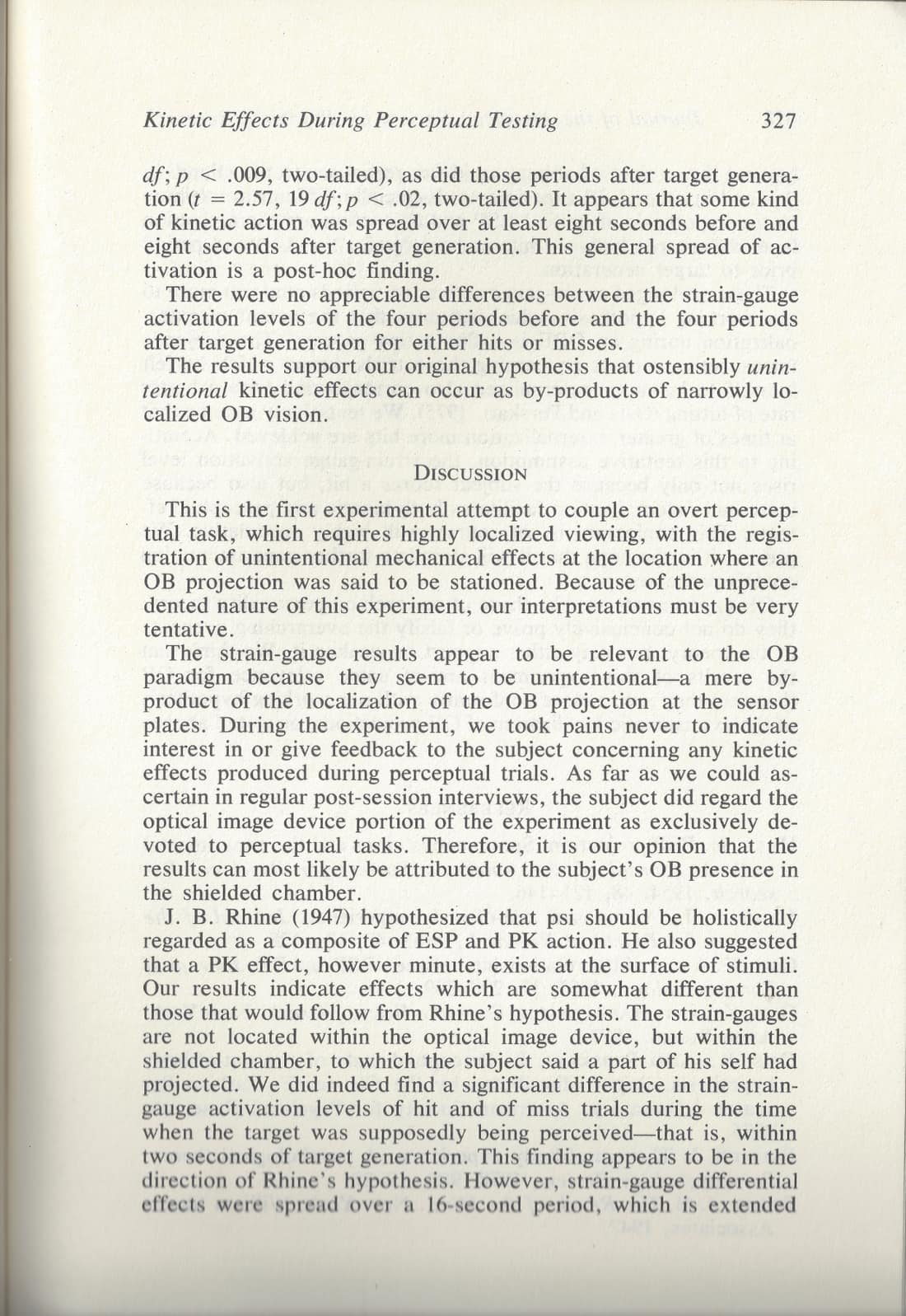
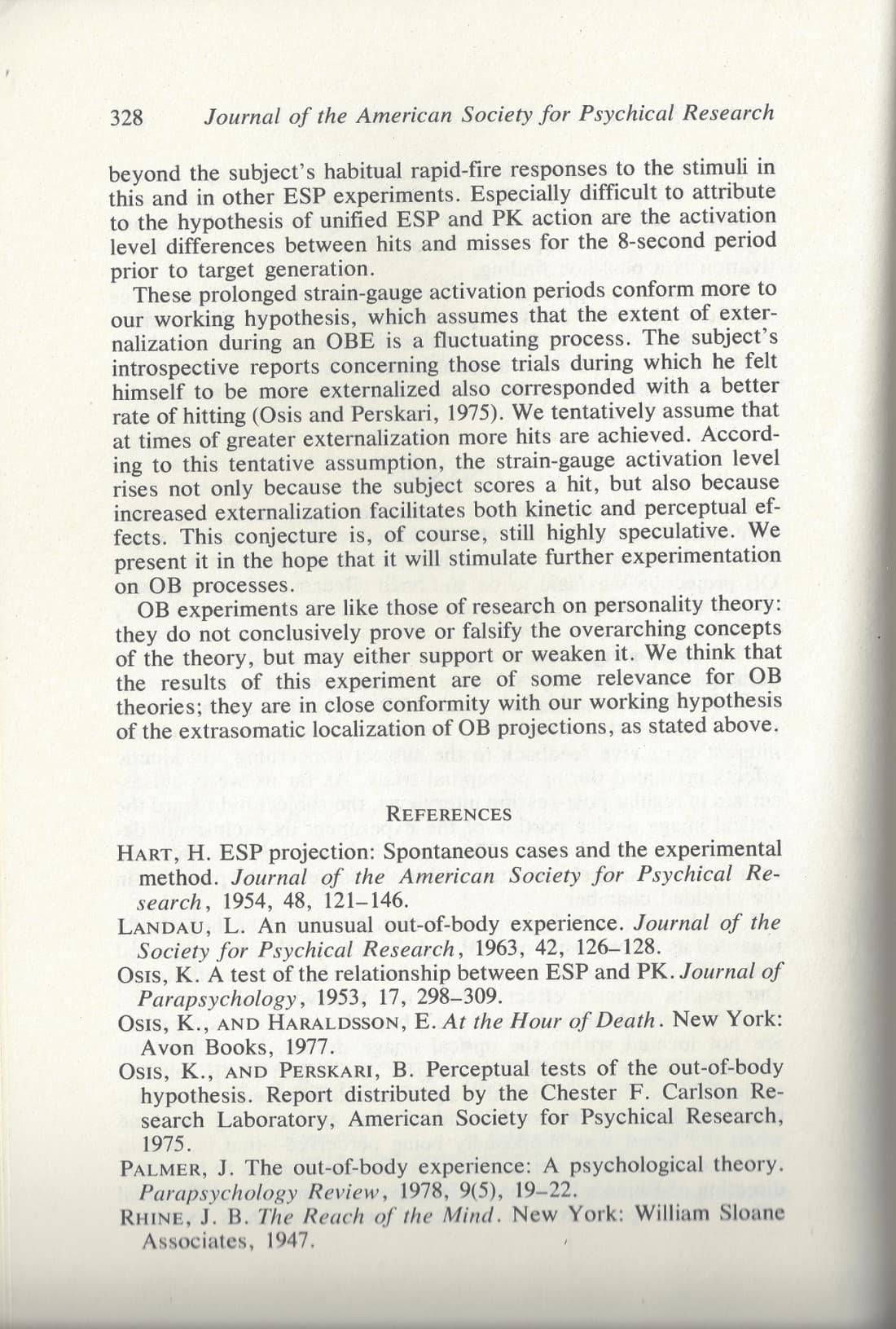
Kinetic Effects at the Ostensible Location of an Out-of-Body Projection During Perceptual Testing
Publication details
Karlis Osis and Donna McCormick. (1980). Kinetic Effects at the Ostensible Location of an Out-of-Body Projection During Perceptual Testing.
This historical document is held in the ASPR’s digital archive as part of The Karlis Osis Articles. Consult the original scan for pagination, illustrations and the author’s wording.
Searchable document text
Text extracted from the scan to help readers find passages. Automatic transcription may contain errors, especially in tables, names and older type. Page numbers below refer to PDF pages; a scanned spread may contain two printed pages. Use the original PDF when quoting or citing.
PDF page 1
Kinetic Effects at the Ostensible Location of an
Out-of-Body Projection During Perceptual
Testing’
KARLIS Osis AND DONNA McCCorRMICK?
ABSTRACT: In this experiment a selected subject was requested to go out-of-body
and localize himself in a shielded chamber containing strain-gauge sensors and
placed in front of the viewing window of an optical image device which displayed
visual targets. The subject was given the overt task of identifying randomly selected
targets displayed in the optical image device. Unintentional mechanical effects on
the strain-gauge sensors were registered on a Beckman polygraph during the time
when the subject was trying to identify the targets. The experiment consisted of 197
trials (resulting in 114 hits, 83 misses) extending over 20 sessions. Blind mea-
surements were made of the strain-gauge activation levels on the polygraph re-
cordings. These data were sampled so that four two-second intervals were measured
immediately preceding and four such intervals immediately following target genera-
tion for each trial.
As predicted, the average strain-gauge activation level for the period immediately
following target generation—that is, when the subject was reportedly ‘‘looking’’ at
the target—was significantly higher for trials which were hits than for trials which
were misses (¢ = 2.16, 19 df; p < .05, two-tailed). The average activation levels over
all eight sampling periods showed a significantly higher degree of activation on
occasions when hitting occurred (t = 3.64, 19 df; p < .002, two-tailed). The results
are interpreted as conforming to the extrasomatic hypothesis of the out-of-body
experience.
INTRODUCTION
Psi has been conceptualized as having two basic capabilities:
cognitive information gain and kinetic action. In the heyday of his
work at Duke University, J. B. Rhine (1947) hypothesized that the
two aspects of psi always go together; in other words, that there is
an ESP component during PK action and a PK action during ESP.
' This paper was presented at the Twenty-Second Annual Convention of the
Parapsychological Association, Moraga, California, August 15-18, 1979.—Ed.
2 This research was supported by a grant from Arthur C. Twitchell, Jr., and gifts
from the McDonnell Foundation, Floyd and Barbara Rees, and Trammell Crow, for
which we are very grateful. We also extend our gratitude to Janet Lee Mitchell and
William Isacke for their assistance, and to Robert Pollack for statistical consulta-
tions.
The Journal of the American Society for
Psychical Research Vol, 74, July 1980
PDF page 2
320 Journal of the American Society for Psychical Research
The first of these propositions was relatively easy to demonstrate
with the implementation of appropriate tests (Osis, 1953). The
second, however, has gone untested and is often explained away
using acausal theories of psi. Nevertheless, the possibility of ki-
netic action during ESP is suggested by accounts of spontaneous
out-of-body experiences (OBEs), where target persons have re-
ported bodily sensations (e.g., warmth, being touched, etc.) and
the displacement of physical objects during unexpected out-of-body
“visits” from friends (Landau, 1963).
The fundamental nature of OB processes are, for the most part,
unknown and therefore subject to wide variations in theoretical
interpretations (Hart, 1954; Palmer, 1978; Tart, 1968, 1977). The
two main contrasting hypotheses are the following:
1. The extrasomatic hypothesis, which states that during a true
OBE—as in Hart’s ‘‘full-fledged’’ and Tart’s ‘‘classical’’ or ‘‘dis-
crete’’> OBEs—consciousness, or a major part of the human per-
sonality, is externalized and exists apart from the physical body.
2. The intrasomatic hypothesis, which states that nothing leaves
the body during an OBE; the personality remains a normal,
psychophysiological unit in a more or less altered state. Verifiable
perceptions during OBEs are attributed to ‘“‘ordinary’’ ESP.
We think that both hypotheses describe some aspects of the
OBE, but, taken separately, are too rigid to accommodate all the
information that is available. Extensive observations both during
laboratory work and our exploratory ‘fly-in’ tests with approx-
imately 200 OB practitioners have provided clues which indicate
different concepts. The OBE appears to be an ever-changing
process rather than an all-or-none phenomenon. In the same indi-
vidual the OB process might even oscillate somewhere between the
two extremes of full externalization, as assumed by the extraso-
matic hypothesis, and full internalization, as assumed by the intra-
somatic hypothesis. The OB experient may at times leave no trace
of externalization, while at other times offering some indices of
having ‘‘been out.’’ Examples of the latter would be perceptual
and/or kinetic interactions with the environment, or being per-
ceived as an apparition by one or more observers. Total externali-
zation might occur at death, as suggested by studies of near-death
experiences (Osis and Haraldsson, 1977), while completely intra-
somatic experiences would accompany altered states—for exam-
ple, as in the case of hypnotically-induced OB states or states
brought about by suggestion and the demand characteristics of the
experiment.
Therefore, we assumed a more flexible working hypothesis in
which the OB projection is conceptualized as a unit that is ever-
changing in the degree of its perceiving-acting capacity, that can
Kinetic Effects During Perceptual Testing 321
move about and, to varied extents, localize itself in a physical
environment. Such a unit would use its ESP for ‘‘seeing’’ and its
PK for ‘‘action.’’ The primary difference between the externalized
mode of the OB state and ordinary psi processes would then be the
matter of localization. During an extrasomatic OBE, psi might
function at a point in space remote from the physical body, a place
where the OB projection feels itself to be. The base of normal psi
action is, on the other hand, believed to be at the body; we assume
the same for intrasomatic OBEs or Tart’s (1977) pseudo-OBEs. If
we go on this assumption, uniting the OB externalization hypoth-
esis with that of ESP and PK activation, certain consequences are
predictable: specifically, that during the successful identification of
visual targets while an individual is reportedly in the extrasomatic
OB state, there will be registrable kinetic effects at the location
where the experient feels his consciousness to be. In other words,
the registrable PK effects at the ostensible location of the OB
projection will be greater when the subject is more ‘‘out,’’ and
consequently hits on visual targets, than at those times when he
supposedly is less externalized and scores a miss on the perceptual
task. This working hypothesis is in concordance with the intro-
spective reports of our subjects, who seem to achieve more hits
during those times when they report being more fully externalized.
Of course, it is not a criterion exclusive of customary ESP, but
appears to be useful for accommodating past and (hopefully) future
results of OB psi.
METHOD
Apparatus and Setting
The apparatus consists of the following units, which will be de-
scribed below: An optical image device, an electronic scoring de-
vice, a shielded chamber, and an eight-channel polygraph. Their
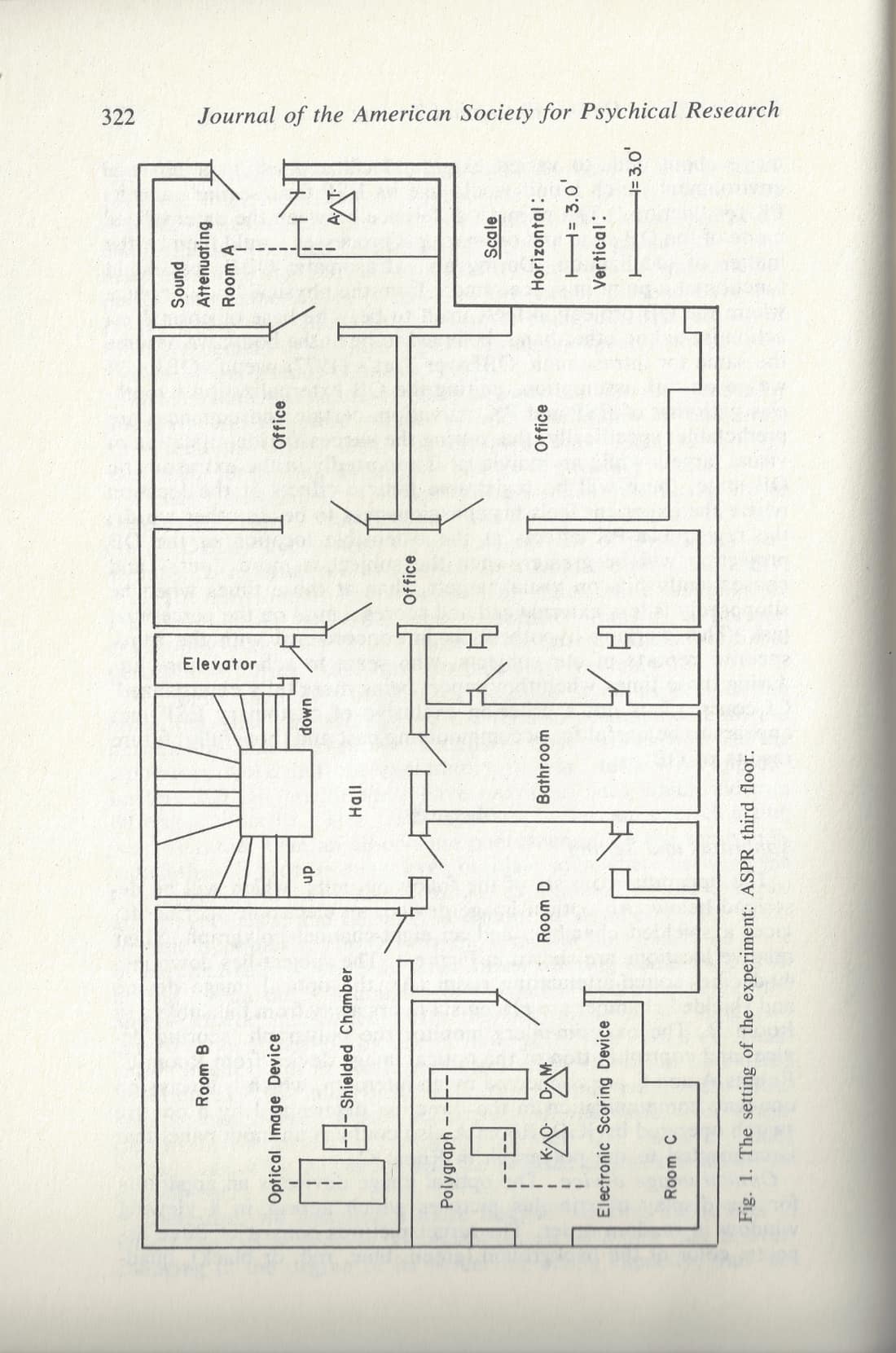
relative locations are shown in Figure 1. The subject lies down in a
40-decibel sound-attenuating room (A); the optical image device
and shielded chamber are placed six doors away from the subject in
Room B. The experimenters monitor the polygraph, scoring de-
vice, and control button of the optical image device from Room C.
Rooms A and C are connected by an intercom, which is always on
one-way communication in the direction determined by a control
switch operated by K.O. Room A also contains an input panel that
is connected to the polygraph in Room C.
Optical image device. The optical image device is an apparatus
for the display of stimulus pictures which appear in a viewing
window in random order. The target pictures consist of three as-
pects: color of the background (green, blue, red, or black), quad-
PDF page 3
322 Journal of the American Society for Psychical Research
Attenuating
Sound
Room
Elevator
Optical Image Device
A
i
\
i
H
!
= 3.0
BAN
Horizontal
k= 3.0'
Vertical
Bathroom
i
Electronic Scoring Device
Polygraph —-
1
ul [+ Shielded Chamber
Fig. 1. The setting of the experiment: ASPR third floor.
Kinetic Effects During Perceptual Testing 323
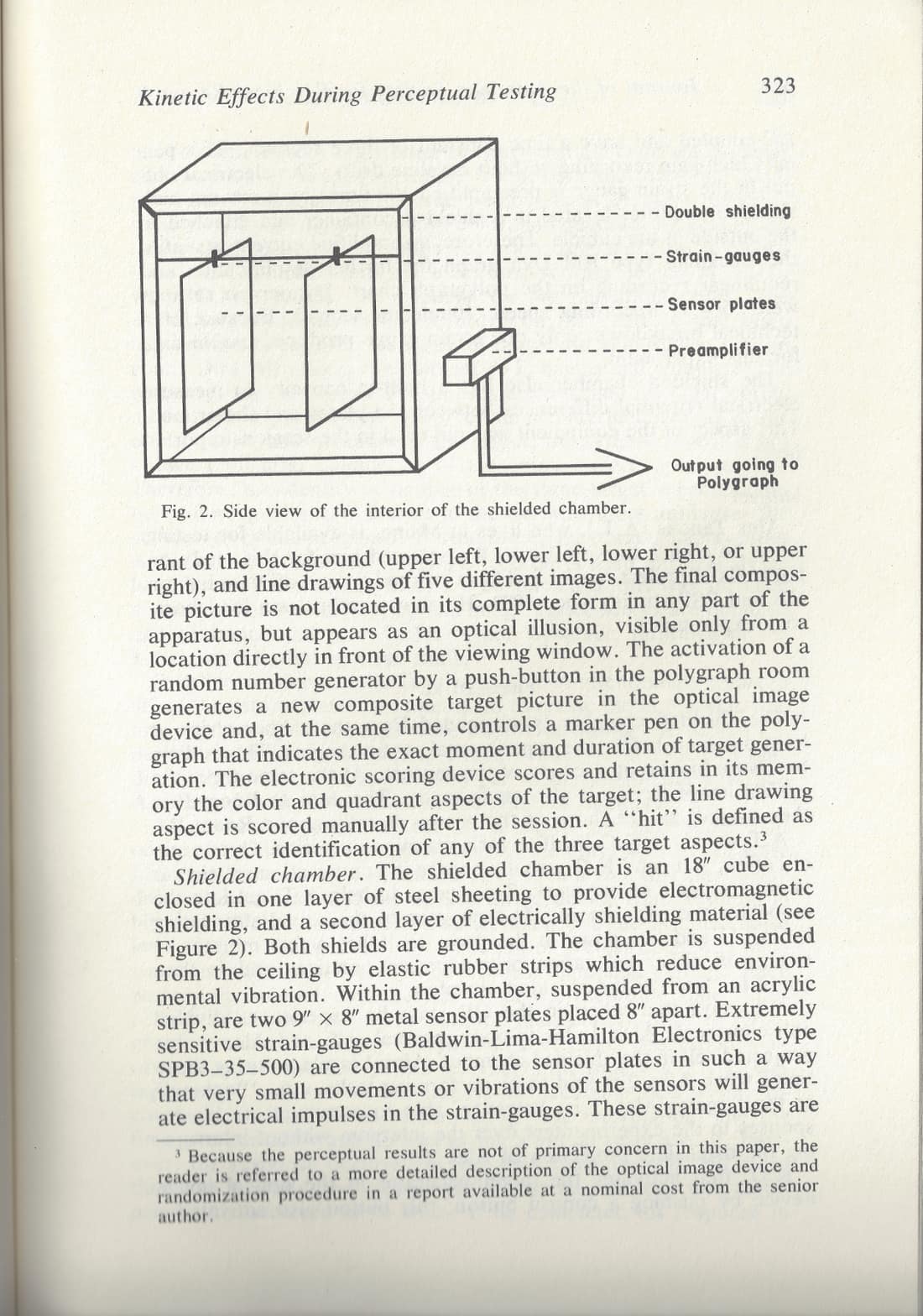
sage igh ly Seeiee age aM Double shielding
weer eee eee Strain-gauges
A ig A eM ge A Sensor plates
kt ap giertinan escnte ha Preamplifier
=> Output going to
Polygraph
Fig. 2. Side view of the interior of the shielded chamber.
rant of the background (upper left, lower left, lower right, or upper
right), and line drawings of five different images. The final compos-
ite picture is not located in its complete form in any part of the
apparatus, but appears as an optical illusion, visible only from a
location directly in front of the viewing window. The activation of a
random number generator by a push-button in the polygraph room
generates a new composite target picture in the optical image
device and, at the same time, controls a marker pen on the poly-
graph that indicates the exact moment and duration of target gener-
ation. The electronic scoring device scores and retains in its mem-
ory the color and quadrant aspects of the target; the line drawing
aspect is scored manually after the session. A ‘‘hit’’ is defined as
the correct identification of any of the three target aspects.?
Shielded chamber. The shielded chamber is an 18” cube en-
closed in one layer of steel sheeting to provide electromagnetic
shielding, and a second layer of electrically shielding material (see
Figure 2). Both shields are grounded. The chamber is suspended
from the ceiling by elastic rubber strips which reduce environ-
mental vibration. Within the chamber, suspended from an acrylic
strip, are two 9” x 8” metal sensor plates placed 8” apart. Extremely
sensitive strain-gauges (Baldwin-Lima-Hamilton Electronics type
SPB3—35—500) are connected to the sensor plates in such a way
that very small movements or vibrations of the sensors will gener-
ate electrical impulses in the strain-gauges. These strain-gauges are
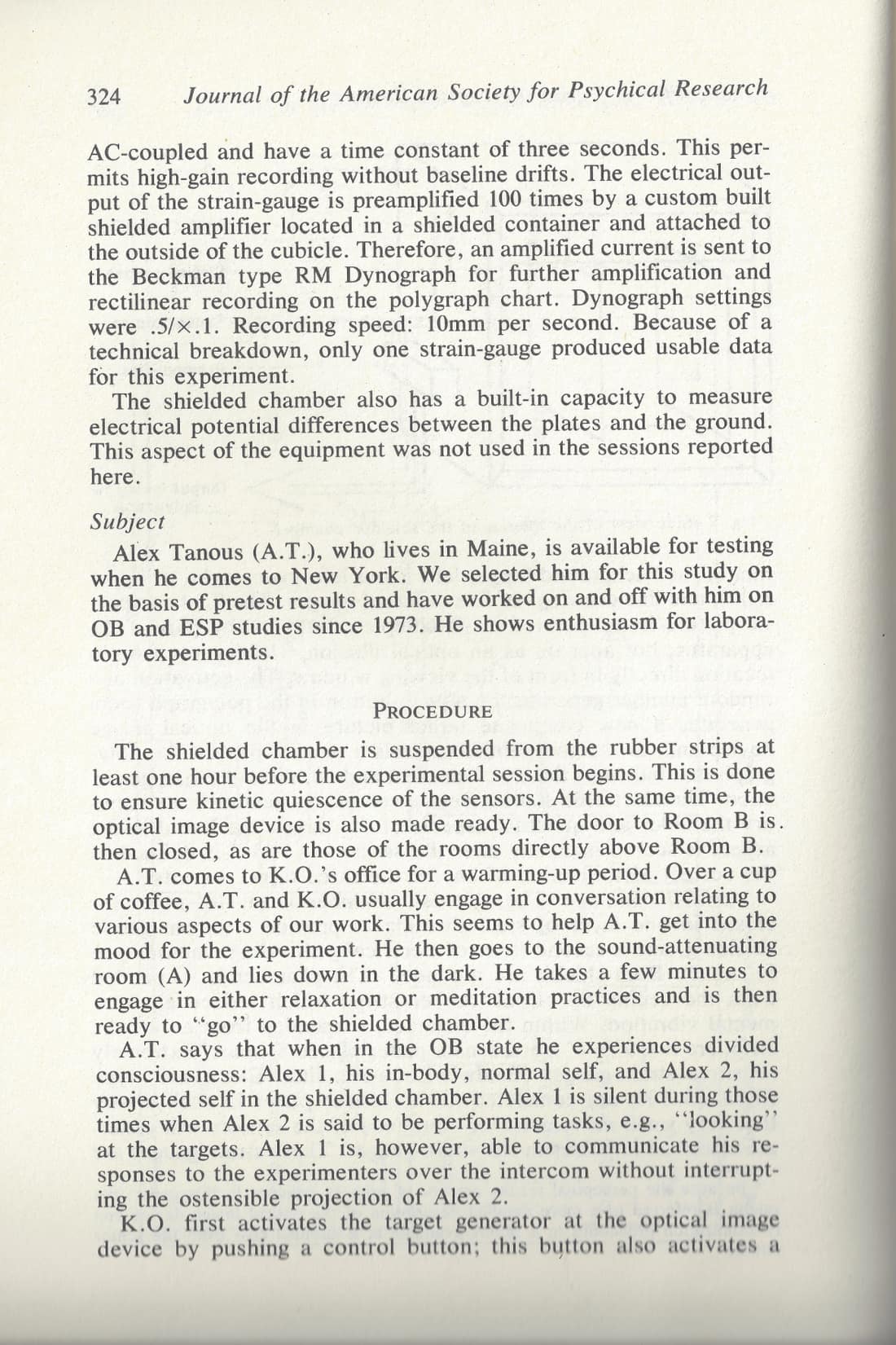
3 Because the perceptual results are not of primary concern in this paper, the
reader is referred to a more detailed description of the optical image device and
randomization procedure in a report available at a nominal cost from the senior
author,
PDF page 4
324 Journal of the American Society for Psychical Research
AC-coupled and have a time constant of three seconds. This per-
mits high-gain recording without baseline drifts. The electrical out-
put of the strain-gauge is preamplified 100 times by a custom built
shielded amplifier located in a shielded container and attached to
the outside of the cubicle. Therefore, an amplified current is sent to
the Beckman type RM Dynograph for further amplification and
rectilinear recording on the polygraph chart. Dynograph settings
were .5/X.1. Recording speed: 10mm per second. Because of a
technical breakdown, only one strain-gauge produced usable data
for this experiment.
The shielded chamber also has a built-in capacity to measure
electrical potential differences between the plates and the ground.
This aspect of the equipment was not used in the sessions reported
here.
Subject
Alex Tanous (A.T.), who lives in Maine, is available for testing
when he comes to New York. We selected him for this study on
the basis of pretest results and have worked on and off with him on
OB and ESP studies since 1973. He shows enthusiasm for labora-
tory experiments.
PROCEDURE
The shielded chamber is suspended from the rubber strips at
least one hour before the experimental session begins. This is done
to ensure kinetic quiescence of the sensors. At the same time, the
optical image device is also made ready. The door to Room B is.
then closed, as are those of the rooms directly above Room B.
A.T. comes to K.O.’s office for a warming-up period. Over a cup
of coffee, A.T. and K.O. usually engage in conversation relating to
various aspects of our work. This seems to help A.T. get into the
mood for the experiment. He then goes to the sound-attenuating
room (A) and lies down in the dark. He takes a few minutes to
engage in either relaxation or meditation practices and is then
ready to “‘go’’ to the shielded chamber.
A.T. says that when in the OB state he experiences divided
consciousness: Alex 1, his in-body, normal self, and Alex 2, his
projected self in the shielded chamber. Alex 1 is silent during those
times when Alex 2 is said to be performing tasks, e.g., ‘“‘looking”’
at the targets. Alex 1 is, however, able to communicate his re-
sponses to the experimenters over the intercom without interrupt-
ing the ostensible projection of Alex 2.
K.O. first activates the target generator at the optical image
device by pushing a control button; this button also activates a
Kinetic Effects During Perceptual Testing 325
marker pen, thereby registering on the polygraph chart the moment
and duration of target generation. Then, over the intercom, K.O.
immediately announces the trial number to A.T., who responds
right away by giving the symbol, color, and quadrant aspects of the
target. His responses are tape recorded, registered on a record
sheet, and punched into the electronic scoring device by K.O.,
while D.M. records the response on the polygraph chart. The
actual target identity is not recorded on the chart so that blind
measurements can later be made of deflection amplitudes. On the
chart, D.M. also notes the moment A.T. begins and completes the
response. As the subject’s responses are punched into the scoring
device, the experimenters are given immediate feedback as to the
correct color and quadrant of the target; the symbol aspect is not
known until after completion of the entire experimental session.
‘Therefore, the identity of neither of the three target aspects (sym-
bol, color, quadrant) is known to the experimenters until after the
subject gives his response. Furthermore, the target display does
not occur until after the polygraph recordings used in the analyses
have been obtained. Ten trials are completed in this way for each
session. After the session, optical image device scores are obtained
and communicated to A.T. He is not, however, informed of the
kinetic effects during these trials.
In order to minimize the likelihood of A.T. intentionally trying to
affect the sensor plates, we attempted to create the impression that
only the perceptual results were important during the formal ex-
periment, and that the kinetic effects would be attended to only
during the subsequent, exploratory part of the session during which
A.T. engages in OB actions in the shielded chamber.
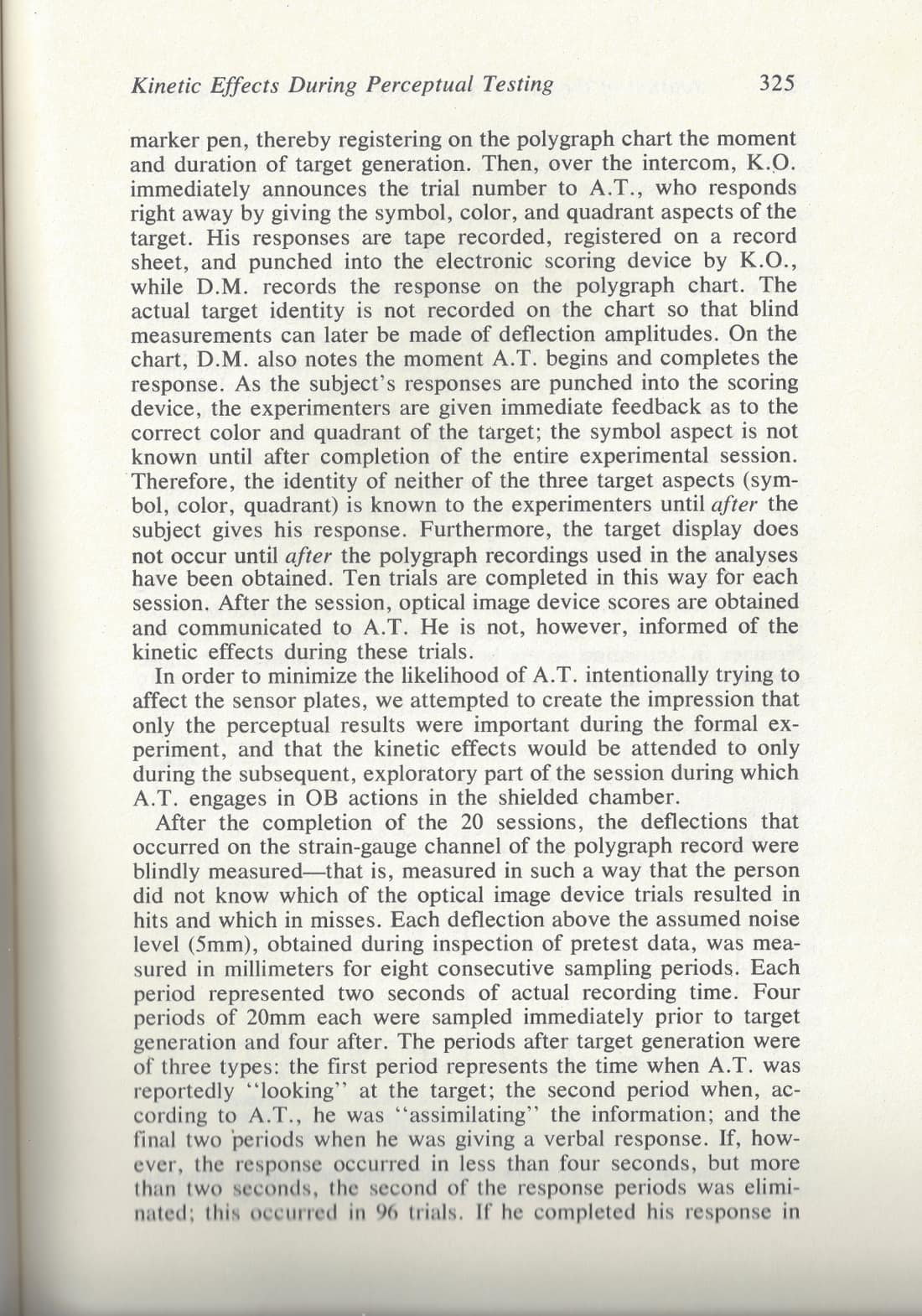
After the completion of the 20 sessions, the deflections that
occurred on the strain-gauge channel of the polygraph record were
blindly measured—that is, measured in such a way that the person
did not know which of the optical image device trials resulted in
hits and which in misses. Each deflection above the assumed noise
level (Smm), obtained during inspection of pretest data, was mea-
sured in millimeters for eight consecutive sampling periods. Each
period represented two seconds of actual recording time. Four
periods of 20mm each were sampled immediately prior to target
generation and four after. The periods after target generation were
of three types: the first period represents the time when A.T. was
reportedly ‘‘looking’’ at the target; the second period when, ac-
cording to A.T., he was ‘‘assimilating’’ the information; and the
final two periods when he was giving a verbal response. If, how-
ever, the response occurred in less than four seconds, but more
than two seconds, the second of the response periods was elimi-
nated; this occurred in 96 trials. If he completed his response in
PDF page 5
326 Journal of the American Society for Psychical Research
less than two seconds—which happened in 11 trials—both periods
were eliminated. This method was used in order to have a clear
record of the strain-gauge activation during response.
RESULTS
We obtained 197 usable trials resulting in 114 hits and 83 misses
of the target pictures displayed by the optical image device; these
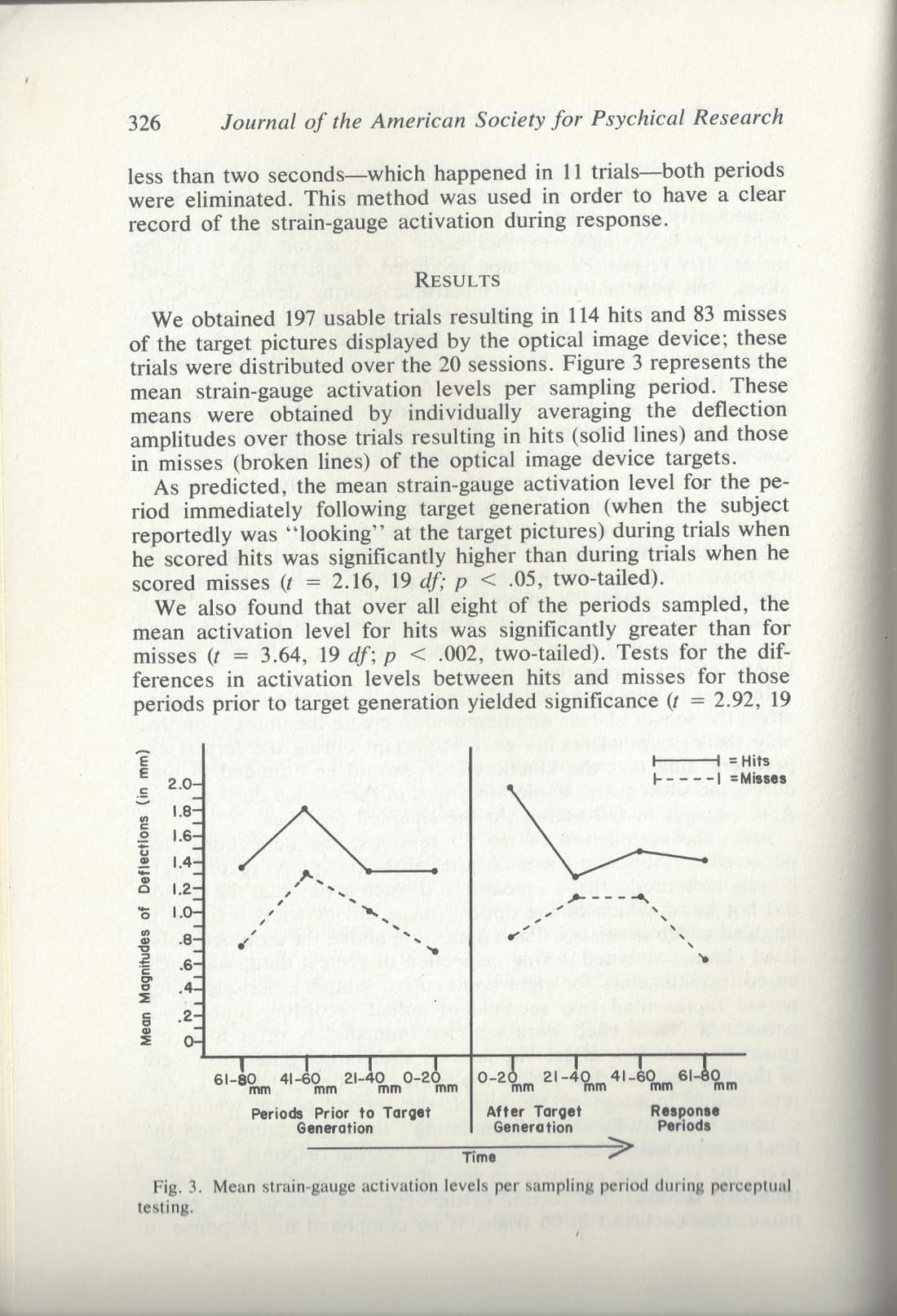
trials were distributed over the 20 sessions. Figure 3 represents the
mean strain-gauge activation levels per sampling period. These
means were obtained by individually averaging the deflection
amplitudes over those trials resulting in hits (solid lines) and those
in misses (broken lines) of the optical image device targets.
As predicted, the mean strain-gauge activation level for the pe-
riod immediately following target generation (when the subject
reportedly was “‘looking’’ at the target pictures) during trials when
he scored hits was significantly higher than during trials when he
scored misses (¢ = 2.16, 19 df; p < .05, two-tailed).
We also found that over all eight of the periods sampled, the
mean activation level for hits was significantly greater than for
misses (t = 3.64, 19 df; p < .002, two-tailed). Tests for the dif-
ferences in activation levels between hits and misses for those
periods prior to target generation yielded significance (¢ = 2.92, 19
€ -—H =Hits
Z 2.0 f----| =Misses
2 1.8
8 16
8 14
Bee
SO
on
wo
vo
ee
=
o
0
=
Cc
i=]
CU
=
5 e a ti fs 4l- 61-80
61-80 41-60, 2-40 0-20, 10-20, 21-40, 41-60.
™m mm
Periods Prior to Target After Target Response
Generation Generation Periods
Time
Fig. 3. Mean strain-gauge activation levels per sampling period during perceptual
testing.
‘
Kinetic Effects During Perceptual Testing 327
df; p < .009, two-tailed), as did those periods after target genera-
tion (¢ = 2.57, 19 df; p < .02, two-tailed). It appears that some kind
of kinetic action was spread over at least eight seconds before and
eight seconds after target generation. This general spread of ac-
tivation is a post-hoc finding.
There were no appreciable differences between the strain-gauge
activation levels of the four periods before and the four periods
after target generation for either hits or misses.
The results support our original hypothesis that ostensibly unin-
tentional kinetic effects can occur as by-products of narrowly lo-
calized OB vision.
DISCUSSION
This is the first experimental attempt to couple an overt percep-
' tual task, which requires highly localized viewing, with the regis-
tration of unintentional mechanical effects at the location where an
OB projection was said to be stationed. Because of the unprece-
dented nature of this experiment, our interpretations must be very
tentative.
The strain-gauge results appear to be relevant to the OB
paradigm because they seem to be unintentional—a mere by-
product of the localization of the OB projection at the sensor
plates. During the experiment, we took pains never to indicate
interest in or give feedback to the subject concerning any kinetic
effects produced during perceptual trials. As far as we could as-
certain in regular post-session interviews, the subject did regard the
optical image device portion of the experiment as exclusively de-
voted to perceptual tasks. Therefore, it is our opinion that the
results can most likely be attributed to the subject’s OB presence in
the shielded chamber.
J. B. Rhine (1947) hypothesized that psi should be holistically
regarded as a composite of ESP and PK action. He also suggested
that a PK effect, however minute, exists at the surface of stimuli.
Our results indicate effects which are somewhat different than
those that would follow from Rhine’s hypothesis. The strain-gauges
are not located within the optical image device, but within the
shielded chamber, to which the subject said a part of his self had
projected. We did indeed find a significant difference in the strain-
gauge activation levels of hit and of miss trials during the time
when the target was supposedly being perceived—that is, within
two seconds of target generation. This finding appears to be in the
direction of Rhine’s hypothesis. However, strain-gauge differential
effects were spread over a 16-second period, which is extended
PDF page 6
328 Journal of the American Society for Psychical Research
beyond the subject’s habitual rapid-fire responses to the stimuli in
this and in other ESP experiments. Especially difficult to attribute
to the hypothesis of unified ESP and PK action are the activation
level differences between hits and misses for the 8-second period
prior to target generation.
These prolonged strain-gauge activation periods conform more to
our working hypothesis, which assumes that the extent of exter-
nalization during an OBE is a fluctuating process. The subject’s
introspective reports concerning those trials during which he felt
himself to be more externalized also corresponded with a better
rate of hitting (Osis and Perskari, 1975). We tentatively assume that
at times of greater externalization more hits are achieved. Accord-
ing to this tentative assumption, the strain-gauge activation level
rises not only because the subject scores a hit, but also because
increased externalization facilitates both kinetic and perceptual ef-
fects. This conjecture is, of course, still highly speculative. We
present it in the hope that it will stimulate further experimentation
on OB processes.
OB experiments are like those of research on personality theory:
they do not conclusively prove or falsify the overarching concepts
of the theory, but may either support or weaken it. We think that
the results of this experiment are of some relevance for OB
theories; they are in close conformity with our working hypothesis
of the extrasomatic localization of OB projections, as stated above.
REFERENCES
Hart, H. ESP projection: Spontaneous cases and the experimental
method. Journal of the American Society for Psychical Re-
search, 1954, 48, 121-146.
LANDAU, L. An unusual out-of-body experience. Journal of the
Society for Psychical Research, 1963, 42, 126-128.
Osis, K. A test of the relationship between ESP and PK. Journal of
Parapsychology, 1953, 17, 298-309.
Osis, K., AND HaRALpsson, E. At the Hour of Death. New York:
Avon Books, 1977.
Osis, K., AND PERSKARI, B. Perceptual tests of the out-of-body
hypothesis. Report distributed by the Chester F. Carlson Re-
a Laboratory, American Society for Psychical Research,
1975.
PALMER, J. The out-of-body experience: A psychological theory.
Parapsychology Review, 1978, 9(5), 19-22.
RHINE, J. B. The Reach of the Mind. New York: William Sloane
Associates, 1947, ;
Kinetic Effects During Perceptual Testing 329
Tarr, GC; T. A ee study of out-of-the-body expe-
riences in a selected subject. Journal of the Ameri Society.
Psychical Research, 1968, 62, 3-27. : ea eee
TART, C. T. Psi: Scientific Studies of the Psychic Realm. New
York: Dutton, 1977.
Chester F. Carlson Research Laboratory
American Society for Psychical Research
5 West 73rd Street
New York, N. Y. 10023
Explore related records
- Some Explorations with Dowsing Techniques — Karlis Osis
- Centennial Compilation of the contents of the Proceedings and the Journal of the American Society for Psychical Research 1885-1984
- The Discovery of Gifted Sensitives — Gardner Murphy
- Physical Phenomena at a Private Circle — William James
- Personality Appraisal and the Paranormal — Gardner Murphy