







Opening the volume…
Turn the page with the arrows either side, by clicking the page, or by dragging a corner.PDF opens the original document in a new tab.
Space, Time, and Consciousness
Publication details
Karlis Osis. (1969). Space, Time, and Consciousness.
This historical document is held in the ASPR’s digital archive as part of The Chester Carlson Articles. Consult the original scan for pagination, illustrations and the author’s wording.
Searchable document text
Text extracted from the scan to help readers find passages. Automatic transcription may contain errors, especially in tables, names and older type. Page numbers below refer to PDF pages; a scanned spread may contain two printed pages. Use the original PDF when quoting or citing.
PDF page 1
SPACE, TIME, AND CONSCIOUSNESS
Karuis Osis
Tonight we remember Chester F. Carlson with affection and
gratitude. Most people know that he invented the Xerox and
that it became a fantastic success. However, let us not forget that
the Xerox had been at one time a most unpopular cause: for six
years not only had it been rejected by Kodak and all the other
large companies to which he had submitted it, but he had been
told repeatedly that his process was an impossible dream; that it
simply could not be done.
Few people know that Chester Carlson was very influential
in backing another unpopular cause, psychical research, to which
he devoted his scientific creativity and personal attention, as well
as his powerful financial support. His influence was almost in-
visible, his manner of participation unselfish and unassuming, and
his donations large—but anonymous. He permitted no honors to
come to him, but it was his hand that cultivated most of the
best psychical research projects of the 1960’s. He did not rely on
gold; he did not seek fame and power for himself nor value it
in others. King Solomon said, “Vanity of vanities, all is vanity.”
If there ever lived a man without vanity, that man was Chester
Carlson. Quietly, almost invisibly, like a gardener watering and
cultivating many plants, he guided and encouraged the labors of
psychical researchers; turned petty discussions of who was right
and who was wrong toward that which is essential and beneficial
to mankind.
I would like to share with you tonight Chester Carlson’s
vision of psychical research, so far as he made it known to us.
Space, Time, and Consciousness 37
It is easy to think great thoughts and leave them at that—just
futile speculations. Chester knew that great ideas could move the
world if they meshed gears with the here and now, with life and
work. In parapsychology, in particular, he expected that benefits
would accrue from closing the gap between ideas of universal
importance and the actual research design of experiments. He
saw as one integral whole the universal meaning of the findings
of psychical research and the tedious laboratory work necessary to
realize this meaning. Part of the secret of Chester’s success may
have been that in him was combined a passion for the great es-
sentials and a realism about small details.
I shall never forget one morning in the laboratory when
Chester Carlson went over all our projects, asking how they hung
together in the search for the deeper meaning of man’s insights
into himself and his universe. Then he quickly shifted gears to an
hour of brainstorming on a small technical detail: the best way
to record automatically the subjects’ responses in a closed-circuit
TV test we were developing. Another day, right after he decided
to give the Society a computer which was to change radically our
research capabilities, he discovered that a small adding machine
was needed in another part of the laboratory. He was all too
familiar with the sweat and toil of everyday routine work and
impressed upon us that constant attention to details and equip-
ment was as necessary as great vision if the full potentials of
psychical research were to be realized.
Space, time, and consciousness were central in our discussions
when Chester Carlson visited the A.S.P.R. laboratory, and there-
fore this is a most appropriate topic for tonight, when we are
meeting to honor his memory. Space and time seem to limit us.
Our mundane, everyday concerns hem us into a narrow environ-
ment in space, into the narrow range of the demands of the im-
mediate present. Through technology, man has expanded: his
reach through space. Through his culture, he has broken through
the prison wall of time, carrying along with him thousands of
years of accumulated learning.
C. D. Broad described four generally accepted limiting prin-
ciples and said that ESP transcends them all (1). Actually, ESP
PDF page 2
38 Proceedings of the American Society for Psychical Research
is a liberating experience. By means of it man can span thousands
of miles in space, as well as reach into the future and the past.
Through extrasensory perception, man can enlarge his grip on
reality. The principles attested to in psychical research bear wit-
ness to man’s sovereignty over his environment and restore to him
his sense of dignity and importance.
Consciousness directly interacting with the space-time world,
consciousness tuning in on an ever-expanding reality which might
even exist beyond this space-time world—this has been a central
concern of psychical research for nearly a hundred years. In this
memorial symposium tonight, we must say with gratitude to Ches-
ter F. Carlson that at last the A.S.P.R. has the laboratory and the
equipment with which to carry out long-range projects in this still
uncharted area.
Can EASTERN Concepts HELP WESTERN RESEARCH?
Why do psychical researchers throw themselves into this work
where progress is uncertain and trials and tribulations many? Why
did a man of international stature like Chester Carlson find it
worth while to put so much of himself and his resources into
psychical research? What is it that keeps psychical research going,
if not the basic need for man to understand himself and his place
in the universe? There is a discontinuity in our culture, a gap
which psychical research gives promise of filling.
We are as large as the reality within our reach, but what are
man’s essential routes to this reality? We share with animals our
sensorimotor system—our eyes, our ears, our hands—but, unlike
them, we can also extend our grasp through culture. We have, so
to speak, four extra “hands” with which to reach out into reality:
science, art, the humanities, and religion. History teaches us that
these extra hands can bring us closer to self-understanding and
healthy self-actualization, and also away from it if they are mis-
used. The old Hindu gods are pictured with four hands of about
the same size, but in our time the hand of science has grown
immensely larger than the other three. We rely mainly on science
to understand ourselves and our universe, so today we should
picture three hands small and childish in comparison with one
Space, Time, and Consciousness 39
extremely large and powerful hand, the hand of science. But would
this still be a sensitive human hand, or that of a robot?
Efficient methods of reality testing gave science an enormous
edge over other routes to reality. However, scientific methods can
also be confining. ‘They are like searchlights throwing narrow
beams on the vast realm of human existence, leaving much in
darkness. We do know a great deal about some psychological
processes such as perception and learning, which man, the ape,
and the rat all share, But there is a growing suspicion that too
much is left out in the present scientific portrait of man. The
thoughtful man in science is unwilling to ignore the immensely rich
insights developed through the centuries in the humanities, arts,
and religion. ‘There is great depth and height to man, as the
Greeks expressed it in their literature and the Hindus in their
philosophy. Nowadays students often complain that they gain
more insights about human nature from classes on Shakespeare
and Dostoevski than from introductory psychology courses.
Psychical research originated from the breadth of a human-
istic vision of reality and discontent with the narrowness of the
scientific conception of man. One starry night in Cambridge, in
1869, the well-known philosopher, Henry Sidgwick, and the clas-
sical scholar, Frederic W. H. Myers, took a walk during which
the concept of modern scientific psychical research emerged. In
the words of Myers,
In a star-light walk which I shall not forget . . . I asked
[Sidgwick] . . . whether he thought that when tradition, in-
tuition, metaphysic, had failed to solve the riddle of the uni-
verse, there was still a chance that from any actual observable
phenomena—ghosts, spirits, whatsoever there might be—some
valid knowledge might be drawn as to a world unseen. Al-
ready, it seemed, he had thought that this was possible .. .
and from that night onwards I resolved to pursue this quest,
if it might be, at his side....In [this]colloquy ... Sidgwick
and I had caught together the distant hope that science might
in our age make sufficient progress to open the spiritual
gateway which she had been thought to close; to penetrate by
PDF page 3
40 Proceedings of the American Society for Psychical Research
her own slow patterns into the vestibule of an unseen world
(7, pp. 454-455).
Thirteen years later, in 1882, the Society for Psychical Re-
search was founded in London, with Henry Sidgwick as its first
president. And perhaps it would not be presumptuous to say
that our present research projects at the A.S.P.R. are in a sense
also the outcome of that star-light walk described by Myers.
But Chester Carlson asked us sometimes whether parapsy-
chology has really accomplished what Sidgwick and Myers had
envisaged so many years ago. Have we perhaps frozen the new
inquiries into extremely narrow “spotlight” areas? Is not the re-
search literature overcrowded with small issues, e.g., trying to
find whether this or that slight change in testing method is a
little better than another?
Chester Carlson and his wife, Dorris, gave me books to read
which I, like many other psychical researchers, did not know
existed. I had not known that Sidgwick and Myers had an Indian
contemporary, Vivekananda, who had written about psychical
phenomena (13). We now realize that he was quite wrong about
many details, but nevertheless he saw with great clarity some
essentials which Chester Carlson thought might be important for
rapid progress in parapsychology. Vivekananda, an intimate friend
and disciple of Ramakrishna, the greatest Hindu spiritual leader
of the century, practiced yoga, knew its literature well, and be-
lieved that the psychological methods of yoga (such as meditation
and concentration techniques) could be used to gain control over
that hidden part of personality where man’s greatness lies. It oc-
curred to him that the experimental methods of western science
could be applied to the prescientific research beginnings made in
the East, and that if properly understood, the Yoga spiritual train-
ing methods could greatly hasten the process of evolving man’s
potentialities. He felt that we need not be at the mercy of the
accidents of mutatica which bring about evolution, but could
take things in hand and release our human potentialities by our
own efforts:
Space, Time, and Consciousness 41
Suppose we investigate these laws and understand their
secrets and apply them to our own needs; it follows that we
grow. We hasten our growth, we hasten our development. . . .
The purpose of this science is to bring out the perfect man
and not let him wait and wait for ages, just a plaything in
the hands of the physical world, like a log of driftwood carried
from wave to wave and tossing about in the ocean. This
science wants you to be strong, to take the work in your own
hands instead of leaving it in the hands of nature, and get
beyond this little life... (13, p. 244).
Vivekananda made plans for founding in India a special
college for this work, but died before he could accomplish it.
As already noted, Sidgwick and Myers launched modern
Psychical research and were very optimistic about its success.
Their Oriental contemporary, Vivekananda, was more realistic
about the struggle ahead. He was especially concerned about
methods of activating the depth processes where psychic powers
Seem to originate. Personal experience had taught him to antici-
Pate the difficulties:
It took me thirty years to learn [the science of mind]—
thirty years of hard struggle. Sometimes I worked at it twenty
hours during the twenty-four; sometimes I slept only one
hour in the night; sometimes I worked whole nights. Some-
times I lived in places where there was hardly a sound, hard-
ly a breath; sometimes I had to live in caves. . . . And yet
I know little or nothing; I have barely touched the hem of
the garment of this science . . . (13, p. 248).
We can glean a principle from Vivekananda’s writings: the
researcher must develop an intimate awareness of the psi processes
in himself before he can effectively study them in others. Without
personal experience, the right hypotheses might not emerge, nor
the right attitude to subjects in experimental sessions.
On the other hand, western psychical researchers are not sup-
PDF page 4
42 Proceedings of the American Society for Psychical Research
posed to care about personal psychical experiences. Thus, the
parapsychologist tends to assume the posture of grand impartiality,
looking down on the psychical processes in his subjects like a colo-
nial ruler looking down on the natives. An uninvolved, untouched
observer seemed necessary to reach the objective truth and to
crystallize reliable abstractions from statistics. This is not always
so in practice, for I know that several successful researchers in
the West have had personal experiences of a psychical or spiritual
nature. Unfortunately, however, they have often been reluctant
to discuss these experiences openly or to utilize them in the de-
signs of their research projects.
Vivekananda can perhaps be compared to the modern exis-
tentialist. He wrote about the personal struggles of the researcher
to activate psychical processes in himself; to achieve inner ex-
perience, a qualitative grasp. Only when armed with personal
insights would he venture into scientific scrutiny and objectivity.
The western observer often appears like a Greek god hovering
over reality and claiming to be outside of it and uninvolved. Quite
possibly this attitude interferes with, or even stops, the very
processes we are trying to observe. There is a fast-growing body
of evidence that the experimenter is part and parcel of the psy-
chological process he observes, as Robert Rosenthal has shown
at Harvard (10). In ESP testing the experimenter’s influence
may be even stronger. After a long research career, the distin-
guished British parapsychologist, S. G. Soal, states that “It almost
looks as if each experimenter imposes his own pattern on the
nature of the results, i-e., displacement, clairvoyance, etc. (9, p.
187).
We do not yet have solid experimental evidence that the ex-
perimenter’s own psi intermeshes with that of the subject, but
seasoned researchers have plenty of unplanned observations sup-
porting Soal’s impressions. For example, I personally seem never
to get positive results when sad, depressed, or angry. Dr. J. Kap-
pers of Amsterdam has told me about a psychometry experiment
which convinced him that the experimenter’s psi can either facil-
itate or block the subject’s ESP processes. If this is so, the re-
searcher himself will have to go wading in the stream of activated
Space, Time, and Consciousness 43
depth processes and originate his research from a vantage point
in the midst of this living flow of psi interactions.
Chester Carlson, as I came to know him, had an even broader
vision than Myers, Sidgwick, or Vivekananda. He was able to
integrate both the western scientific approach and the eastern
scientific beginnings; to bring together the computer and the saint.
He had a vision that if one applied scientific method to the hidden
part of personality where the psychical and the spiritual meet, im-
mense breakthroughs and benefits for mankind would eventually
follow. But he was also realistic, and sometimes even pessimistic,
saying that this breakthrough would come only when the scientific
method was applied in truly creative ways which would hit the
very core of the phenomena. He believed that this creativity would
come more readily if researchers would activate in themselves that
which they wanted to study in others. As you have heard earlier
this evening from Dorris Carlson, her husband’s personal experi-
ence with eastern methods of concentration convinced him that
such activation is quite feasible.
Retreat AND Try ANEW
Chester Carlson also believed in another methodological prin-
ciple closely connected with his own experience. He had invented
the Xerox process by a straightforward, rational method. He had
found that all the major companies in the copying field were con-
centrating their research efforts on photochemical processes similar
to those used for half a century in all cameras. However, the
development of photochemical copiers, which the giant companies
had been pushing with all their unlimited resources, showed slow
progress and reached a rather disappointing impasse. At this point
Chester Carlson decided that the whole direction of their efforts
was wrong; he searched for a new principle and finally decided
on the electrostatic one, from which he developed the Xerox. In
short, he backtracked out of the blind alley which had blocked
all his contemporaries and so gained a new outlook on hitherto
unused _ potentialities.
Chester suspected that in some areas of parapsychology,
methodology was in the same unsatisfactory state that the efforts
PDF page 5
44 Proceedings of the American Society for Psychical Research
of Kodak and Westinghouse to develop copying machines had
been in two decades ago. He saw clearly that the yield of para-
psychological research was in some respects rather meager. In the
years between 1930 and 1960 it had been shown convincingly that
the general research methods used in the psychology of perception,
learning, and personality testing could be successfully applied in
the ESP field, and a number of general psychological principles
had been found applicable to ESP in various experiments. How-
ever, the yield of ESP in experiments continued to be very meager
and the great problem of ESP activation—of finding the real
“push button”—was not solved despite considerable effort.
Another great question in parapsychology has to do with the
essential nature of ESP. What is the link between the sender and
the receiver in telepathy, between the guesser and the card in
clairvoyance? No large-scale projects involving all available scien-
tific methodology and know-how has ever been directed toward
this crucial question. Why these difficulties?
Chester Carlson suspected that we might have run into blind
alleys, as the Kodak Company did when it devoted all its research
to the known and obvious process. He insisted that changes in re-
search were necessary; that we had to sidestep the inbreeding of
ideas by developing new methods and new theoretical insights.
The backbone of modern parapsychology—card-guessing tests
themselves—came into question. We often wondered what para-
psychology would be like today if the “father” of card-guessing
techniques, Charles Richet, had not known how to play cards, or
if J. B. Rhine had used his great ingenuity to develop other tech-
niques. These radical doubts stretched my own research ideas
toward the new, the “never before.” But I must admit, however,
that this sometimes got under my skin. It was difficult to believe
that all the hard work and ingenuity which had gone into psy-
chical research might not be enough. In fact, I threw his chal-
lenge back to him and urged him to make the necessary radical
discovery himself: to invent, so to speak, the “Xerox” of para-
psychology! Chester Carlson certainly had the qualifications for a
major scientific breakthrough, but the last time I spoke with him,
not long before his death, he had not yet developed this “Xerox.”
Space, Time, and Consciousness 45
However, he had suggested three approaches to new methodology
for the A.S.P.R. laboratory which might have helped to lead him
to such a breakthrough.
First, Chester urged us to develop a project which we called
“Scientists in Residence.” He wanted to sponsor our bringing
leading scientists from other disciplines to live and work, one at a
time, at the Society, each for a three-month period. In this way
they would be able to familiarize themselves with relevant litera-
ture and with our current projects; to have frequent conferences
with the laboratory staff and other researchers in the New York
area. It was his hope that a creative outsider, who had studied
the basic findings in parapsychology and received constructive
feedback from workers in the field, might see research possibilities
overlooked by the insiders. He was also planning with us a series
of three- to five-day conferences for small groups of brilliant rep-
resentatives from the physical and behavioral sciences who would
meet with us at a secluded place for intense brainstorming. Just
two days before his death this plan was tried out on a small scale:
he participated in a six-hour session with Dr. Edward W. Samson,
a physicist from Boston.
The second direction in which Chester Carlson was groping
for progress was related to epistemology, or the theory of knowl-
edge. The basic principles of gaining, verifying, and building co-
herent systems of knowledge have grown out of the developing phy-
sical sciences, with some principles adapted to the needs of the
behavioral sciences. Perhaps something radically different is needed
to crack the secrets of ESP. Carlson had toyed with the possibility
of backtracking to the very roots of current methodology, to the
source of the principles of knowledge, in order to work out a new
approach. He suggested that we consider incorporating into re-
search methodology the ways in which sensitives and mystics ap-
pear to gain knowledge. Science is built of the bricks of perceptual
observations. Of course, the scope and precision of perception is
greatly amplified by modern technology, e.g., electronic sensors,
etc. Still, the basic bricks are the same, regardless of how they
are processed later by intellectual and mathematical manipula-
tions. ESP appears to be a radically different way of contacting
PDF page 6
46 Proceedings of the American Society for Psychical Research
reality, utilizing direct awareness and bypassing ordinary sensory
observations. But we are still a long way from being able to con-
ceptualize the process adequately.
Carington (2), Tyrrell (11), Driesch (3), and others have
suggested that ESP is a way of becoming directly aware of external
reality, much in the same manner that we become aware of what
is in our hearts and memories. Carington developed an onto-
logically-founded theory of telepathy (2), but no one as far as I
know, except C. G. Jung (4), has thought it out as a theory of
knowledge or possible new methodology for getting and verifying
knowledge. Can efficient reality testing methods be adapted to the
extrasensory mode of apprehending reality without falling back on
sensory observations?
Chester Carlson saw the need for radically new methodological
principles which would also utilize extrasensory observations as a
basis for scientific inference. We brainstormed, but our discussions
did not get very far. As far as I know, he had not been able to
come up with a testable theory or model. He stressed repeatedly
that new understanding of paranormal phenomena might come
to parapsychologists by the same routes as they had come to the
sensitive and the mystic. He found it significant that scientists and
thinkers of the stature of Henry Margenau, Fritz Kunz, and
Donald Hatch Andrews had recognized that Hindu seers had some
apprehension of the field-like structure of the universe thousands
of years before the scientific field theory was formulated.
The third approach Chester suggested was that we look for
testable variables in the methods the seers claimed had brought
them “immediate awareness of reality.” He had been impressed
by the semi-experimental nature of the ancient methods of yoga
and Zen and he thought that if researchers could make use of such
techniques, great advances might result. The sutras often state
that if you fulfill certain conditions and engage in specific activ-
ities, a definite change of consciousness will result. Stating prob-
lems in this way is certainly closer to the spirit of science than
merely referring to untestable faith, as most theologies do. Again,
Chester suggested research with the experimenter himself as sub-
ject in order to arrive at a reasonable starting point. He thought
Space, Time, and Consciousness 47
that without personal awareness and personal insight, work in ESP
might be compared to that of a color-blind person doing research
on the psychology of color perception.
Chester Carlson also hoped for a bridge between East and
West in one more area which I will try to describe from a western
standpoint. In moments of immediate danger to life we suddenly
feel its sacredness. The motion picture, ““The Russians Are Com-
ing,” portrayed this quite convincingly in the scene where a child
was about to fall from a church steeple. The Russians and the
Americans, who had been about to blow each other up, immedi-
ately changed their attitude. Fear, hate, pride, and anger were
momentarily transcended while both warring parties joined in the
rescue action. Where there had been no effective communication,
there was suddenly mutual understanding.
ESP communication might be similarly blocked. We have
a perceptual defense system which screens out or neutralizes dis-
turbing and unwanted sensory messages. Since the reach of ex-
trasensory messages is much greater, there must be an even
greater need for effective screening and neutralizing devices. Other-
wise we would be bombarded constantly by disturbing telepathic
awareness of hatred, jealousy, sexual desires, threatened violence,
etc. Such defenses must be a necessity of life, but threats to life
seem to disarm our paranormal defenses as effectively as our
normal defensiveness. Spontaneous case collections are dominated
by so-called crisis situations, e.g., accidents, grave illness, and death.
How can our defenses be disarmed for testing ESP? Of
course, we cannot awaken the feeling of the sacredness of life by
threatening the destruction of the agent. Is there another way to
induce non-defensive acceptance and readiness for unrestricted
communication? The books which Chester and Dorris Carlson
gave me to read say that there is. Feeling this sacredness of the
other person, Vivekananda claimed, can be induced by various
yoga methods; by experiencing the self of another as one’s own
self—supremely valued, sacred, identical with Brahman (12, 13).
Zen enlightenment is said to induce the same non-defensive open-
ness (5), and western mystics from Eckhart to Walt Whitman
have made similar claims.
PDF page 7
48 Proceedings of the American Society for Psychical Research
Are these claims based on true observations or are they just
wishful thinking? Chester Carlson thought that progress in this
direction is both possible and observable. He himself claimed
neither samadhi nor satori, but he truly lived with the reverence
for life which most of us know from the writings of Albert
Schweitzer. For example, I will never forget one morning when
we were strolling through Chester’s meadow where young fruit
trees had been planted. I discovered some caterpillars eating the
leaves of a tiny little tree and reached out my hand to crush
them. “No, Karlis,’’ Chester said, “let them have another chance.”
He gathered the caterpillars on his palm and brought them to a
larger tree where they would not be destructive. Chester Carlson
met life with goodness and found in nearly everyone something
to accept, something to be warm about.
Naturally, the question arises whether this monistic reverence
for life is important for activating ESP in experiments. Can it
be induced in subjects by meditation methods? We discussed many
times the pros and cons. Carlson had no firm answers, but he
thought the problem worthy of intense experimentation.
CHESTER CARLSON’S IDEAS AND THE WorK OF
THE A.S.P.R. LaBsoraTory
Dr. Schmeidler announced at the beginning of this symposium
that the A.S.P.R. has decided to call its research facilities the
Chester F. Carlson Research Laboratory. There are more reasons
for doing this than merely to honor a man who has generously sup-
ported our work. Generous he was; in fact, he was the anonymous
donor who regularly provided the bulk of our research budget and
approximately doubled our endowment. However, his spiritual in-
fluence was even more important. His broad vision of psychical
research influenced in many ways all that we were doing, but he
never requested that a particular experimental project be carried
out. Rather than giving orders, he believed in fostering with loving
care the creativity of those doing research. He spent much time
with us discussing ideas and research problems, but always on our
level, never from above. These wide-ranging talks, like brain-
storming sessions, molded our projects, sharpened our thinking,
Space, Time, and Consciousness ie)
and made our outlook more meaningful. Every time he went out
the laboratory door, he took his navy blue hat—but he left his
vision behind.
The A.S.P.R. is an organization of many minds and its suc-
cess has depended on the labors and vision of many men and
women, and particularly on the leadership of Gardner Murphy.
But tonight we trace the footsteps of one man, a great man. Let
us glance at the Society’s research projects carried out in the
’sixties to see how Chester Carlson’s ideas touched them.
We have never had a single “Carlson project,” but all our
work has a “Carlson tinge” in that our research program tries to
integrate modern psychological know-how and computerized tech-
niques with the concept of turning inward to the essentials. We
have organized a long-range search for the roots of the paranormal
processes in that uncharted reality where consciousness, space, time,
and—perhaps—infinity intersect.
My first project at the A.S.P.R. (sponsored by the Ittleson
Family Foundation) was essentially introspective. We questioned
twenty-nine creative artists for four to five hours each in tape-
recorded depth interviews. The main problem was to discover how
their ways of experiencing and behaving are altered in creative
arousal—when they are working at their best—and how the crea-
tive mood compares with states favorable to ESP. The painstaking
details of scientific methodology were an integral part of this
project. Two thousand pages of interview material were carded,
cross-indexed, and carefully analyzed. An attempt was made to
penetrate to the very depths of the changed states of consciousness
from which both creativity and ESP seem to evolve. This material
was also integrated with changed states of consciousness which can
be induced in the laboratory by hypnosis, drugs, sensory depriva-
tion, etc. This project is discussed in a book, now almost com-
pleted, in which we try to show how the roots of creativeness—in
the artist, in the psychic, in men like Meister Eckhart—can be
described in terms of modern psychology.
What we learned from this creativity project was then ap-
plied to an experiment on changed states of consciousness, in
which we are testing ideas gleaned from artists and seers of all
PDF page 8
50 Proceedings of the American Society for Psychical Research
ages. The details of this experiment are too technical to describe
here, but they involve psychological inducement of altered states
of consciousness, something like Maslow’s peak experiences (6),
wherein the very core of human personality reveals itself. And
again, we are trying to do this in a sophisticated way, assessing
the changed states by means of psychological scales and evaluating
the results by factor analysis and multiple regression on the ESP
scores.
A third project concerns distance and ESP and tackles the
problem of how consciousness and physical space intersect in psi
phenomena. Some of you may have seen the Society’s Proceedings
in which the first phase of the experiment is described in detail
(8). In this project, using all the research technology available
to us, we are trying to ascertain how the unknown “X” factor
which connects the sender and the receiver, or the perceiver and
the perceived object, is or is not affected by distance. So far, it
seems that we have succeeded in untangling a multitude of factors
which have obscured the distance factor. In the published experi-
ment there were twenty-seven different threads, or variables, to
untangle and keep separate from the main variable, which was
distance. We are trying in this ongoing research to express math-
ematically the relationship between distance and ESP and hope
to formulate something like a new natural law where space, time,
and consciousness intersect. However, we must be careful in deal-
ing with an issue as important as this and cannot rush our find-
ings into premature formulations.
CHESTER CaRLson’s ImpossiBLE DREAMS
Chester Carlson was deeply interested in man’s possible sur-
vival after death, and he had supported a large-scale A.S.P.R.
project bearing on this problem. Questionnaires concerning death-
bed experiences were sent to five thousand physicians and nurses,
and then the best respondents were followed up by telephone in-
terviews in order to elicit further information concerning these
experiences and how they related to the patients’ medical and
cultural backgrounds. In this study we obtained plenty of relevant
data more consistent with the survival hypothesis than with the
Space, Time, and Consciousness 1
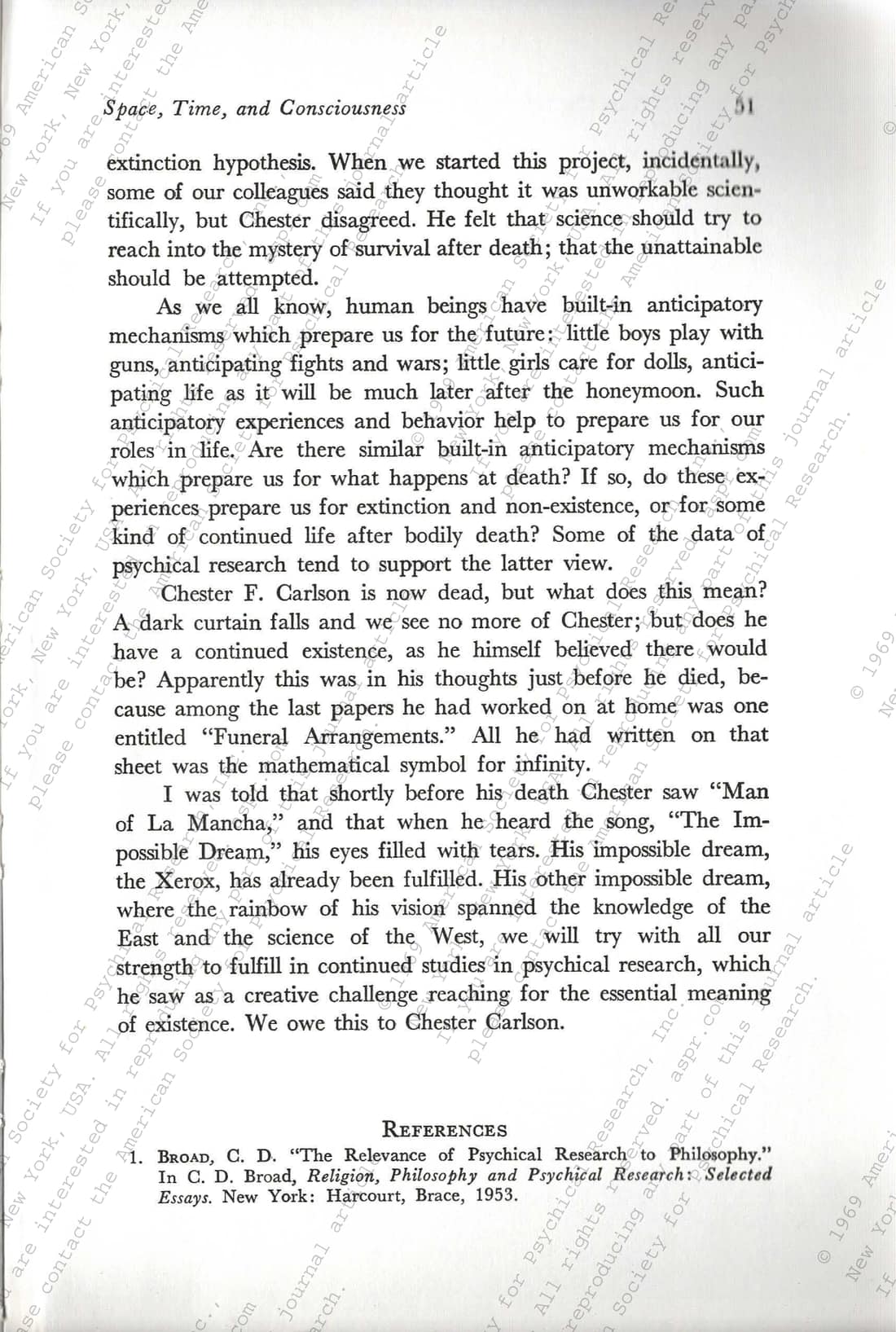
extinction hypothesis. When we started this project, incidentally,
some of our colleagues said they thought it was unworkable scien-
tifically, but Chester disagreed. He felt that science should try to
reach into the mystery of survival after death; that the unattainable
should be attempted.
As we all know, human beings have built-in anticipatory
mechanisms which prepare us for the future: little boys play with
guns, anticipating fights and wars; little girls care for dolls, antici-
pating life as it will be much later after the honeymoon. Such
anticipatory experiences and behavior help to prepare us for our
roles in life. Are there similar built-in anticipatory mechanisms
which prepare us for what happens at death? If so, do these ex-
periences prepare us for extinction and non-existence, or for some
kind of continued life after bodily death? Some of the data of
psychical research tend to support the latter view.
Chester F. Carlson is now dead, but what does this mean?
A dark curtain falls and we see no more of Chester; but does he
have a continued existence, as he himself believed there would
be? Apparently this was in his thoughts just before he died, be-
cause among the last papers he had worked on at home was one
entitled “Funeral Arrangements.” All he had written on that
sheet was the mathematical symbol for infinity.
I was told that shortly before his death Chester saw “Man
of La Mancha,” and that when he heard the song, “The Im-
possible Dream,” his eyes filled with tears. His impossible dream,
the Xerox, has already been fulfilled. His other impossible dream,
where the rainbow of his vision spanned the knowledge of the
East and the science of the West, we will try with all our
strength to fulfill in continued studies in psychical research, which
he saw as a creative challenge reaching for the essential meaning
of existence. We owe this to Chester Carlson.
REFERENCES
1. Broap, C. D. “The Relevance of Psychical Research to Philosophy.”
In C. D. Broad, Religion, Philosophy and Psychical Research: Selected
Essays. New York: Harcourt, Brace, 1953.
PDF page 9
10.
11.
12s
13,
Proceedings of the American Society for Psychical Research
Carincton, W. Matter, Mind and Meaning. New Haven: Yale Univer-
sity Press, 1949.
Driescu, H. Psychical Research: The Science of the Super-Normal.
(Authorized translation by T. Besterman.) London: G. Bell, 1933.
June, C. G. “Synchronicity: An Acausal Connecting Principle.” In C. G.
Jung and W. Pauli, The Interpretation of Nature and the Psyche. New
York: Pantheon, 1955.
Kapreau, P. (Ed.). The Three Pillars of Zen. Tokyo: John Weather-
hill, 1965. (New York: Harper & Row, 1966.)
Mastow, A. “Cognition of Being in the Peak Experience.” International
Journal of Parapsychology, Vol. 2, Autumn, 1960, 23-50.
Myers, F. W. H. “In Memory of Henry Sidgwick.” Proc. S.P.R., Vol.
15, 1900-01, 452-464.
Osis, K., and Turner, M. E., Jr. “Distance and ESP: A Transcon-
tinental Experiment.” Proc. A.S.P.R., Vol. 27, September, 1968, 1-48.
Rune, J. B., and Brier, R. (Eds.). Parapsychology Today. New York:
Citadel Press, 1968.
RosENTHAL, R. Experimenter Effects in Behavioral Research. New
York: Appleton-Century-Crofts, 1966.
Tyrre.ti, G. N. M. The Personality of Man. Baltimore: Penguin Books,
1947.
VIVEKANANDA. Jndna-Yoga. New York: Ramakrishna-Vivekananda Cen-
ter, 1955.
————. Raja-Yoga. New York: Ramakrishna-Vivekananda Center,
1955.
The Chester F. Carlson
Research Laboratory
A.S.P.R.
5 West 73rd Street
New York, N. Y. 10023
Explore related records
- Psychical Research and the Study of Personality — Gardner Murphy
- Centennial Compilation of the contents of the Proceedings and the Journal of the American Society for Psychical Research 1885-1984
- The Discovery of Gifted Sensitives — Gardner Murphy
- Physical Phenomena at a Private Circle — William James
- Personality Appraisal and the Paranormal — Gardner Murphy