

Opening the volume…
Turn the page with the arrows either side, by clicking the page, or by dragging a corner.PDF opens the original document in a new tab.
The Beginnings of Chester Carlson
Publication details
Dorris Carlson. (1969). The Beginnings of Chester Carlson.
This historical document is held in the ASPR’s digital archive as part of The Chester Carlson Articles. Consult the original scan for pagination, illustrations and the author’s wording.
Searchable document text
Text extracted from the scan to help readers find passages. Automatic transcription may contain errors, especially in tables, names and older type. Page numbers below refer to PDF pages; a scanned spread may contain two printed pages. Use the original PDF when quoting or citing.
PDF page 1
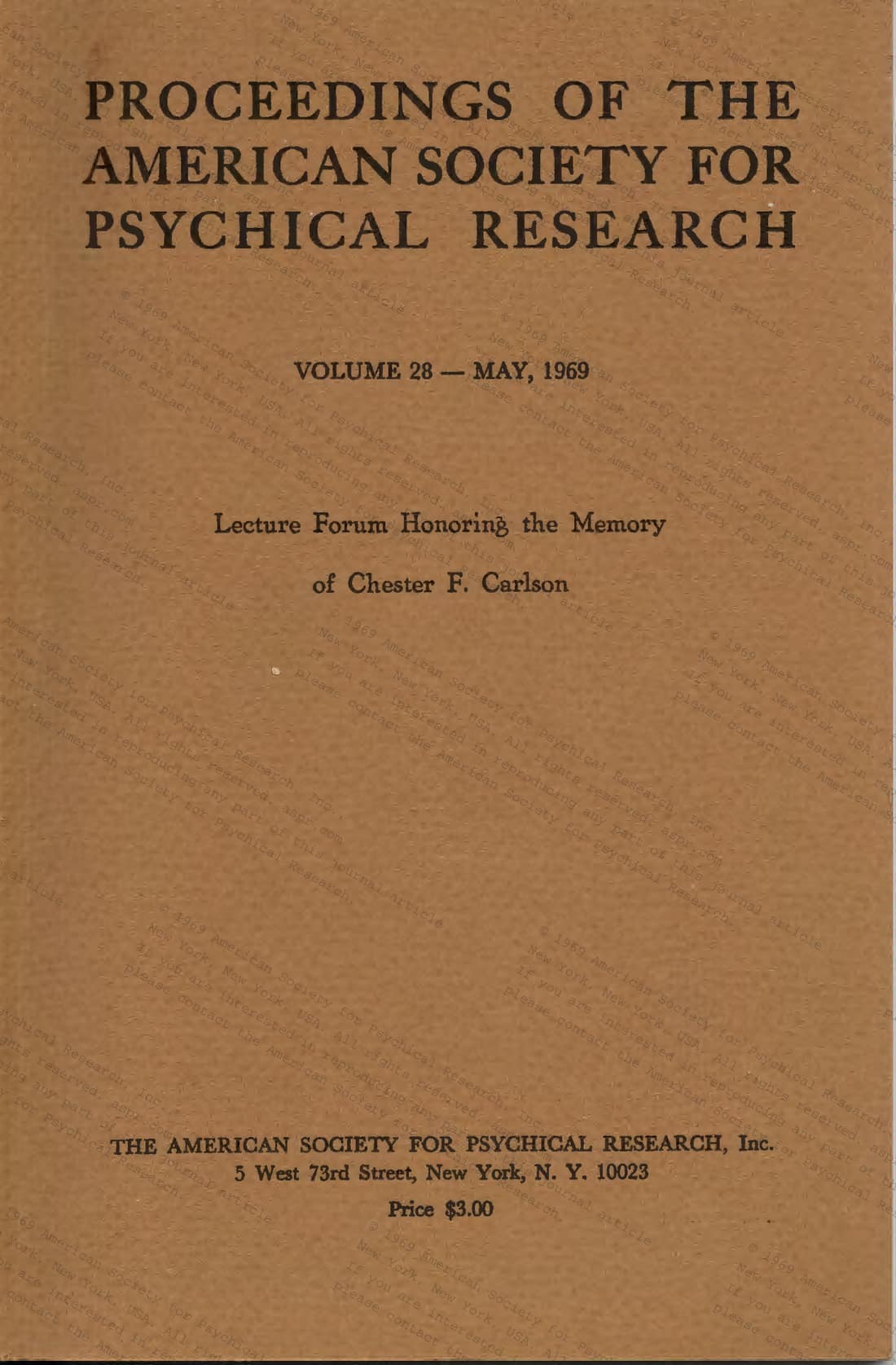
: PROCEEDINGS OF THE
AMERICAN SOCIETY FOR
PSYCHICAL RESEARCH
VOLUME 28 — MAY, 1969
_ Lecture Forum Honoring the Memory
of Chester F. Carlson
5 West 73rd Street, New York, N. Y. 10023 —
Price $3.00
PDF page 2
THE BEGINNINGS OF CHESTER CARLSON’S INTEREST
IN PARAPSYCHOLOGY
Dorris CARLSON
I think it is very rash of me to attempt to say anything at
all this evening, especially in the presence of a group of learned
parapsychologists who are making such profound contributions to
our knowledge of the nature of man. However, you might be
interested to hear how one person who, as a result of his environ-
ment and formal education, was a physical scientist, and yet
came to be interested in parapsychology. Because of this environ-
ment and education, Chester Carlson was supposed to be a
materialist; but perhaps by nature he was not fully equipped to
be an out-and-out materialist, although he always maintained the
standards of the physical scientist.
About twenty years ago, in our home, a series of paranormal
experiences began to occur, apparently through my instrumentality.
Sounds—for the most part words representing personal names
and places—were heard clairaudiently, and images of known or
unknown persons and events were seen in “objective” form, fre-
quently when my eyes were closed. And there were various pre-
cognitive experiences which were often verified days, or even
several weeks, later. These psychic experiences were shared with
my husband, and I think they may have disturbed him at first
because he recognized their implications for his theoretical outlook
on the world and on the nature of man.
Looking back, it seems to me as though I were “used” as an
instrument to draw my husband into the field of parapsychology.
I felt like a nonentity, to tell you the truth, although this was an
exciting process for me too. But these experiences seemed to
involve Chester also. He was not the type of person to be satisfied
merely to read about the measurements and statistics of other
PDF page 3
6 Proceedings of the American Society for Psychical Research
people’s work and research; it was not enough for him merely to
hear about other people’s experiences. He felt that he had to
test the research itself by having the experience himself. He
was very quiet, very busy every day in his laboratory where he
was trying to improve and discover new applications for xero-
graphy, and he usually did his thinking without talking much
about it. Anyway, these psychic phenomena started to occur and
there were many aspects to them; they came one after another,
and as soon as one type would be expected, that type would
cease and another type would be introduced. This was without
any effort on his part or on mine, though it could be said that
I tried to cooperate in the process. I was being constantly surprised
by these phenomena. As I said, if one type was expected, that
stopped and another took its place; thus, there was always an
element of spontaneity and freshness, an element of the unexpected
in these phenomena.
In regard to the precognitive experiences, I early learned
not to anticipate the source from which verifications would come
because the conscious, logical mind was usually wrong when it
tried to interfere with an area of the deeper self which seemed
to know more than this so-called “logical” mind. I early learned
that paranormal experiences flowed more easily and with less
distortion when body and mind could serve as an open, unob-
structed channel without interference from preconceived notions
or opinions. Now, since manifestations of such phenomena have
developed in new and more subtle ways, I see that I am function-
ing at a higher level when the mind can become as nearly like a
white sheet of paper as possible.
I should say here that I do not believe psychic phenomena
have any value as an end in themselves; however, I do believe
that they may point to one aspect of the potential development
of man which is little tapped—that is, consciously little tapped—
today.
In the beginning, I had no idea that my husband was ob-
serving these occurrences with such profound interest. He did not
let me know exactly how he felt about them. But he made his
own tests. The first time he made a test he did not tell me that
Chester Carlson’s Interest in Parapsychology 7
he was going to do so. Often in the evening he would sit in silence
with his eyes closed, concentrating on some problem that he had
in the laboratory. On this particular evening he sat in his chair
beside the fire, I sat across the room on the sofa reading, and our
little cocker spaniel was lying asleep on the floor. My husband, as
I said, had his eyes closed, and I thought that he was concen-
trating, as usual, on a laboratory problem. Later on, after the ex-
perience had happened, he told me that he had determined to
make this test because of what he had witnessed in connection
with my own experiences; that is, the words I heard clairaudiently
and the clairvoyant images which would sometimes be verified
days later by something that would happen unexpectedly to him,
by something that would come in the mail, or the like. And Ches-
ter thought that if I could do this, perhaps he could too. So, on
this particular evening, he concentrated on hearing a sound. He
had thought, he told me later, of hearing the sound of a voice.
He concentrated for about fifteen or twenty minutes and nothing
happened. He became discouraged, felt that there was nothing to
this at all, and decided to give up. At that instant, in the center
of the room, away from any wall and away from the ceiling and
away from the floor, so that it could not be said that the boards
were cracking or anything like that, there came an explosive
noise. This noise sounded somewhat as though a large paper bag
had been filled with air and then burst. This was not a subjective
experience—not only did my husband hear the sound, I also heard
it and was startled by it. And the sleeping dog was startled by
it and jumped up.
You can easily imagine what this experience did to deepen
Chester’s interest in parapsychology. And then he did a sensible
thing: he saturated himself with the literature of the research
which had been carried out in past years, and he also tried to
discover the present aims of parapsychology. In doing this, he
became convinced that the study of the paranormal might be an
important means of adding to man’s knowledge about himself.
And so he became very much absorbed in parapsychology. And
he greatly admired the men and women he met who are doing
parapsychological research. So far as I can tell, and knowing his
PDF page 4
8 Proceedings of the American Society for Psychical Research
temperament so well, I believe that Chester encouraged these men
and women to develop their own ideas for research; he never
tried to direct or to limit what they sought to accomplish. He
merely gave moral and financial support to the investigations to
which others were dedicated. My own position through the years
was one of not becoming directly involved, but loving the dedicated
men and women in the field and encouraging my husband to
support their work.
In the field of science there are those who take measurements
and compile statistics. This is like coming into a mango orchard
and measuring the size of the trees, counting the branches and
twigs, in order to understand the mango and then compiling
statistics about the findings. Funds are allocated for this purpose;
dedicated men and women come into the orchard and work very
hard at this one aspect. But then one day a man comes to the
orchard who also burns with a desire and need to understand
the mango, so he simply selects a few mangoes and eats them.
Who really understands the mango better? Surely both types are
necessary to the process of adding to man’s knowledge about
himself.
Chester’s training, as I have said, was that of the physical
scientist, but he was also uniquely an “eater of the mango.”
Perhaps the so-called “subjective” experience of testing the fruit
itself might add a new dimension of understanding to “objective”
research. At any rate, Chester’s life took an entirely different turn
when he made his own experiments and succeeded in “hitting the
target.” He was a shy and modest man and, so far as I know,
he did not tell parapsychologists about these experiments. But at
any rate, he had some very definite reasons for supporting the
field of parapsychology.
To return to our personal experiences, one of the most inter-
esting phases was that of sharing dreams. We discovered that we
were having the same dream on the same night—this was one of
those unexpected developments mentioned earlier. There would
be little differences in the dreams, of course, little distortions that
would come through, but the two dreams would be recognizable
as concerning the same person or the same incident. Dr. Montague
Chester Carlson’s Interest in Parapsychology 9
Ullman might have planned an experiment such as the little one
I will now tell you about:
One morning I jotted down the things that I heard and the
images that I saw; these were just disconnected fragments and
they didn’t mean anything at all to me. I had no idea that Chester
was going to dream about them. I would often tell him what I
heard or saw, but on this particular day I did not. Many hours
later, Chester had a dream so vivid that he called out with great
emotion in his sleep and I had to awaken him and ask him to tell
me what was taking place. As he related the details of this mov-
ing dream-experience, I clearly recognized the material which I
had received and recorded some sixteen or seventeen hours
earlier. Whether this experience involved a telepathic interchange
between Chester and myself (as in the experiments of Dr. Ullman
utilizing a sleeping percipient and a waking agent), or whether
I had a precognitive awareness of what was later to appear in the
content of Chester’s dream, I cannot presume to say.
Here is another experience that came during this same period:
One day, while working around the house, I heard the word “Lil-
liput” and I knew that it was significant. I knew that I must
record it and that it would relate to something which would
occur in the future. Five or six weeks later we went to Toronto,
where we had never been before, and checked in at a hotel.
While Chester was registering, I went over and glanced at the
magazines on the newsstand to see if there was an English or
Canadian magazine I might want to buy. Then I noticed a maga-
zine called Lilliput (I had never heard of it before). I immedi-
ately recalled my earlier clairaudient experience and knew that
I must buy the magazine. I did so, and in it was the story of a
man and woman who had the same dreams on the same night!
Chester was impressed with the seeming intelligent planning
and preparation for this and other types of psychic phenomena.
I have no explanation for the source of such happenings. Perhaps
you do.
We did not often discuss business, but we frequently talked
about the meaning of life and the possible implications of para-
psychological research. We wondered where it might go wrong;
PDF page 5
10 Proceedings of the American Society for Psychical Research
how it could be used for the benefit of man; how it could lead
to clues to the next step in possible conscious evolution; what the
new discoveries and developments might be.
In this connection, you might be interested in something that
Chester told me about people who make new discoveries or do
very important and unique research. He said that the very great
inventions and discoveries are made by lone individuals—by the
person working alone here and there, having his own dream, his
own faith in himself, and thinking in untraditional, unconventional
ways. He said that often many people arrive at the same invention
at the same time because they thought in logical, conventional
ways. These are the run-of-the-mill ideas, and the Patent Office
bears this out because many people seek to patent the same in-
vention at the same time. But the really great research is almost
always done by the lone, and sometimes lonely, person working
by himself. He is usually not a part of a large organization, nor
is he being controlled by those who cannot share his inner vision
of the meaning of what he is attempting to create. This concept
would surely also seem to apply to parapsychologists, because their
field is not a popular one; they have been severely criticized and
have had to work alone under many handicaps. And so a great
deal of admiration has gone out from us to them.
I suppose that once any science is established, there is the
danger of the barnacles and accretions of what had become the
traditions of that science adhering to it. But this need not be
the case with parapsychology, which seems to be breaking ground
in ever-widening new territories. I am sure that if Chester Carlson
were here tonight, he would salute those who are working so hard
in this field.
Pittsford
New York 14534
Explore related records
- Psychical Research and the Study of Personality — Gardner Murphy
- Centennial Compilation of the contents of the Proceedings and the Journal of the American Society for Psychical Research 1885-1984
- The Discovery of Gifted Sensitives — Gardner Murphy
- Physical Phenomena at a Private Circle — William James
- Personality Appraisal and the Paranormal — Gardner Murphy